Here are the steps for making this pysanka:
1.

2.

3.

writes about war from a young person's view #bannedbyrussia

Here are the steps for making this pysanka:
1.

2.

3.

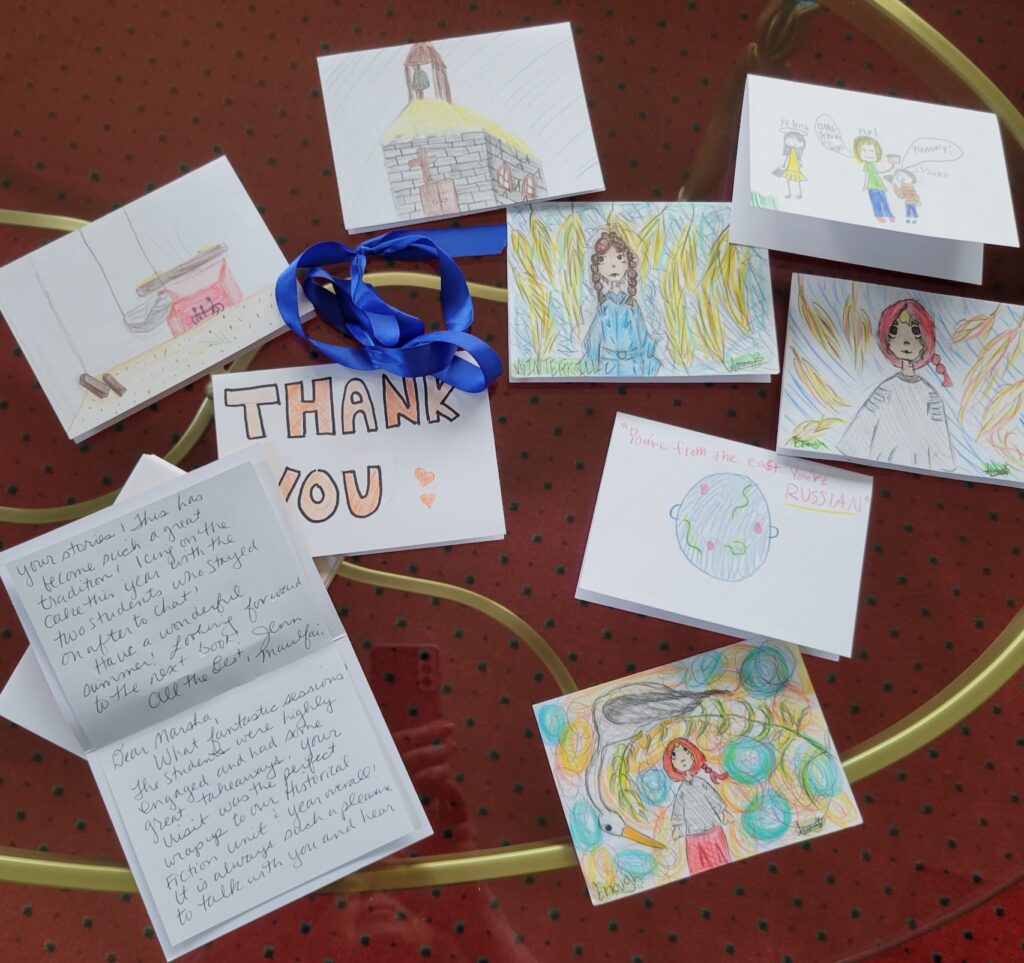
I had such a wonderful visit with 5th grade students from Craig Elementary School in Georgia who were reading Making Bombs for Hitler and studying WWII. We compared the connections of what happened then and what is happening now with Russia’s war on Ukraine. We talked about revisions, research, and movies in your head. Check out these pics!


Thank you, Paulette MacQuarrie, for this great interview with myself and Chrystyna about our books for kids that are set during Russia’s war upon Ukraine. I consider Chrystyna’s book to be somewhat of a prequel to mine, since hers is set in 2014, during the invasion of Crimea, while mine is set in Feb 2022 in Mariupol, when Russia continued its war. The book in the middle, Ukrainian Food Flair, was edited by Paulette and is available on Amazon. The recipes are GREAT — especially the sweets!
It is such an honour to have my WWI novel, Dance of the Banished, finally available in a Turkish language edition. Thank you Qizilbas Publishers, Britanya Alevi Federasyonu, Pajama Press and Catherine Mitchell, for making this happen. Here’s a clip of the books, ready and looking beautiful, on a pallet rack at the printer in Turkey:


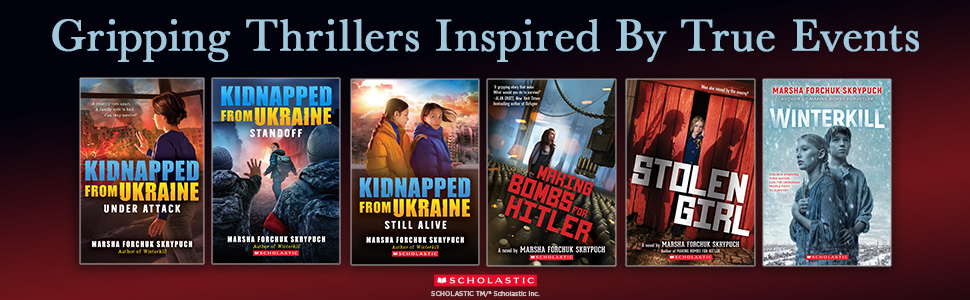
Book #2 of my Kidnapped from Ukraine trilogy, published on Oct 7, 2025.
This gripping, accessible novel by celebrated Ukrainian Canadian author Marsha Forchuk Skrypuch follows two sisters as they struggle to survive the Russian invasion of Ukraine in February 2022.
12-year-old twin sisters Rada and Dariia Popkova couldn’t be more different. Dariia is outgoing and chatty while Rada is quieter and artsy. But what they have in common is their love for each other and their home. The family lives in the Ukrainian city of Mariupol, which is attacked by the Russians on Feb 24th, 2022. The attack separates the family — Dariia is with her mom and Rada with her dad.
Standoff follows Rada and her father as they navigate the treacherous journey from shelter to shelter and make their way to the Azovstal plant so that her father can fight in the resistance. Meanwhile, Rada is still trying to get in contact with her sister and mother. As the war rages and each family member must contend with their own battles, their love for their country and their family keeps them going.
Read an excerpt here.
Reviews

★Skrypuch, Marsha Forchuk. Standoff. 288p. (Kidnapped from Ukraine: Bk. 2). Scholastic. Oct. 2025. Tr $25.99. ISBN 9781546104568.
Gr 4 Up–A brilliantly written and sensitive portrayal of the reality facing innocent children and families in a war zone. With historically accurate quotes and events interwoven, Rada’s story shows the world what Ukrainians faced in the early days of Russian attacks. Rada becomes separated from her family after missile attacks destroy their apartment building. She shelters with neighbors in the basement of a steel plant while her dad rushes to help defend their city. With limited communication, she’s left to wonder about the fate of her mother and twin sister. Time after time, Rada and her bunker family plan to evacuate during planned ceasefires only to find themselves under attack when the Russians violate the agreements. They fight to survive on meager bits of food stored in their emergency backpacks. After weeks underground, their clothes are moldy. They drink a cup of hot water for breakfast and supper. Rada and her schoolmate, Viktor, risk their lives to gather items to help them survive. Readers will be in awe of Rada. She rejects cruelty even living in the most dire conditions and manages to face each new devastation with courage and humanity. Rada’s indomitable spirit, her refusal to give in to despair in the face of outrageous cruelty, shows readers how heroism takes many forms. Readers will fly through the pages to stay with Rada’s story and try to find out the fate of her family. This second title in the series offers a horrifying look inside the conditions in war-torn Ukraine while also inspiring hope for heroes and survivors. VERDICT Purchase for all middle grade shelves. Readers who have firsthand experience with refugee camps and war zones may especially benefit from support while reading. School Library Journal, October 2025
Even better than the first book. This one dealt all the punches. Skrypuch takes us inside the infamous steelworks in Mariupol during the Russian siege and shines a light on a dark history of Russia’s attack on Ukraine.
In this installment of the series, Daria’s twin sister Rada is the focus. Separated from her mother and her sister on the first day of the invasion, Rada and her father have taken shelter in the steel mill in Mariupol where they will be holed up for weeks. Skrypuch does not hold back: she takes her reader deep into the bowels of the tunnels and carefully plots her story around the factual events and background of the siege.
Through a child’s eyes, we see what matters; how resilient not only the characters depicted here are, but as a nod to the spirit of Ukraine’s resistance in general. This story is positively a must for anyone who even wants even a little bit more understanding about what has been going on in Ukraine in one of the most devastating wars on the European continent since WW2. This novel could stand alone, but I suggest reading the first one [as well]. Chrystyna Lucyk-Berger, Author.
“Essential: Reading this book is better than any news story you could see, especially as the war continues today. And remember – Russia started it.” Kiss the Book.
“As in other Skrypuch historical fiction, Standoff is heavy on the actual events from history, a history that is still happening. Readers will be caught up in the unwarranted onslaught of Putin’s army, in awe of the determination demonstrated by those who took cover in the Azovstal factory and fighters who held out for so long against greater numbers of more well-armed Russian soldiers.
Highly recommended series for grades 5-8. Text is free of profanity and sexual content but violence is present and reflects the ongoing war between Ukraine and Russia.” Melanie Delaney, Librarian.
My grandchildren bought this at their school book fair last week. Just finished reading it. Marsha J. Skrypuch has done it again. An amazing depiction of real events told in a way that children can not only understand, but can also feel empathy for the characters. This book should be in every library. Chrystyna P, grandparent.
Once again, Ms. Skrypuch brings a current news story to life for readers who might not know how horrible the conditions in Ukraine are right now. Many middle graders like to read books about World War II, but don’t understand that there are conflicts that are every bit if not more devastating going on right now. Ms Yingling Reads.
Marsha Forchuk Skrypuch knows how to tell a story of immense tragedy by pairing it with resilience, affection, and hope. Helen Kubiw, CanlitforLittleCanadians.

Had a great conversation hosted by Paulette MacQuarrie’s Nash Holos Ukrainian Roots Radio with Chrystyna K. Lucyk-Berger about our new books, both set during Russia’s war on Ukraine. Paulette is also an author. She compiled a fantastic Ukrainian cookbook. The interview was live, but will be available as a youtube video and podcast later on.


Thank you, Deborah Kalb, for the great questions! Interview here.

CHAPTER ONE
The List
Saturday, November 5, 2022
A ski village in the Carpathian Mountains
Babushka sat across from me at the kitchen table in the ski
chalet where our families had been living for the past few
months. Drone components were laid out in front of us, and
our shared tool set was spread out on a cloth between us: solder
gun, clippers, ties, and tweezers. Babushka’s training as a jeweler
made her a natural for assembling drones, which were desperately needed by the Ukrainian army. When she asked if I
could help, I’d jumped at the chance. I had just finished heat-
shrinking the second antenna to the frame of my drone when
Mom walked in carrying mugs of tea.
“Stop right there for a moment, Yaroslava,” said Babushka.
Her tongue stuck out of the corner of her mouth, and her brow
was creased in concentration.
“There,” she said, setting down her needle- nose pliers.
“Camera secured.” She looked up at Mom. “Thank you for
the tea.”
“Rada, are you able to take a bit of a break? I’d like to show
you something outside,” Mom said.
“Perfect timing,” I said, stretching to ease the stiffness in my
back. We’d been working for hours without a break. I grabbed
my mug and followed her outside to my favorite spot on the rock
that overlooked the mountains.
Mom pulled her phone out and swiped it on. She held it up to
show me. “I just got a message from Dariia on my Facebook
Messenger account.”
“Oh my God,” I said. “Is she okay?”
“She’s healthy. She’s living with a Russian family in a suburb
of Moscow, and she’s treated like a prisoner and a servant.
They’ve changed her name and birth date. I’ve got all the
details here.”
“Wow,” I said, pulling out my own phone. I always put my
notifications on silent when I make drones. “I’ve got a message
too.” I opened it. “The same as yours, Mom. But there’s a second one too.”
“What does it say?”
I opened the second message and showed it to her. “It’s a page
of addresses and names.”
Mom grabbed the phone from me. “It’s a listing of
Ukrainian kids, with their original names and new Russian
names, I bet. The addresses are in Russia. And the contact information lines up with the kids’ Ukrainian names.
I think these are other Ukrainian kids who were kidnapped
to Russia, like Dariia.”
“Dariia is so smart,” I said. “I bet that’s exactly what this is.”
“This is the best news we’ve had in a long time.”
I clung to Mom, and we bawled our eyes out. Dariia was alive.
We knew where she was, and we could now communicate with
her. And in typical Dariia fashion, she wasn’t just worried about
saving her own skin, she was helping others who were stuck like
she was.
“What do we do now, Mom?”
“We tell her that we’re okay and we’re working on a way to get
her out.”
“But how will we do that, Mom?”
“I don’t know yet, but we’ll figure this out.”
Mom keyed in a message to Dariia and showed it to me before
hitting Send:
“Rada and I are sheltering in the Carpathian Mountains.
Your father is in a Russian prisoner of war camp. Info on other
kids welcome. We love you.”
Mom handed me back my phone. I leaned into her shoulder
and held the phone between us. I slowly scrolled through the
names until I reached the information about my sister.
“She’s in Serpukhov,” I said.
“That’s practically all the way to Moscow,” said Mom.
“She may as well be on the moon. How can we possibly rescue
her from there?” I asked.
“We’ll figure it out,” said Mom. “Keep scrolling.”
“Look,” I said. “This girl named Genya is also in Serpukhov.”
I scrolled back up to Dariia and then back to Genya. “They’re
in the same apartment building. Even the same unit.”
“If there are two kids in the same place, maybe we can connect with the other family and work together.”
“The mother’s number is right here,” I said, enlarging it on
the screen.
Mom punched the number into her phone.
It rang, and rang, and rang.
No one picked up.
It didn’t go to voicemail.
I couldn’t help but wonder if the mother had been captured,
or maybe killed. Or maybe just the phone was dead— buried in
the burning rubble of a Russian bombing. I groaned. “This is
impossible.”
Mom wrapped me in a hug. “None of this is easy. Show me
Genya’s information again.”
I scrolled to the spot and showed it to her.
“Let’s try the aunt,” she said.
Mom put her phone on speaker and keyed in the aunt’s number. One ring, two. Then a prompt to leave a voice message.
Mom looked startled. “Um, ah . . .”
I leaned closer to the phone and said, “This is Yaroslava
Popkova. My daughter was kidnapped, just like your niece.
They’re living in the same apartment. Please call me.” I keyed
in Mom’s number at the prompt, then disconnected and sent the
same message by text.
“Thank you,” Mom said. “I had a deer-in-headlights moment.”
“I get it,” I said. “And now we’re one step closer.”
“Let’s just hope she gets the message and she’s able to call
back,” said Mom. “And we’ve got all these other kids’ families to
work with too. We’ll figure this out.”

Here’s the link to the interview on Scholastic Canada’s blog.
What inspired you to write your book?
Under Attack was inspired by Russia’s 86-day siege of Mariupol, Ukraine in 2022, and their massive kidnapping campaign of Ukrainian kids.
The book starts on the first day of Russia’s war on Ukraine and it follows the fate of Dariia and her mother as they are separated from the rest of their family. They barely survive, day by day, hour by hour, as missiles rain down. The two are ultimately captured and separated and Dariia is sent to a brainwashing camp in Russia and placed with a Russian family.
This current event that is still unfolding resonates deeply with me, because I had already written a book about it: Stolen Girl, set during the Nazi Lebensborn program in WWII. Putin obviously gains inspiration from Hitler.
What did you enjoy most about writing?
I love shedding light on quiet heroes. As I was doing the research for this book, I was in awe of the brave and creative audacity of individual Ukrainians fighting and sabotaging in each small way that they could against the behemoth that is Russia.
What were some challenges that you faced while writing?
This was an emotionally devasting book to write. I am of Ukrainian heritage.
When writing about a war that’s still going on, one must honour those who are living through it but not betray their privacy. For this reason, the characters are inspired by real people, but for the events, I didn’t use anything that was shared in confidence. Instead, I used documented testimony, interviews, and accounts.
What do you hope your readers will take away from your book?
I want my readers to step into Dariia’s shoes and feel what it’s like to have war come to your home.
How do you come up with the names for your characters?
This novel is set in Mariupol, Ukraine in 2022. In that time and place, there are given names and surnames that are in common use. The names that I use in this book are all derived from real names of people living there in 2022.
What books have had the biggest impact on your life?
I am dyslexic and taught myself how to read when I was nine years old and in grade four for the second time. I chose Charles Dickens’ Oliver Twist as the book I would marathon through until I could read. That book changed my life. Up until that time, I knew how to cheat at reading – guess, memorize, look at pictures – but Oliver Twist required that I actually sound out letters inside of each word and say it out loud to figure out the word. It took me a whole year to read it, but as I became a better reader, the story began to play like a movie in my head. None of the remedial readers that teachers had tormented me with up to that time ever put movies in my head. After reading Oliver Twist, I knew that I wanted to write novels that put movies in people’s heads. And I wanted to write on similar themes like what Charles Dickens did – and if you’ve read my books, you know that I do. But I also decided that I’d leave out the words that people skip over. Dickens was paid by the word, and so he used too many.
What books were your favourite to read growing up?
Because I came to reading in an unusual way, I didn’t select books in a usual way. After reading Oliver Twist, I decided to read all the big fat books in the children’s novel section in alphabetical order by author’s last name. That meant I read all of Louisa May Alcott, Walter Brooks’ Freddie the Pig series, Diary of Anne Frank – because it was mis-shelved with the As, and Black Beauty because it was mis-shelved as a B-authored book. I didn’t get to the end of the alphabet by the time I reached high school and figured out better ways of selecting reading material.
What’s your writing process look like?
I do considerable research before I start writing, and then kamikaze research during. My standard routine is to write for three hours a day and that three hours would consist of reading and revising what I’d written the day before, and then plunging forward on new scenes. Beginning a novel is always the hardest and I can rewrite the first 25% of a novel over and over again before finally getting it to gel and then I’m off galloping. Once I get to THE END for the first time, revision starts. The first draft usually takes about six months and the edits can take a similar length of time.
What’s next for you?
I’m working on a story about a real girl in the medieval times who’s captured as a slave and becomes a queen. It may or may not end up being a trilogy.
Am getting over a head cold but still managed to do seven mini presentations today without losing my voice!