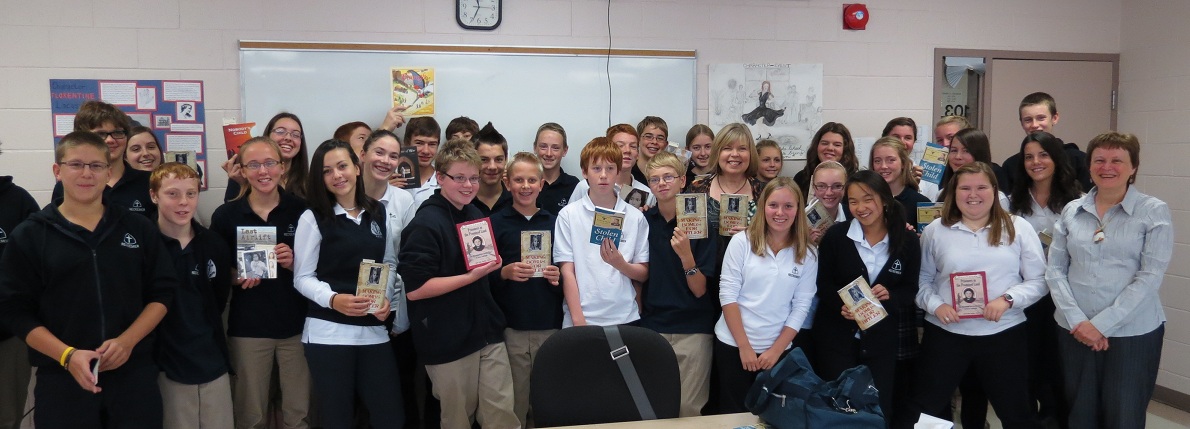
 Marie Cooper of Redeemer Christian High School in Ottawa sent me this great photo of the grade nine class just after my October presentation. Standing to the far right is Alta MacFie, librarian extraordinaire.
writes about war from a young person's view #bannedbyrussia
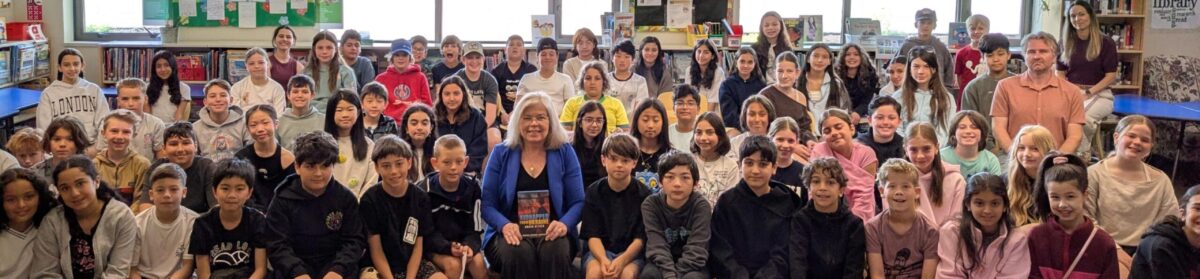
Marie Cooper of Redeemer Christian High School in Ottawa sent me this great photo of the grade nine class just after my October presentation. Standing to the far right is Alta MacFie, librarian extraordinaire.
http://www.winnipegreview.com/wp/2012/11/it-takes-a-village-as-applied-to-ya-fiction/
Posted: NOVEMBER 8, 2012
Columns, The Winnipeg Review
By Marsha Forchuk Skrypuch
I find it lonely being one of the few fiction writers who has tackled the lesser-known stories of World War II. The atrocities of Hitler are justifiably infamous, but a troubling number of people have never even heard of Stalin and his atrocities. Part of the reason for that is because you can’t tell your story if you’re dead, and Stalin managed to silence a whole heck of a lot of people.

In The Darkest Corner of the World (Dancing Cat Books), Urve Tamberg has managed to give voice to an entire small nation that was nearly obliterated in World War II. Well-researched and compellingly written, it deserves to be widely read.
Urve agreed to answer my questions for TWR.
The Darkest Corner of the World is set during WWII, yet the part of WWII history you deal with has received very little attention. Can you tell me about that?
Winston Churchill said that “history is written by the victors.” For most of the twentieth century, the Soviet Union was the “winner.” They illegally annexed the Baltic countries of Estonia, Latvia, and Lithuania during the Second World War, and for five decades the Iron Curtain limited communication between the West and the Eastern Bloc countries. Letters were censored, and people on both sides of the ocean were afraid to tell their stories.
After Estonia regained independence in 1991, stories slowly started to filter out, but even now there is very little written in English, much less written for a younger audience.
Another reason that Estonia’s stories have not been told is because of its tiny population. There are about 1.5 million Estonians in the world. Much of the literature to date has been written in Estonian, so fluency in the language has been a necessity.
This story is a personal one for you. Are any of the characters based on
family members?
The story is personal, but the characters are fictitious though I’ve tried to portray Estonian characteristics such as dark humour, sarcasm, and sheer stubbornness in the characters.
The setting on Hiiumaa Island takes place on my mother’s farm. When I was growing up, I thought Hiiumaa was a sleepy place where nothing interesting happened, but during the Second World War, the front passed through my mother’s farm twice, once in 1941 when the German Army drove the Soviets out of Estonia, and once in 1944 when the Soviets returned to occupy the country for the next fifty years.
Which character is most like you?
There is no one character I’d compare myself to. I’d like to think that, like Madli, I would’ve been brave, and smart, and defiant. But as a fifteen-year-old girl, could I have stood up to a Russian soldier? Could I have protected my little brother from the Soviet army? I know that I could do all that and more as a mother protecting my children, and I hope that I would have done the same as a teenager.
One doesn’t know how one would react under adversity until one is confronted with it. In researching the novel, stories of kindness came up time and time again, even in the most horrific of circumstances. For example, on the night of the deportations, when soldiers rounded up the families, some men told the deportees to bring warm winter clothes, sewing machines, and food since they knew that people were being sent to Siberia. Deportees were actually allowed to bring up to 100 Kg of supplies with them, but other soldiers gave people no time to pack, and literally forced people in their nightclothes to waiting trucks.
Do you believe in evil?
Yes, I believe people can be evil. If you believe people are good, then you must believe in the opposite as well. There is no other word than “evil’ to describe the actions of Stalin and Hitler.
Will there be a companion novel or sequel?
I’ve had a number of people ask me about a sequel, and I’ve started to research the next book.
My work-in-progress sheds light on another little-known story of World War II in the Baltics. In the late summer and early fall of 1944, over seventy thousand Estonians (along with thousands of Latvians, and Lithuanians) escaped to Sweden or Germany as the Red Army returned to occupy the Baltic countries. My parents were among those who left on small boats, and risked their lives to cross the stormy waters while Soviet planes patrolled overhead. Hundreds of people did not survive the hazardous journey.
What was your biggest challenge in writing this novel?
Since this is my first novel, there are three things that were challenging for me. I call them the three Rs — researching, rewriting, and relevancy.
As someone with no background in history, I had to research everything from the dates of major events to bathrooms, shoes, and bathing suit styles. Accuracy was very important because I felt that I had to honour the events and people of Estonia during that time period. My ability to read Estonian gave me access to a richness of work that wouldn’t be available to anyone who didn’t speak the language (needless to say, there aren’t many of us). I spend months reading life histories, and textbooks in both Estonian and English.
E.B. White said, “The best writing is rewriting.” I gave myself permission to use my first novel as a learning experience and spent years learning about the craft of writing. It was very tempting to rush the process, but it took about four or five years from conception to publication, and countless rewrites. I joined critique groups, SCBWI, CANSCAIP, and started going to courses and conferences. I love that I’m always learning something new, and that writers are so generous about sharing their experiences.
And finally, relevancy. How could I make this story appeal to teens? I knew the story had to draw them in on an emotional level and decided to included romance and betrayal. Also, Madli likes all the same things today’s teens do. Boys, summer vacation, parties, movies from America, and travelling. When I went to school, history was taught as a series of dates and treaties and wars and battles, none of which interested me in the least. Now I realize I’m interested in how people felt, and the every-day dilemmas they faced.
Did you ever feel like giving up? What made you continue?
I’m not the type to give up. So no, I didn’t think of giving up, but there were periods of lengthy procrastination, and navel gazing. Coming from a background of science and business, it’s hard to know if your writing will connect with people. The reason I persevered was due to the support of other writers, through associations such as SCBWI and CANSCAIP, as well as critique groups such as Kidcrit [Editorial note: Marsha Skrypuch has been running this free online critique group for sixteen years. To join, you must have a completed first draft of a children’s or YA manuscript. For permission to join, go here].
My critique partners helped me put my work into perspective. They praised the good parts, and offered gentle criticism for the sections that required work. I’m the type of individual who really wants to know how to improve, and am happy when there are many suggestions to consider.
This is your first novel. Can you tell me about your publishing journey?
I didn’t know I wanted to be a writer until a few years ago. I’ve always been an avid reader, and somewhere in the back of my mind, had the desire to write a novel. Like many people, I didn’t think writing would be as difficult as it was.
It took me four intense years of historical research, and learning writing craft before I submitted the manuscript for publication. I think the hours that I put in were probably the equivalent of another university degree, though the end result is a published novel, not a degree.
I could never have done this on my own. Like any profession, it’s important to connect with your peers. From the start, I have been part of amazingly supportive and perceptive critique groups. Organizations such as CANSCAIP and SCBWI provided important resources, and still do.
I met my editor, Barry Jowett from Dancing Cat Books, at a course run in Brantford (many Ontario writers would know that course was run by you). At a one-on-one meeting, he liked my first page, and wanted to see more. And based on some good advice, I didn’t rush to send him the manuscript. In fact, after much consideration, I ended up rewriting the whole novel from first person to third person before I sent it to him. That took a year. Fortunately, when I contacted him, he did remember the novel, asked to see the entire manuscript, and the rest is history.
What advice would you give an aspiring writer?
They say it takes a village to raise a child. It also takes a village to write and publish a novel so my advice would go something like this:
First— congratulations! You’re the prospective parent of a manuscript! The manuscript may have as few as five hundred words if it’s a picture book, or sixty-thousand words if it’s a young adult novel. You have an embryo of an idea, and want to nurture it to life. Gestation could take months, or even years. During that time, you’ll want to talk to other parents/writers, compare progress, and read as much as possible about care and feeding of your new manuscript. And when you need a break from that, reach for a good book.
During the time of manuscript gestation, you’ll get lots of questions, and perhaps even receive unsolicited advice from well-meaning people who are not writers. Why is this manuscript taking so long? Will it be published by Christmas? Do what any expecting parent usually does; smile knowingly and mumble “As long as it’s healthy.”
Hang around with experienced parents, i.e. people who have written books and had them published. In other words, find your writing tribe. Join associations, whether it’s SCBWI and CANSCAIP for children’s writers, or other groups for mystery writers, or romance writers, or sci-fi writers. Learn the craft of writing. We learn science, piano, and other skills. Writing is a skill that can be learned through courses, workshops, and reading books about writing.
Find trustworthy caretakers i.e. find a critique group. Find those people who you can trust to read your work, and offer suggestions for improvement. These people will cheer you on, and keep you motivated. Find people whose aspirations are in line with your own. Although writing may be solitary work, getting a manuscript to publication takes a village
Resource Links
Volume 18, Number 1
October, 2012
SKRYPUCH, Marsha Forchuk
One Step at a Time: A Vietnamese Child Finds Her Way
Pajama Press, 2012. 92p. Illus. Gr. 3-6.
978-1-927485-02-6. Pbk. $12.95
One Step at a Time is an easy-to-read book about Tuyet, a Vietnamese girl adopted by a Canadian family. It is the sequel to Last Airlift: A Vietnamese Orphan’s Rescue from War and picks up where that book leaves off. Tuyet suffers great pain from having a weak ankle. Just weeks after her adoption, her new family decides Tuyet should have surgery to correct the problem. Tuyet goes through the surgery, learns to use crutches, and takes physiotherapy in the hope of one day being able to walk confidently on her own two feet.
At the same time, Tuyet, who speaks little English, is learning about her new family, new home, and new culture and is healing from terrifying experiences in Vietnam. Events that seem ordinary to many Canadian children are extraordinary for Tuyet, and we share her confusion and delight as situations—such as a flaming cake and a pile of pretty boxes, or the passing of a crop-dusting airplane—begin to resolve into meaning.
This is a gentle non-fiction telling of a particular period in Canadian history and of the experience of being a new immigrant with health concerns. Notes in the end matter provide some useful context for readers who may not understand the significance of polio or the conventions of narrative non-fiction. Black-and-white photos, including pictures of Tuyet and her family, add to the reading experience. Although Tuyet’s experiences are unusual and sometimes frightening, the narrative is full of love, kindness, and comfort.
One Step at a Time is a good choice for sensitive young readers interested in non-fiction about other children, other cultures, and recent history; it may be eye-opening for many readers. Although aspects of Canadian culture have changed, the disorientation that new Canadians experience may be similar to Tuyet’s. The book is likely to encourage many questions and wide-ranging discussion in a reading group, and the story is highly likeable. Readers do not need to know the author’s earlier book about Tuyet to understand this one, but many will want to read more about this brave and spirited girl.
Thematic Links: Families; Adoption; Vietnam; Health and Wellness
Leslie Vermeer
Making Bombs for Hitler, By Marsha Forchuk Skrypuch, 160 pages. @ SPL: J FIC Skryp
Making Bombs for Hitler brings to light one of the lesser-known aspects of World War II and the Holocaust – slave labourers, often teenagers or young people in their early 20s. Captured by Nazi soldiers in Russia, especially in the Ukraine, they were brought to Germany and forced to perform dangerous work from dawn to dusk.
Regarded as “expendable,” they were shot if they became too sick to work. In Marsha Skrypuch’s story, Lida was one of the youngest slave labourers. When she was taken by Nazi soldiers, Lida was separated from her parents and her younger sister and sent to a labour camp. Surviving on a meager daily portion of bread and thin soup, and clothed in only a thin dress, Lida survived the long days of hard work only through luck, resourcefulness and the desire to find her sister.
Then, with a group of other girls, she was assigned the dangerous work of constructing bombs that would be used by the Nazis to kill allied soldiers and civilians. How Lida survived the terrible days which followed was later a mystery to her.
But she did survive, barely, and was later rescued by allied soldiers, only to find that she could not go home. Joseph Stalin regarded anyone who had been captured by the Nazis to be a Nazi. Such people were either killed or sent to work camps in Siberia.
Making Bombs for Hitler is a companion book to writer Marsha Skrypuch’s award-winning Stolen Child, which relates the story of Lida’s sister, Larissa. Both of these stories, told with sensitivity and compassion, are based on historical fact.
** Recommended for ages nine to 12.
– Sally Hengeveld, librarian
Making Bombs for Hitler by Marsha Skrypuch (Scholastic Canada) $8.99
Torn Apart: the Internment Diary of Mary Kobayashi, by Susan Aihoshi (Scholastic Canada) $16.99
ON Remembrance Day especially we take time to pay homage to those who went to war so that we might enjoy freedom – a freedom which was bought at a horrific cost for so many.
We can more easily appreciate the sacrifices made on our behalf by learning about them through various resources – family history, television documentaries and books. One very powerful approach to learning is through personal narrative, which broadens and enriches the historical perspective. Kids (and this reviewer) can relate more easily to social history, which allows them to see through the eyes of the protagonist and comprehend how war affects a particular individual.
Two excellent books that provide this perspective are Making Bombs for Hitler by Marsha Skrypuch and Torn Apart by Susan Aihoshi. Both titles focus on individuals who by strength of character and resourcefulness face and deal with circumstances that drastically change their worlds.
Skrypuch writes about the slave raids conducted by Hitler throughout the Soviet Union during the Second World War. Between three million and 5.5 million Ostarbeiters, as these people were called, were transported to Germany and forced to work under horribly inhumane conditions. Thousands died either from starvation or from overwork.
Many who were rescued and sent back to the Soviet Union were killed by Stalin who considered even Nazi captives to be Nazis. For this reason people kept silent for many years about their experiences as captives and it was not until the Soviet Republic dissolution in 1991 that information began to surface.
The story describes the capture by the Nazis of eight-year-old Lida and her little sister Larissa. They endure appalling conditions on the train to the work camp and are separated as soon as they arrive.
Lida is advised by another prisoner to lie about her age and find a skill or she will likely be killed. She tells the Germans about her ability as a seamstress and is sent to work in the laundry where she proves that she is indeed talented. Unfortunately, she is soon transferred to a new assignment, assembling bombs. With incredible bravery, Lida and her fellow prisoners risk certain death in carrying out a plan to sabotage the bombs and contribute their bit to defeating the Nazis. Finally, they are rescued and in the gruelling aftermath of war Lida and her friend Luca face more challenges in the refugee camps.
The harsh, brutal and unrelenting pain, fear and misery encountered by the camp labourers is made evident in Skrypuch’s wonderful writing. Lida’s world is documented with clarity and accuracy. The reader is left wondering how anyone can survive such misery and thankful that we live in a different place and time.
Susan Aihoshi’s Torn Apart is subtitled “The Internment Diary of Mary Kobayashi” and is set in Vancouver in 1941. While in no way as gut-wrenching as the Skrypuch title, it makes it clear that war affects everyone. This is another title in the excellent Dear Canada series which melds fiction with historical information and photographs.
In the acknowledgements we learn that the author has drawn on family experiences to flesh out the book’s main character. The diary format provides a window on the everyday life of a girl whose entries begin on her 12th birthday, Saturday, May 24, 1941. We see her happy family life begin to disintegrate as the government imposes more and more restrictions on Japanese Canadians.
Mary’s entry for Sunday, Dec. 7, 1941 describes the news about the bombing of Pearl Harbor and its effect on the family. Mary ends her entry with the comment, “The war has finally become real in a way it never was before.” Finally, the unthinkable happens and Mary’s grandfather is sent away to a labour camp.
A mere seven months later Mary and her sisters find themselves on a train to New Denver to begin a new life in an internment community. Her family is fractured as her mother is still in Vancouver caring for an ill brother and her father has been detained for questioning. The diary ends with a reunited family still living in New Denver hoping to eventually return home.
Mary’s life as a child in the 1940s in Vancouver in many ways reflects the life of any child of that era. She describes her enjoyment of Guides, her school life and her special interests and activities. Mary’s voice is authentic and charming and because she is so likable the reader is all the more appalled at the unfeeling cruelty of the government. It was not until Sept. 2, 1988 that Brian Mulroney announced a Redress Settlement which acknowledged the offences against Japanese Canadians during and after the Second World War and ensured that in future no Canadian would be subject to this kind of injustice.
Torn Apart is suitable for readers aged eight to 12. Skrypuch’s title is for a slightly older audience that includes adults. Reading either or both will reinforce your gratitude for the heroic efforts made by those who fought for us.
Fran Ashdown worked for many years as the children’s librarian at the Capilano branch of the North Vancouver District Library. She will be thinking of her father, an RAF radio officer, on Remembrance Day. For more information check your North Shore libraries.
Contributing Writer