Last Airlift: Cooperative Children’s Book Centre Choices 2013 review

Cooperative Children’s Book Center Choices 2013

Skrypuch, Marsha Forchuk. Last Airlift: A Vietnamese Orphan’s Rescue from War. U.S. edition: Pajama Press, 2012.99 pages (trade 978-0-9869495-4-8, $17.95)

The last Canadian airlift to leave Saigon during the Vietnam War was on April 11, 1975. The plane carried 57 babies and children, along with rescue workers. Son The Anh Tuyet was one of the orphans on board. About nine years old at the time, she was experienced helping care for younger children and babies—something she did all the time at the orphanage where she’d lived. So perhaps it was no surprise that when she first met the Morris family in Toronto a few weeks later, she assumed the couple with three young children had picked her to be their helper, not their daughter. But they had chosen her to be their child, and in the coming weeks and months, as Tuyet adjusts to life in the West, she also begins to understand what it means to be part of a family, and loved unconditionally. Marsha Forchuk Skrypuch never strays from Tuyet’s child-centered perspective in recounting her experiences. In an author’s note, Skrypuch describes interviewing Tuyet (obviously now an adult), who found that she remembered more and more of the past as she talked. Dialogue takes this narrative out of the category of pure nonfiction, but Tuyet’s story, with its occasional black-and-white illustrations, is no less affecting because of it. (Ages 9–14)

“Readers will be … riveted . . . ” Horn Book Magazine on One Step At A Time

“Skrypuch’s Last Airlift: A Vietnamese Orphan’s Rescue from War (rev. 9/12) told the dramatic story of eight-year-old Tuyet’s 1975 rescue from Saigon aboard a giant plane filled with babies in cardboard boxes. This sequel describes Tuyet’s adjustment to life with her adoptive Canadian family, the story’s drama this time revolving around the surgery she must have on her leg. Polio has left Tuyet with one leg that’s weak and smaller than the other: “Her ankle turned inward, making her foot useless. She had to limp on the bone of her ankle to get around.” Memories of fire, bombs, helicopters, and a hospital—things she thought she’d forgotten—come flooding back, and Tuyet is all alone in the hospital (no parents allowed) and knows no English. Readers will be just as riveted to this quieter but no-less-moving story as Tuyet bravely dreams of being able to run and play—a new concept for a girl who has spent her days caring for babies. Especially satisfying is Skrypuch’s portrayal of Tuyet’s growing trust in her adoptive family, whose love and affection never fail to amaze and thrill her. Illustrated with photos. Includes notes, further resources, and an index.”
—jennifer m. brabander

Reading.org review of One Step At A Time

Skrypuch, Marsha Forchuk. (2013). One step at a time: A Vietnamese child finds her way. Toronto, Ontario, CA: Pajama Press.

One Step at a TimeThis companion book to Last Airlift: A Vietnamese Orphan’s Rescue from War (2012) provides the chapters that follow in the life of young Tuyet, a Vietnamese orphan stricken with polio and raised in a Vietnamese orphanage until her adoption by a Canadian family. As Tuyet becomes part of her new family, she also faces the surgeries that are required to repair her inward-turning foot. Unable to speak much English, the young girl is frightened by the hospital and surgical lights, the doctors, the consultations and examinations since she is still dealing with the nightmares of war-torn Vietnam and near-death experiences with guns and helicopters. As the surgeries conclude and the painful physical therapy begins, her new life starts to take shape. The cover of the book and the red shoes pictured take on a very special meaning by the end of this heart-warming book that will leave readers in tears. Teachers can read an interview with the author on the back matter for her book.

– Karen Hildebrand, Ohio Library and Reading Consultant
Reading.org


How one author brings life to millions who have lost it

The endless quest for exposure

Posted by on Tuesday, February 12, 2013 The Sputnik.

How one author brings life to millions who have lost it

“Some people call me the Genocide Queen.”

Marsha Skrypuch earned this title through writing books. As a Ukrainian born in Brantford, she has penned over 10 titles about a myriad of problems throughout time, including wars, immigration, famine, and yes, genocide.

“I like to give voice to people who have not been able to have a voice,” said the 58-year-old author.

Skrypuch’s goal is to normalize a variety of people’s experiences from around the world. When she could not find a body of fiction about Armenian experiences and hardships at the library, she decided to begin her research and recount those events herself. She wanted to know who spoke for the millions of people who had died in the Armenian Genocide from 1915-18 through deportations and massacres. She realized that many survivors of the genocide had lost their identities, and she felt obligated to tell their stories.

With her Master’s Degree in Library Science, Skrypuch considers herself to be a detective. She found the diary of a girl who survived the genocide from a library in California, where there was only one copy available. She needed it. After ordering it through an interlibrary loan, Skrypuch was allowed to have it for 48 hours to transcribe as much as she could. Multiply that experience by 50, she said, and she has enough information for a single novel.

However, research became easier as time went on and word spread about her works.

“Just by the fact of writing the first book in an authoritative and respectful way … all of a sudden I was brought into the Armenian community and trusted with these things that they didn’t want to show other people, because they were afraid of how they would be used,” she said.

Skrypuch said approximately 85 per cent of Armenians living in Turkey at the time of the genocide were killed, and the remaining 15 per cent were saved by Muslims. Because of this, it was clearly difficult for an Armenian to write on the topic due to their intolerance for the Turks.

“You have to look within the community and see the shining lights who were able to transcend the politics and hate of the time and risk their lives to help their fellow human beings,” she said.

Dr. Dave Jenkinson is a retired professor at the University of Manitoba, and he taught children’s and adolescent’s literature courses for over three decades. He has been the editor of CM: Canadian Review of Materials, an online book review journal, for 15 years.

During his years as a professor, Jenkinson used Skrypuch’s novels in his classes as “examples of excellence in the [historical fiction] genre.”

“All truly good books have to speak to a wide audience, and Marsha’s novels do that because, at their core, they address fundamental human concerns that transcend both time and place,” said Jenkinson.

Many of Skrypuch’s works are marketed to schoolchildren and young adults, despite dealing with ghastly and grotesque recollections of past horrors. She said that readers are more likely to identify with the victim of her fiction when marketed to children or young adults, because in most cases, “the victim is the dessert” for adult-targeted fiction. For Skrypuch, “children’s lit is written to change the world.”

However, after Enough’s release in 2000, Skrypuch’s own life was at stake.

The story, written about a young girl and her father saving a Ukrainian village from famine by tricking the sadistic leader, resulted in death threats and hate mail so callous that Skrypuch started bringing police protection to her book launches. She had to cancel her son’s birthday party, and the police had to accompany him to recess when he was in kindergarten. Slurs such as “neo-Nazi” were hurled at Skrypuch for speaking out about Holodomor, the Soviet Union’s man-made famine that killed almost 10 million Ukrainians from 1932-33.

After the release of Hopes War in 2001, another story based on World War II Ukraine, the hate mail started again.

“It was a really dark time for me, and I didn’t know if I would continue to write,” she said.

Skrypuch’s self-proclaimed breakout book, Nobodys Child, rekindled her passion for writing after it was released in 2003. It focused on an Armenian girl rescued by her friend before she suffered a horrific fate in the Armenian Genocide. Skrypuch moved from doing eight school visits a year to over 160 a year to promote her book. Nobodys Child was shortlisted for awards both nationally and internationally the following year.

It was not until many years later that a Ukrainian book was treated with the same respect.

Viktor Yushchenko, former President of Ukraine, awarded Skrypuch with the Order of Princess Olha for Enough in 2008, celebrating the first commercial piece of fiction written about Holodomor in the English speaking world. The award, a Ukrainian civil decoration, is given to citizens for “outstanding achievements in development of economy, science, culture, social sphere, defense of Motherland, protection of man’s constitutional rights and freedoms, state building and public activity, [and] for other services before Ukraine.”

“Marsha’s fiction and nonfiction puts a human face on past events which could easily become just forgotten footnotes in history,” said Jenkinson, “Because Canada has, fortunately, never experienced war firsthand on our soil, we need to be made aware of the horrendous impact that armed conflict, whether it be within a single country or between countries, can have on ordinary people.”

Skrypuch’s sharpened research skills, and knack for keeping an audience allows the stories of historical horrors to reach around the globe, though she sees her own work on a much simpler scale.

“I will never dwell on the despicable nature of some people,” she said, “I like to highlight the heroism.”

Layla Bozich

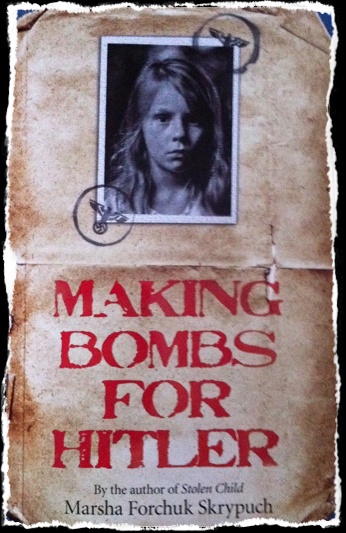
Thanks, Andrea Mack, for the lovely Bombs review!


That’s Another Story blog here.

I couldn’t put this book down! Whenever I read about life in a work or concentration camp, I am shocked and saddened that people could ever treat other people in such a cruel and inhumane way. At times, this book made me feel very emotional. I was rooting for the main character, Lida, and her friends to survive. The author did a great job of creating a character that I cared about. I liked the way her research blended seamlessly into the story to create a compelling read. Now I want to read her other book about Lida’s sister, called Stolen Child.

As a writer, I would study this novel to see how every detail was portrayed through the main character’s perspective. There is nothing unnecessary to the story here.


Meet the professional: Denise Anderson, Director of Marketing and Publicity, Scholastic Canada


My CANSCAIP Interview with: Denise Anderson, Director of Marketing and Publicity, Scholastic Canada

How did you become the director of marketing and publicity for Scholastic Canada?

My background is journalism and public relations. My first job in the book industry was with Coles Bookstores in corporate communications, first as an assistant to Kelly Duffin (a great mentor) and then as the editor of their bi-monthly consumer magazines.

I then moved to Scholastic as their publicist briefly before heading to Vancouver to work at Raincoast and Douglas & McIntyre. When I returned to Toronto in 1998, I worked at D&M, managing special sales and Candlewick Books, which they distributed at the time.

I returned to Scholastic in 2002 to work in marketing. Scholastic Canada had decided to focus on growing its trade presence. Many of the people I’d worked with were still there and now running the company, and the others brought on board were people I knew from so many years in publishing –it made for a very comfortable transition!


What advice would you give to someone who wanted a career in marketing or publicity for a publisher?

You have to be willing to do anything: work nights, weekends, get coffee, lift boxes. If you go to an industry party, you’re not there as a guest. You have to be alert and make sure things go smoothly. You have to be a multi-tasker who pays attention to detail.

When hiring, I will look for people with retail experience who have also taken publishing courses. But the most important factor is that you have a passion and knowledge of books. You are surrounded by book people and if you don’t love that, it’s hard to take the pace.


Can you describe the qualities of a dream author to work with?

These days, it is crucial to be connected on social media. An author must have online presence. They must be accessible to their audience. Having said that, they don’t have to spend all of their time on Facebook, Twitter, and blogs, but there are so many exciting possibilities for promotion and this is often the way readers find you.

In the world of children’s books, it’s really important to have a website where teachers and librarians can go to get information about you: your books, your biography, whether you do school visits.

Authors who are “out there” doing events and appearances are fantastic. The ones who tell their publishers what their doing and when, with plenty of time for us to help promote and get books where they need to be are even better!

Dream authors also know that there is a fine line between promoting a book and harassing about a book. They are respectful of everyone’s time. It’s great to let the local bookstore know you have a new book out, offer to sign stock or whatever they’d like, but going in every day to see if they’ll bring more in doesn’t generally earn you any friends.


And now describe an author from heck.

An author from heck is one that plans events on their own but doesn’t let us know until a day or two before and then expects us to somehow have books in place and do promotion for them.

They are too aggressive with their needs. There is a fine line between promoting and irritating, and the author from heck is blind to that line. I don’t know any publicist who doesn’t wish there were more hours in a day and who doesn’t do everything possible to get the word out about their books.

It is completely understandable that not everyone is super tech-savvy these days, but it’s very important to at least have a basic knowledge. “I don’t have email” doesn’t instill confidence in an author’s ability to help spread the work about their books.


Authors are almost by definition introverts. Do you get frustrated by authors who won’t do publicity things for you?

It does no one any good to put an author into an uncomfortable situation. We respect the various personalities of authors and try to make sure that what we ask them to do is in keeping with their comfort levels. While not everyone looks forward to getting up and talking in front of a crowd, I would say most of the authors I’ve worked with are as happy as I am to get out of the office and talk to people.


Can you describe your typical day?

There isn’t really such thing as a typical day, although every day seems to involve a lot of email and meetings! It could involve meeting about our websites, signing off on ads and catalogues, working on authors’ tour schedules.

Our department tends to get a lot of general questions and complaints sent our way, on top of the usual tasks. It varies at the time of year as well. If a sales conference is coming up, I’m preparing presentations and gathering sales and marketing materials; meeting with our team to create marketing plans; and organizing the “social” part of conference.

September is “book festival” month, so we are arranging for author appearances, getting promotional materials to our retail partners at the events and manning booths on weekends. It’s also when we have a lot of authors on tour. Summer is also surprisingly busy, prepping for the fall events.


What advice do you have for a first-time author?

Join CANSCAIP.

Connect with other authors and illustrators. It is a small but generous community and there are lots of mentors who are willing to share their own experiences.

Be nice to everyone. Canadian children’s publishing is a small community. You never know where someone may turn up next. Also, word gets around, so make sure the words about you are positive ones.

Hone your presentation skills. Being able to do school and library presentations is absolutely key. The first step may be doing one for free at your own kids’ school.


If you could generalize, what would be the most common problems you run into?

Many new authors have unrealistic expectations about bookstore signings. We read about line-ups out the door with mega-author bookstore signings, but unless you’re Dav Pilkey, the reality is that most authors will get few people out. Even relatively well-known authors will get few people out. But if that happens, appreciate those who showed up and spend some quality time with them. Sylvia McNicoll wrote a great blog about book launches recently.

A better way around it is to plan a community event that is creative and interesting. Invite your friends and family, neighbours, students, teachers, and the local media. And ask your local independent bookseller to be the vendor. This brings attention to you and your book, and it helps your local bookseller as well.

We are always on the lookout for new ways to connect authors with bookstores in a successful way.

Peer into your crystal ball and tell me what you see in the future for publicity in children’s publishing…..

Now is like the wild west. It’s an exciting time in book publicity. There are so many new opportunities and they are constantly changing. It is crucial to be flexible and adaptable.

I love the bloggers. In the last couple of years, they have become the new way to promote books. I have had more fun marketing books in the last two years than ever. There are so many cool new venues out there and hardly enough hours in the day to keep up with it all. Not necessarily every new online venue will be successful, but it is so fun to try.

Some of the challenges? We need to support authors and illustrators more with training on Skype and other online tools. Ebooks are on the rise, even in the children’s book industry. I hope that means people will just buy more books in different formats.


Marsha Skrypuch is the author of sixteen books for children and young adults. Her two most recent are One Step At A Time: A Vietnamese Child Finds Her Way (Pajama Press, 2012) and Making Bombs For Hitler (Scholastic, 2012). She is thrilled to have two Forest of Reading 2013 nominated books: Silver Birch Fiction for Making Bombs, and Red Maple non-fiction for Last Airlift.

--

An interview with Paul Yee about the writing of Money Boy

From my Winnipeg Review column:

Paul Yee is best known for his works about early Canadian Chinese immigrants, like his Governor General’s-winning picture book, Ghost Train, or his short story collection, Tales from Gold Mountain.

Money Boy coverWhen Money Boy (Groundwood) came out in 2011, I was intrigued. While still set within Chinese immigrant culture, it is a contemporary novel about a teen who is kicked out of his house for being gay. It’s an absorbing read. When we first meet the protagonist, Ray, he is surrounded by every material comfort – a big screen TV, his own laptop and desktop, trendy clothing, lots of friends. But his mother stayed in China and his father has remarried. Ray has a stepbrother who seems to be the favoured son. Ray struggles with school and finds escape in an online Chinese war game.

When Ray’s father discovers that he’s been visiting gay websites, the reaction is abrupt and absolute. Ray is unceremoniously thrown out of the house, his clothing and belongings tossed out on the front lawn with him.

Ray doesn’t feel that he can go to his friends for help. They don’t know that he’s gay and he has no idea what their reaction would be. He resorts to living on the street and bit by bit loses everything that he thought was precious – his wallet, his cell phone, his laptop – and with that, access to the war game that he’s addicted to. Cut off from friends and family and with no means of living, he decides to become a “money boy” – a prostitute.

His life plunges to an unbearable low, but slowly it reassembles itself in unexpected ways, and Ray isn’t the only one to discover the truly important things in life.

This is a well-written page-turner, but more than that, it’s an important book – allowing the reader to step inside the shoes of a gay teen from a rigidly traditional immigrant family and experience for themselves what a difficult life these kids have.

Paul Yee kindly agreed to answer some questions about Money Boy.

Money Boy is quite a departure from the historical fiction that you’re so well-known for. Can you tell me about that?

Yes, I wrote a lot of historical fiction but, to me, Money Boy isn’t really a departure. From the start, my writing raised issues. My early work addressed problems around immigrants being invisible in Canadian history and literature, and around racial minority persons trying to fit into the mainstream. Money Boy has a gay protagonist, and his issues include the various faces of intolerance as well as finding a safe place in today’s world.

How long did Money Boy live in your head?

“…live in your head…” doesn’t work for my writing process. That phrase suggests that a story or character has a life of its own which gets released from the writer’s mind (often his/her subconscious). In my writing, I pick an issue and then work madly to create a story around it. My stories live more on paper than in my head, because I tend to write out, in longhand and on the computer, all brain-storming and problem-solving.

Can you tell me about your research process for this book? How does that compare to the sort of research you did for The Bone Collector’s Son or I Am Canada: Blood and Iron.

I was a history major so accurate setting and details have always been central, in particular where I want to build a story around a social issue that truly exists. For Money Boy, I needed to know about life in China (education, fast food, homosexuality, etc), homelessness in Canada today, as well as MMORPG’s (Massively Multiplayer Online Role-Playing Games), a booming part of computer games that I in my middle age knew nothing about. I’ve visited China several times but only as a tourist. (Actually, showing “research” as “purpose of visit” to China raises red flags to visa officials.)  I love research: the big danger is getting swallowed up or distracted by details that don’t relate to my needs but which is just great stuff about our complex world!

What’s been the response of readers to Money Boy? Reviewers? Book ban-ners?

Reviewers like Money Boy because it deals with coming-out from an unusual angle (visible-minority immigrant). As well, in 2011, a rash of suicides focused attention on gay male teens and bullying. But the book was a tough sell. The first publisher who saw Money Boy told me that it was impossible to make money from gay-themed books. It was sobering to learn from librarians that any student seen holding a gay-themed book would likely be teased or harassed about being gay.

In many ways Ray seems younger than his eighteen years. Was it an editorial decision to make him chronologically older?

We had no editorial discussion around Ray’s age. He may seem younger because he’s naïve, fearful, temperamental, and lacking in confidence, which come from his difficult upbringing, immigrant status, and closeted life.

Which character was the most challenging to write? Why?

Chen the owner of Rainbow Sushi was a challenging character to write because he’s a minor figure in the story so he doesn’t get much text, yet I wanted very much to include someone from the flamboyant side of the gay sensibility.

Which character is most like you?

I am most like Ray because I grew up, as an orphan, ashamed of who I was, fearful of authority figures, and entirely lacking in self-confidence.

What is your writing routine?

If there’s a book, I write all day from 8:00AM to 9:00 or 10:00 PM with breaks for meals and dog-walking. I take work outside too: great ideas come to me while riding public transit, or waiting in doctor’s offices or in malls. I can work in public libraries but not coffee shops.

What aspect of being a writer drives you nuts?

What drives me nuts about being a writer is the lack of back-up. That is, if you don’t do the writing, then it doesn’t get done. There’s no assistant or team that steps in, so you always wonder, “Is it safe to take a holiday in the middle of a writing project?

What are you working on now?

Another historical novel.

Do you have advice for an aspiring author?

Read, read, read.