It was fun being the YA columnist at the Winnipeg Review for the last few years, and now I’ve handed my pen over to Anita Daher. She turned the tables on me, and launched her column by interviewing ME! HA!
Check it out, here.

writes about war from a young person's view #bannedbyrussia

It was fun being the YA columnist at the Winnipeg Review for the last few years, and now I’ve handed my pen over to Anita Daher. She turned the tables on me, and launched her column by interviewing ME! HA!
Check it out, here.
Thank you, Melanie, for this great interview!
 Marsha Skrypuch and I have a history.
It makes sense because we both write and care about history–particularly stories where there has been injustice. I believe that we are humanitarians, who hope that our stories of the past will resonate with the present, bringing awareness about people who have for–one reason or another–been silenced. Continue reading “Melanie Fishbane’s Dance of the Banished interview”
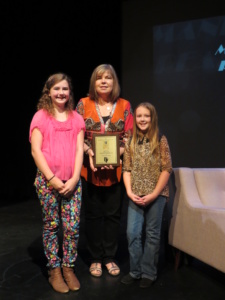 On September 26th 2014,the MANITOBA YOUNG READER’S CHOICE AWARD was presented to Marsha Forchuk Skrypuch for her novel Making Bombs for Hitler. The award was presented at a special ceremony held at the Manitoba Theatre for Young People, with hundreds of kids in attendnace. Marsha was selected by Manitoban tweens who had read at least 5 books from the nominated list.
Students and fans gathered to hear Marsha Continue reading “MYRCA and Marsha”
Thank you, Derrick Grose and School Libraries in Canada for this fabulous interview:
|
Oliver Twist had a story!
Marsha Skrypuch was born in Brantford, Ontario, on December 12, 1954 Continue reading “An interview about Dance of the Banished, why I write, and my interned grandfather” |
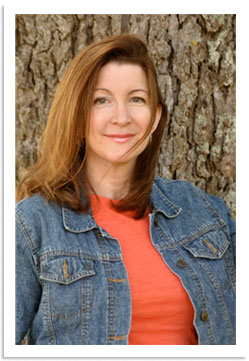
This post was originally published on Brenda Kearns’ blog here.
Most people will say that fiction is fake and non-fiction is true, but have you ever had a news article written about yourself or a topic you’re very familiar with? Was it 100% accurate? Not likely!
Yet news articles are supposed to be non-fiction. Ditto for textbooks. They’re filled with facts and figures that are based on suppositions of the time but that doesn’t make them true. Continue reading “Fiction, Non-fiction and Narrative Non-fiction”
The interview was originally published on Christine Kohler’s website here.
One piece of advice that writers are given is to write what we know. I disagree with that. I think it’s more important to write what you don’t know, but what you’d like to know about.
Before I became a writer, I got my Master’s degree in Library Science, not to become a librarian, but to learn what I didn’t know. Becoming a librarian helped me become a history detective. All of my books delve into some fragment of history that has been shoved under the carpet and forgotten.
Lidia, my mother-in-law, died in early 2008. A few weeks before her death she said to me, “You’ve written all these stories about bits of history that no one else has written about, but you haven’t written about what it had been like for me as a Ukrainian child in World War Two.”
Her comment stunned me, but there was much truth in it. She had told me so much her childhood, living on the Front, in the midst of where the battles were actually fought. In case you don’t know what the Front is, it’s where the two fighting armies confront each other— in this case, the Soviets and the Nazis. I asked her once how you could tell when the Front was upon you. “The ground trembles,” she said, “from the tanks.”
The Nazis moved through her home town of Zolochiv in Western Ukraine twice. Both times, they took over her house. They didn’t allow her or her parents to leave: The three were captive hosts, expected to cook and clean for the invaders. But they also listened in on conversations. Once, Lidia heard of an “Action” at her school the next day. “You’re staying home,” said her mother. When she went back two days later, all of the blonde and blued-eyed girls had been taken away, never to be seen again.
Years later, my mother-in-law found out that they were all dead. They had been taken for the “Lebensborn Program” where carefully selected Polish and Ukrainian children were stolen from their families and brainwashed into thinking they were German, then placed into high-ranking Nazi households as trophy children. When the Nazis lost the war, these children were no longer trophies. They were an embarrassment and a badge of guilt. Some were abandoned, never understanding why. Others will killed. Others continued as members of their “family” after the war, but sometimes remembered who they really were in their old age, realizing their whole life had been a lie, and those they considered family were actually the killers of their real family.
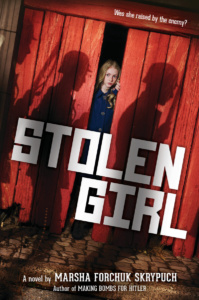
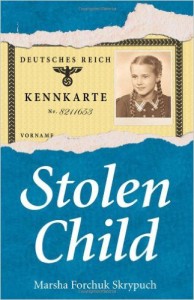
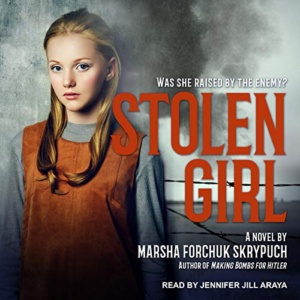
This was an aspect of World War Two that I had never heard from anyone beyond my mother-in-law. At her deathbed, I promised her that I would write about her experiences. The first novel of my WWII trilogy was Stolen Child— not about Lidia—but about a girl like one of her less fortunate classmates—stolen by the Nazis and robbed of her identity.
As I did the research for that novel, I realized how rare it was for a child to be deemed “worthy” of the Lebensborn program. The Nazis captured millions of Ukrainian and Polish children, but only a few hundred thousand were selected. The rest were labeled “not racially valuable” and were either killed outright or used as slave labour.
This fact became the inspiration for the second novel of my trilogy. What would it be like to be stolen with your sister, but separated for different fates because your sister was considered “racially valuable” while you were considered disposable?
Lida, the disposable sister, is the heroine of MAKING BOMBS FOR HITLER, the second novel of my trilogy.
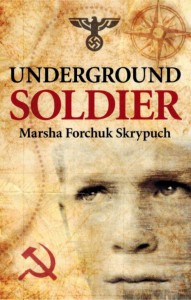
While writing that novel, the character of Luka appeared, initially as nothing much more than a “wild-haired boy.” Soon, as good characters are wont to do, he took on a life of his own. Ultimately, he escaped from the slave labour camp. The third novel in the trilogy explored what he ended up doing after hiding in a wagon of corpses and jumping out in the middle of nowhere before the wagon got to the crematorium.
His story is based on real experiences as well—about the many escaped slave labourers and other survivors of the Front who just couldn’t take it anymore. They stole weapons from the Soviets and the Nazis and formed an army that hid literally under the ground. They fought the invaders on two sides—the Soviets and the Nazis—and hid under the mountains and forests. For that novel, I interviewed people who had done exactly this as children—took up arms and fought—realizing that they would likely die, but it was worth it if it meant that future generations might live in freedom.
The events unfolding in today’s Ukraine have chilling parallels to what I’ve written about in my World War Two trilogy. I pray that we are not on the brink of World War Three.

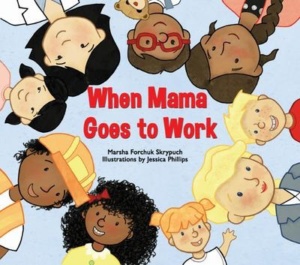
Teachingbooks.net recently recorded this brief interview and reading with me about When Mama Goes To Work.