Thanks, Andrea Mack, for the lovely Bombs review!


That’s Another Story blog here.

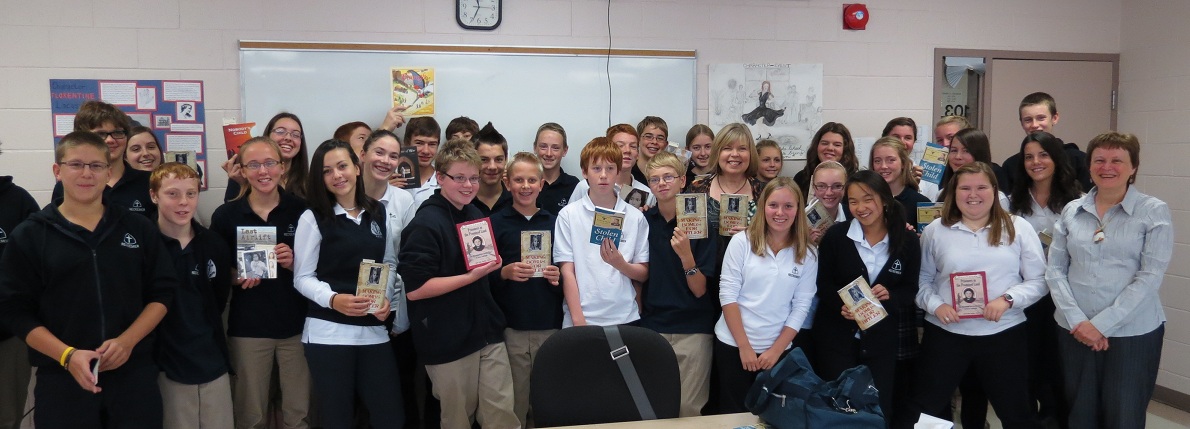
I couldn’t put this book down! Whenever I read about life in a work or concentration camp, I am shocked and saddened that people could ever treat other people in such a cruel and inhumane way. At times, this book made me feel very emotional. I was rooting for the main character, Lida, and her friends to survive. The author did a great job of creating a character that I cared about. I liked the way her research blended seamlessly into the story to create a compelling read. Now I want to read her other book about Lida’s sister, called Stolen Child.

As a writer, I would study this novel to see how every detail was portrayed through the main character’s perspective. There is nothing unnecessary to the story here.


I heart OLA!

Where can a Canadian children’s author feel like a rock star? At the Superconference, and at Forest of Reading events — both organized by the OLA!

What a wonderful time I had last week, meeting up with fellow writers, teacher-librarians and librarians. I am especially in awe of the myriad of volunteers who run the Forest of Reading festivities.

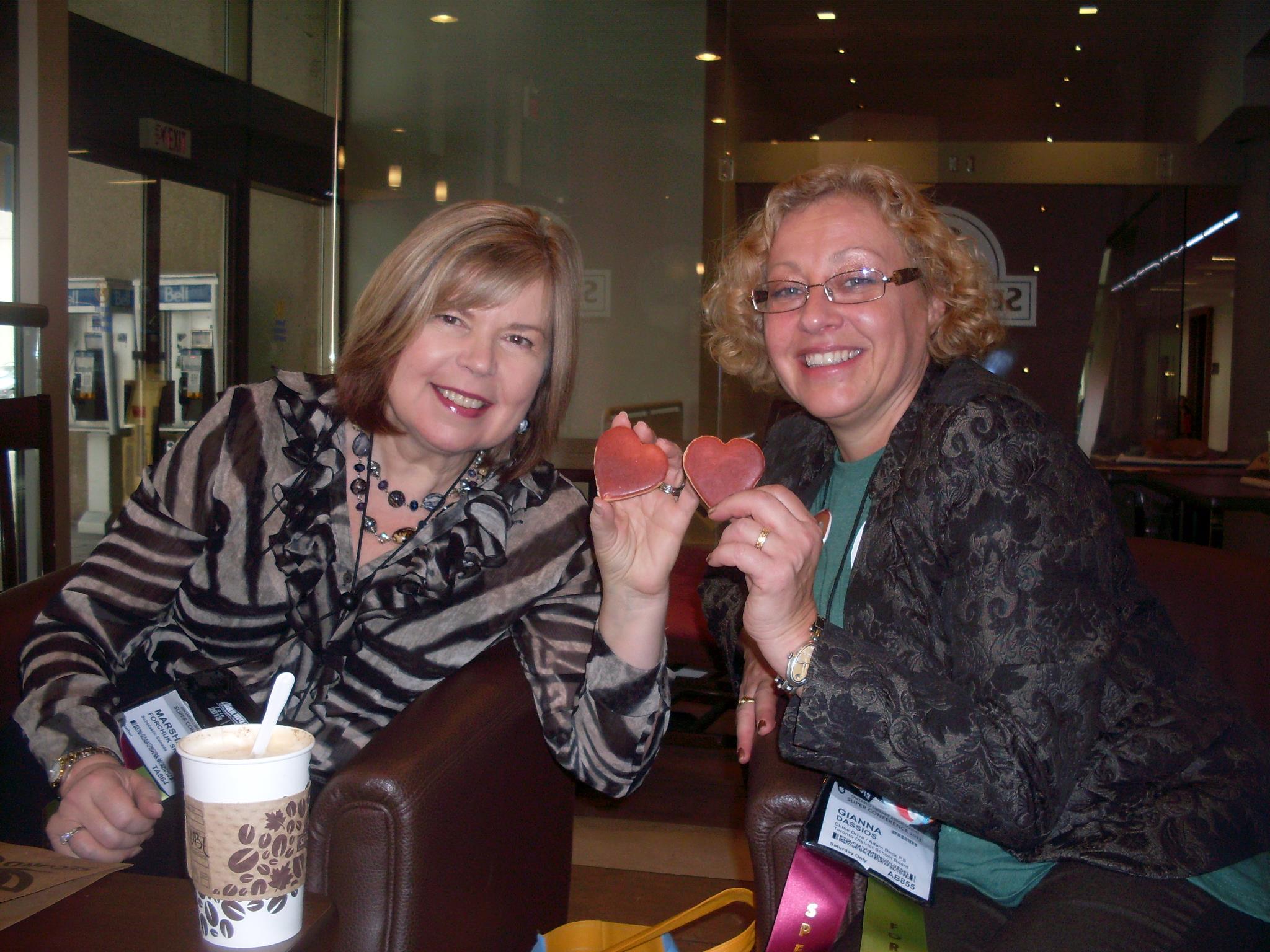
Here’s a photo of me with the wonderful Gianna Dassios, who co-chairs the Forest of Reading with Helen Kubiw. We ran into each other at the Second Cup and she bought me a heart.

At the OLA Superconference with Gianna Dassios.

It Takes a Village as applied to YA fiction

http://www.winnipegreview.com/wp/2012/11/it-takes-a-village-as-applied-to-ya-fiction/

Posted: NOVEMBER 8, 2012

Columns, The Winnipeg Review

By Marsha Forchuk Skrypuch

I find it lonely being one of the few fiction writers who has tackled the lesser-known stories of World War II. The atrocities of Hitler are justifiably infamous, but a troubling number of people have never even heard of Stalin and his atrocities. Part of the reason for that is because you can’t tell your story if you’re dead, and Stalin managed to silence a whole heck of a lot of people.

In The Darkest Corner of the World (Dancing Cat Books), Urve Tamberg has managed to give voice to an entire small nation that was nearly obliterated in World War II. Well-researched and compellingly written, it deserves to be widely read.

Urve agreed to answer my questions for TWR.

The Darkest Corner of the World is set during WWII, yet the part of WWII  history you deal with has received very little attention. Can you tell me about that?

Winston Churchill said that “history is written by the victors.” For most of the twentieth century, the Soviet Union was the “winner.” They illegally annexed the Baltic countries of Estonia, Latvia, and Lithuania during the Second World War, and for five decades the Iron Curtain limited communication between the West and the Eastern Bloc countries. Letters were censored, and people on both sides of the ocean were afraid to tell their stories.

After Estonia regained independence in 1991, stories slowly started to filter out, but even now there is very little written in English, much less written for a younger audience.

Another reason that Estonia’s stories have not been told is because of its tiny population. There are about 1.5 million Estonians in the world. Much of the literature to date has been written in Estonian, so fluency in the language has been a necessity.

This story is a personal one for you. Are any of the characters based on
family members?

The story is personal, but the characters are fictitious though I’ve tried to portray Estonian characteristics such as dark humour, sarcasm, and sheer stubbornness in the characters.

The setting on Hiiumaa Island takes place on my mother’s farm. When I was growing up, I thought Hiiumaa was a sleepy place where nothing interesting happened, but during the Second World War, the front passed through my mother’s farm twice, once in 1941 when the German Army drove the Soviets out of Estonia, and once in 1944 when the Soviets returned to occupy the country for the next fifty years.

Which character is most like you?

There is no one character I’d compare myself to. I’d like to think that, like Madli, I would’ve been brave, and smart, and defiant. But as a fifteen-year-old girl, could I have stood up to a Russian soldier? Could I have protected my little brother from the Soviet army? I know that I could do all that and more as a mother protecting my children, and I hope that I would have done the same as a teenager.

One doesn’t know how one would react under adversity until one is confronted with it. In researching the novel, stories of kindness came up time and time again, even in the most horrific of circumstances. For example, on the night of the deportations, when soldiers rounded up the families, some men told the deportees to bring warm winter clothes, sewing machines, and food since they knew that people were being sent to Siberia. Deportees were actually allowed to bring up to 100 Kg of supplies with them, but other soldiers gave people no time to pack, and literally forced people in their nightclothes to waiting trucks.

Do you believe in evil?

Yes, I believe people can be evil. If you believe people are good, then you must believe in the opposite as well. There is no other word than “evil’ to describe the actions of Stalin and Hitler.

Will there be a companion novel or sequel?

I’ve had a number of people ask me about a sequel, and I’ve started to research the next book.

My work-in-progress sheds light on another little-known story of World War II in the Baltics. In the late summer and early fall of 1944, over seventy thousand Estonians (along with thousands of Latvians, and Lithuanians) escaped to Sweden or Germany as the Red Army returned to occupy the Baltic countries. My parents were among those who left on small boats, and risked their lives to cross the stormy waters while Soviet planes patrolled overhead. Hundreds of people did not survive the hazardous journey.

What was your biggest challenge in writing this novel?

Since this is my first novel, there are three things that were challenging for me. I call them the three Rs — researching, rewriting, and relevancy.

As someone with no background in history, I had to research everything from the dates of major events to bathrooms, shoes, and bathing suit styles. Accuracy was very important because I felt that I had to honour the events and people of Estonia during that time period. My ability to read Estonian gave me access to a richness of work that wouldn’t be available to anyone who didn’t speak the language (needless to say, there aren’t many of us). I spend months reading life histories, and textbooks in both Estonian and English.

E.B. White said, “The best writing is rewriting.” I gave myself permission to use my first novel as a learning experience and spent years learning about the craft of writing. It was very tempting to rush the process, but it took about four or five years from conception to publication, and countless rewrites. I joined critique groups, SCBWI, CANSCAIP, and started going to courses and conferences. I love that I’m always learning something new, and that writers are so generous about sharing their experiences.

And finally, relevancy. How could I make this story appeal to teens? I knew the story had to draw them in on an emotional level and decided to included romance and betrayal. Also, Madli likes all the same things today’s teens do. Boys, summer vacation, parties, movies from America, and travelling. When I went to school, history was taught as a series of dates and treaties and wars and battles, none of which interested me in the least. Now I realize I’m interested in how people felt, and the every-day dilemmas they faced.

Did you ever feel like giving up? What made you continue?

I’m not the type to give up. So no, I didn’t think of giving up, but there were periods of lengthy procrastination, and navel gazing. Coming from a background of science and business, it’s hard to know if your writing will connect with people. The reason I persevered was due to the support of other writers, through associations such as SCBWI and CANSCAIP, as well as critique groups such as Kidcrit [Editorial note: Marsha Skrypuch has been running this free online critique group for sixteen years. To join, you must have a completed first draft of a children’s or YA manuscript. For permission to join, go here].

My critique partners helped me put my work into perspective. They praised the good parts, and offered gentle criticism for the sections that required work. I’m the type of individual who really wants to know how to improve, and am happy when there are many suggestions to consider.

This is your first novel. Can you tell me about your publishing journey?

I didn’t know I wanted to be a writer until a few years ago. I’ve always been an avid reader, and somewhere in the back of my mind, had the desire to write a novel. Like many people, I didn’t think writing would be as difficult as it was.

It took me four intense years of historical research, and learning writing craft before I submitted the manuscript for publication. I think the hours that I put in were probably the equivalent of another university degree, though the end result is a published novel, not a degree.

I could never have done this on my own. Like any profession, it’s important to connect with your peers. From the start, I have been part of amazingly supportive and perceptive critique groups. Organizations such as CANSCAIP and SCBWI provided important resources, and still do.

I met my editor, Barry Jowett from Dancing Cat Books, at a course run in Brantford (many Ontario writers would know that course was run by you). At a one-on-one meeting, he liked my first page, and wanted to see more. And based on some good advice, I didn’t rush to send him the manuscript. In fact, after much consideration, I ended up rewriting the whole novel from first person to third person before I sent it to him. That took a year. Fortunately, when I contacted him, he did remember the novel, asked to see the entire manuscript, and the rest is history.

What advice would you give an aspiring writer?

They say it takes a village to raise a child. It also takes a village to write and publish a novel so my advice would go something like this:

First— congratulations! You’re the prospective parent of a manuscript! The manuscript may have as few as five hundred words if it’s a picture book, or sixty-thousand words if it’s a young adult novel. You have an embryo of an idea, and want to nurture it to life. Gestation could take months, or even years. During that time, you’ll want to talk to other parents/writers, compare progress, and read as much as possible about care and feeding of your new manuscript. And when you need a break from that, reach for a good book.

During the time of manuscript gestation, you’ll get lots of questions, and perhaps even receive unsolicited advice from well-meaning people who are not writers. Why is this manuscript taking so long? Will it be published by Christmas? Do what any expecting parent usually does; smile knowingly and mumble “As long as it’s healthy.”

Hang around with experienced parents, i.e. people who have written books and had them published. In other words, find your writing tribe. Join associations, whether it’s SCBWI and CANSCAIP for children’s writers, or other groups for mystery writers, or romance writers, or sci-fi writers. Learn the craft of writing. We learn science, piano, and other skills. Writing is a skill that can be learned through courses, workshops, and reading books about writing.

Find trustworthy caretakers i.e. find a critique group. Find those people who you can trust to read your work, and offer suggestions for improvement. These people will cheer you on, and keep you motivated. Find people whose aspirations are in line with your own. Although writing may be solitary work, getting a manuscript to publication takes a village


Next big thing: What I’m working on now…

Writers are tagging each other with a questionnaire about what they’re working on now.  I was tagged by Gary Barwin. To read Gary’s answers, go here.

I would like to tag Lisa Dalrymple, Urve Tamberg, Sylvia McNicoll, Karen Wilsey Bass, and Gabriele Goldstone.

Addendum: Karen Wilsey Bass has responded here.

Urve Tamberg has responded here.

Gabriele Goldstone has responded here.


What is your working title of your book?
Luka Underground

What is the one-sentence synopsis of your book?

The story of an Eastern European boy captured by the Nazis who escapes and joins the resistance.

Where did the idea come from for the book?
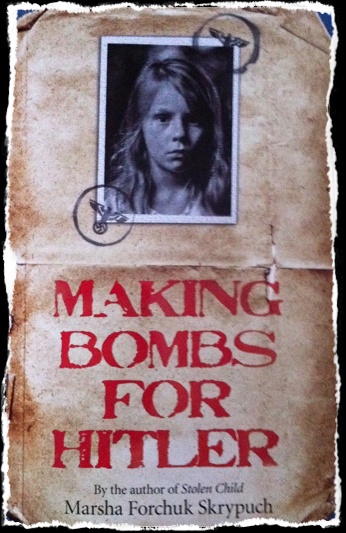
This is a linked novel to two of my previous WWII novels, Stolen Child and Making Bombs for Hitler. All three novels step into the shoes of a child captured by the Nazis. The first is about Larissa, who is deemed “racially valuable” and brainwashed into thinking she is German. The second is about her sister Lida who is deemed “not racially valuable” and is used as a slave to make bombs. This current work-in-progress is about Lida’s friend, Luka, who escapes the slave camp in a wagon of corpses, joins other escapees and fights back.

What genre does your book fall under?
Historical fiction.

Which actors would you choose to play your characters in a movie rendition?
Liam Hemsworth is Luka all over.

Will your book be self-published or represented by an agency?
I am represented by Dean Cooke of The Cooke Agency. The novel is already sold to Scholastic Canada and will be published in Feb 2014.

How long did it take you to write the first draft of your manuscript?
I am still writing it! My first WWII historical came out eleven years ago. I have been researching the era for two decades. This particular story has been in my head for more than a decade, but I only began putting it down on paper in the spring.

What other books would you compare this story to within your genre?
Luka Underground is WWII historical fiction for children. Luka is Ukrainian, and other than the novels that I write, there is not a body of commercial fiction on Ukrainians in WWII. The European war was fought on land that is now Ukraine and between Hitler and Stalin, ten million Ukrainian civilians were killed, yet very few writers have tackled this topic.

Part of the reason is that it is hard to tell your story if you’re dead.

The other reason is because while Naziism ostensibly ended when Germany lost the war, the Soviet Union continued with their atrocities until that entity dissolved in 1991 (and have they truly ended? Putin is not exactly a shining light of democracy. Ditto for Yanukovych in Ukraine). It wasn’t until after the fall of the Soviet Union that people from nations oppressed by the Soviet Union were able to come forward and tell their stories.

Before 1991, the Soviets promoted a propagandized version of WWII, where all heroic deeds were done by “Russians” and citizens of nations captured by the Soviets were painted as evil. Non-Russian Soviets were sent in great numbers to the Gulags for “re-education”, so even after the fall of the Soviet Union, these people didn’t have the vocabulary to relate their own WWII experiences.

Recently there have been books written, like Timothy Snyder’s Bloodlands, and Alexander von Plato’s Hitler’s Slaves, that paint a more complete picture of the fate of Eastern Europeans in WWII.

Comparable novels would be Urve Tamberg’s just released The Darkest Corner of the World, about an Estonian child in WWII, and Ruta Sepetys’ Between Shades of Gray, about a Lithuanian child in WWII.

Who or what inspired you to write this book?

My late mother-in-law, who lived in Ukraine during WWII and survived the Front moving through her town — twice. She told me so many snippets and flashes of memory from a perspective that I had never read about in books. I promised her when she was on her deathbed that I would write the stories of people she had known and loved and lost. For Luka’s story in particular, Peter Potichnij, a retired professor from McMaster University, has been an inspiration. As a 12 year old, he joined the Ukrainian Insurgent Army, and he has spoken at length about his experiences, as well as collecting a tremendous amount of primary data.

What else about your book might pique the reader’s interest?

The two prior novels have met with critical acclaim. Stolen Child, published in 2010, was the inaugural winner of the Crystal Kite Award for the Americas, was shortlisted by the Canadian Library Association for Children’s Book of the Year and was an Honour Book for the Manitoba Young Readers’ Choice Award. Making Bombs for Hitler, just published in Feb 2012, has been shortlisted for the Ontario Library Association Silver Birch Fiction award and is receiving rave reviews.

My CANSCAIP Interview with Pajama Press editor, Ann Featherstone

CANSCAIP Interview with Pajama Press editor, Ann Featherstone


How did you become an editor?

I did my undergraduate degree in English literature, specializing in the development of the novel. I took as many upper level courses as I could find, including a particularly memorable class called “Victorian Tales of Terror.” I loved analyzing the great novels, deconstructing them to see how they worked so successfully, and I figured I was destined to write my thesis on Wilkie Collins and get on with the business of becoming an English professor, even though I had serious doubts about my ability to teach. I had it all mapped out, in my head anyway. But I found a job at Munro’s in 1975, my last year of University. It’s a fabulous store in Victoria, BC. And I never looked back, I loved it so much…until 1990, when the publisher of a tiny house in Victoria was looking to expand from 1.5 employees to 2.5, and he offered me a job as “managing editor.” I have to laugh at that now, because I found out pretty quickly that I was going to have to teach myself to become a real editor, and then a good one. But first I had to go out and buy a chair and a lamp! I wore out several copies of The Chicago Manual of Style, editing by hand, of course. So there was a lot of erasing going on in those days. I also promoted the books as best I could and packaged orders. I even laid out type for the first year or so, cutting the long sheets of type and fitting them onto layout pages. A lot has changed since 1990, both at Orca and in publishing in general.

What advice would you give someone who wanted to become an editor?

Today I’ve seen a number of editors break in by getting into a publishing program that offers internships. I think that will be the way it goes from now on, instead of seeing people slowly rise through the ranks. We have all had to tighten our belts, especially the big publishers. And I’ve seen many really experienced senior editors laid off, with former interns put in their place. It used to be that editors came from bookselling or a publisher’s promotions department or sales force. Still others seem to have worked their way in as proofers. But you don’t see that so much anymore. Interns get thrown into the deep end, just as I had to 22 years ago. It’s definitely a sink or swim situation. But I have to say that an English degree and years as a bookseller gave me a superb if somewhat slow start, and I’ve never regretted it.

What do you look for in a manuscript?

I look for a strong voice first, then characters that inhabit a world I can believe in. If a writer has those qualities, even if they are weak in other areas like plotting and structure, I think they have a chance to make it. I also hope to find stories that are really engrossing because they are good stories, not stories that are “good for children.” Although there are many values I look for in a characters, like honesty, loyalty and courage, I don’t want a lesson that overwhelms the plot. What drives the story? I ask myself; if it’s the moral or theme, then I’m not interested. If the characters don’t drive the story, I just don’t want to go there.


What are the qualities of a dream author?

I hope for enthusiasm and a willingness in authors to look at the editorial process as a chance to make their work shine rather than an intrusion on their sense of self worth. My favourite authors tell me they love the editorial process. They might sometimes gulp when they see my edit, but they treat me with the same respect I treat them. And they really try to see my point. They also seem to understand that I am ambitious for them and determined to make sure the final product is something they can be proud of. And they make me feel that it has been a collaborative process.

The worst authors?

I have to say I’ve been really lucky to work with lovely people most of the time, people who have become my friends and respected colleagues over the years. But every once in a while I come up against writers so protective of their work that they don’t want to change one word, let alone consider my suggestions. They see the process as a teeth-gritting operation that they must endure; and if they make changes, it is only because they feel under duress to pass through the gauntlet of the publishing process. On the other hand, there are a few people who will do whatever I suggest without question, and that’s not a great way to keep the creative process going either.

How many steps does editing take?

There’s the initial read. Then I discuss it with the publisher. Gail and I decided long ago that, if one of us hates the story we won’t do it, even if the other one loves it. And that has stood us in good stead. But we do discuss it pretty carefully before making a decision. There are many projects out there that are perfectly publishable. But are they right for our house, at that particular time or in the near future? Then I will discuss with the author in general terms the kinds of changes I can see for the work. If the author verbally agrees to the changes in principal, they will be offered a contract. So far, this can take a number of months, so sometimes I will do some handholding and keep the lines of communication open so the author doesn’t feel that they have been neglected. The publisher is always up to their neck with work, and considering new manuscripts or negotiating contracts frequently has to take a backseat to other more pressing issues. So I try to be as available as I can be to the author during this period. Then, once the contract is signed, I work on my substantive edit. Once the author gets this, we will sometimes discuss it a number of times as the author is working on the rewrite. Then, when the rewrite comes in, I will read it again and discuss with the publisher the changes that have been made. Often the publisher will be required to read the book carefully again, in order to discuss big changes. If everything checks out, I will go through another edit, which incorporates line editing along with any lingering substantive issues. When that comes back, I will do another check through the manuscript to make sure it is as clean as I can make it before I hand it in to the designer. When the designer is done, I will work on the PDF of the design, making any further changes I feel necessary as well as any new issues that appear. While I’m doing this, the proofer is making their suggestions on another file. I look over the proofers changes, “stetting” anything I don’t agree with, saying yes to corrections that are indisputable and issues of house style. The author will also be looking at the PDF, adding their remarks and concerns to the mix. I resolve the issues the proofer found with the author’s opinions and my own, as well as the publisher’s if I feel it necessary. And then I clean up the PDF. I may have to run more corrections after looking at the designer’s work. And once I am no longer worried and have finished worrying everybody else to death, the book is ready to go to the printer. I also prepare the book blurbs: back cover copy as well as flap copy and author bios. I also write the catalogue copy and proof the catalogue. In addition, I write CIP annotations and try to think up clever tag lines for advertising.

I have no idea how many steps that is, to be honest. And it’s too daunting to go back and count!

Of all these jobs, what’s your least favourite?

Without a doubt, catalogue and promotional copy! It is such a headache for me, I can’t even tell you! But as the editor, I’m in the best position to understand the book and our decision to publish it, so I gird my proverbial loins and agonize my way to finished copy that the publisher is kind enough to call “fine” or sometimes even “brilliant.” And then I get a little inkling of why writers need praise and why they find satisfaction is what they have accomplished. Writing is hard work!

Your advice for first-time writers?

Don’t panic! If you are turned down, please, please don’t take it personally. There really are a multitude of reasons why your manuscript might be turned down, so many of which will have nothing to do with the quality of your writing. While your first book is making the rounds, you absolutely must start work on another book. Don’t depend on hitting it big with book one of a huge series that you have planned and won’t write until book one is accepted. If you start getting some personal comments but you are still not offered a contract, try to collate the opinions. Maybe the time isn’t right for your book. Maybe this one was the exercise you had to go through to become a stronger writer. Keep on sending it out until you run out of publishers, then start over with another idea. Try to stay true to your own heart as a writer and continue to write for the genre you love. If you get your first book accepted, congratulations, but you are not done yet by any means. Try to become savvy about the children’s publishing business. Join the Canadian Children’s Book Centre, join a writing group, subscribe to Quill & Quire. Check out Canadian Materials, School Library Journal and Kirkus reviews online. Subscribe to Publisher’s Weekly Children’s Bookshelf, the Horn Book’s email notices, and “Goodreads” newsletter. Ask people to recommend their favourite blogger; there are tons of great ones. Join CANSCAIP as a “friend” until you are published and then become a full member. Join the American counterpart, SCBWI. Go to some conferences and writing workshops. If nothing else, it will tell you whether or not you are truly cut out for a career in this industry. And please read children’s books—recent ones, books recommended by your local bookseller (independent, if you can) or children’s librarian. The absolutely worst thing you can do is continue to write in a vacuum. Find a community of writers out there and become inspired. Never turn down the opportunity to read a well-reviewed or award-winning book in your chosen genre. Don’t isolate yourself by saying you don’t want to be influenced by other writers’ ideas. If you can’t read children’s books for your own enjoyment, this may not be the right path for you.

Peer into your crystal ball …

I’m not very good at predicting trends. I just know that I can’t figure out why vampire novels are still so strong! So I like to look at the industry in general rather than tell you that I’m sure that historical romance/fantasy/mysteries will be the next big trend in kid’s books (even though I suspect they will!) A recent article in Publisher’s Weekly reported the latest stats on children’s books sales compiled by the American Association of Publishers. And as things go in the States, it often follows in Canada a few years later, right? The AAP reported that from April 2011 to April 2012, overall children’s book sales have gone up 24.3%, with hardcover sales increasing by a whopping 42.8%! In fact, the only category of children’s books to go a little soft is board books, which have gone down 14.9%. I don’t think that e-book sales will start ringing the death knell of quality books for children, nor will the iPad destroy good books in their zeal for more creative apps to entertain. What is happening—and this is something I predicted after reading my first Harry Potter and felt vindicated especially after The Hunger Games—is that more and more adults are reading YA titles for their own enjoyment. This represents a largely untapped market; more and more publishers will be producing quite sophisticated covers for their YA titles in future. Early readers are no longer selling; it’s hard to make a profit in this genre. Juvenile novels are still strong in Canada.

But I also think that the economy is going to continue to challenge publishers; overall sales in Canada are not as encouraging as they are in the US just yet. It’s getting harder and harder for the independents to compete with the chains and online bookselling giants like Amazon; and this reality will continue to influence the kinds of books that publishers will look for even as it saddles them with brutal returns after as early as three months. So for now, we continue to look for books that will appeal to library and school buyers as much as bookstores. We will look for stories with broad appeal. We will be looking at fewer books more creatively promoted. And we will continue to cherish authors who know how to get out there and flog their own material. We will look forward to a time again when quality will automatically rise to the top, even as we become more afraid that those days are over forever. But there will always be hope. Publishers have to keep their publishing programs active if they want to stay alive; their editors will always be looking for breakout authors. And we will remain optimistic because we love children’s books. If we didn’t, we’d be no longer in this delightful, and equally frustrating, industry.

Linda Bailey — Toads on Toast!

Here’s my Winnipeg Review interview with Linda Bailey:

For the picture book crowd, there are few more beloved dogs than Linda Bailey’s Stanley. Since the publication of Stanley’s Party in 2003 and the subsequent Stanley books, all illustrated by Bill Slavin, Linda has had a massive following. And not just with kids. Adults appreciate the humour of the Stanley books as well.

Linda Bailey has garnered well-deserved critical acclaim and oodles of awards, both in Canada and in the US.

When I heard about Linda’s most recent picture book, I was a little bit taken aback. Toads on Toast? She couldn’t really have written a kids’ book about eating toads, could she? Had wry humour turned to gruesome humour?

Once I read Toads for myself, I was intrigued. Linda kindly agreed to answer these questions:

Toads on Toast is an intriguing departure from your Stanley books. Different illustrator, a completely different kind of story, although still the classic Linda Bailey wry humour. How did this story come about?

Thanks for the “wry humour.” I try to be wry! How did Toads come about? The easy answer is word play. I noticed one day that “toads” and “toast” sounded the same. But in terms of meaning, they were a bizarre combo. As it happens, I like bizarre combos, so I began to ponder how a bunch of toads might find themselves on top of a piece of toast. This led me into folktale turf in which small critters are sometimes gobbled up by larger critters, amid heart-stopping dramatic tension. I came up with characters-at-risk (young toadlets), a villain (Fox) and a heroine (Mama Toad) with enough smarts to outfox a fox. So that’s the surface answer. The deeper answer is that one of my favourite characters in all literature is Mr. Toad in Wind in the Willows. Love that guy! Wanted to do a toads story for him.

The illustrations in Toads on Toast are an essential part of the storytelling and the humour. How much say do you have in the illustrations?

As someone who writes humour, I get more leeway than most picture book authors. A lot of the humour I write has visual “punchlines,” and the text makes no sense without the picture. So I do find myself describing funny actions or scenarios that go with (or contradict) the words. That said, I am nothing and nowhere without a funny illustrator. The illustrator (in this case, the very funny Colin Jack) has to GET the joke, and have his/her own giggle, and make it hilarious in his/her own way. I never imagined, for instance, that Mama Toad would end up looking like Lucille Ball or that one of the toadlets would spend most of the book inside a floating soap bubble.

Does the illustrator get to have any input on your words?

Sometimes. But the words get written long before the illustrator even knows the story exists. I wrote a “SPLAT!” sentence in my text about Mama’s entrance as she leaped into Fox’s kitchen. Colin included the giant word “SPLAT!” in his drawing. It was much better in the art than in the text, so I deleted my sentence. When something is shown well in the art, you can change/cut the text.

Do you like to eat frog’s legs?

I have never actually eaten a frog’s leg. I hear it tastes like chicken.

How long did it take you to write Toads on Toast? How many drafts?

Interesting question. Some books take dozens or hundreds of drafts. Some books come easily. Toads came relatively easy. Maybe ten? Plus tons of picky polishing.

Who is your favourite character?

Mama Toad, for sure. She’s melodramatic and over-the-top, and I love her barely controlled maternal hysteria. (Her best line, in my opinion, is “Take ME instead!”) I also adore the I-Love-Lucy lips and red hair in the art.

Which character is most like you?

This is hard to answer because my theory is that ALL the characters I create are some version of me. I think they all bubble out of some place in my sub-conscious. So I relate to Fox, who is basically just a bored guy, looking to change his diet. I relate to the toadlets who are rebellious and subversive in a way I have always wanted to be. And certainly, I relate to Mama, who will do anything it takes to keep her kids off Fox’s plate.

What is your writing routine?

I tend to write in bursts. I do a lot of traveling and speaking, and at those times, I find it hard to focus on a fictional inner world. When I do get solitude and quiet, I go into that inner world (or worlds) quite intensely and hardly look up.

What aspect of being a writer drives you nuts?

The business side — contracts, schedules, finances, travel arrangements. Did I mention contracts?

What are you working on now?

Lots of things. I have a habit of hanging onto good ideas that aren’t quite ready for prime time. I don’t delete them. I keep them in my computer and go back – again and again. Often I find ways to take them farther. Or I might find a whole new angle. Or tastes in publishing might change. Sometimes it takes me five or ten years to bring a story to “finished.” That’s okay. I now have lots of stories in my files, and I’m working (off and on) on all of them.

What advice would you give to an aspiring author?

The usual advice, I guess. That it doesn’t matter how much talent you have if you don’t have persistence and stamina. I believe it’s a craft, not an art. You learn by doing. Practice makes perfect. Malcolm Gladwell’s 10,000-hour rule (The Outliers) does apply here. A few writers are like shooting stars, right out of the gate. Far more “grow” slowly. They get better and better and then excellent by putting in time, passion, self-education and many, many hours. I’ve seen it so often. Hang in.


An interview with Don Aker about Running on Empty

Here is my interview, originally published in The Winnipeg Review:

Don Aker is one of those authors who has a gift for creating spot-on unlikeable male teen characters. Like your own kids (or maybe like you) they do stupid things and are then shocked at the outcome of their actions. But because they’re like your own kids (or you) it’s easy to step into their shoes and be transported.

Don Aker’s newest, Running on Empty, does not disappoint. It’s about Ethan Palmer, the son of a wealthy lawyer, who doesn’t know how good he’s got it. When he damages the family car by bashing it into the garage, his father decides to give him a life lesson. Instead of paying for the damage through insurance, he makes Ethan pay. Ethan had been saving to buy a special car of his own, but when all of his money is used up on the repairs, this sets him on a desperate spiral downward into the world of online gambling, and stealing from friends and family to pay for gambling debts. 

This is not a problem novel. It’s more like a thriller. As each chapter unfolds, Ethan sinks deeper, and all around him, the people who love him are having their own problems but he can’t see that. Each of Aker’s characters are so well thought out that they could sustain a novel of their own. Every time I thought I’d pegged someone, I was wrong.

Don kindly agreed to answer some questions about the writing of Running On Empty:

Running On Empty’s main character, Ethan, is anything but saintly, and this is not unusual for your young adult fiction. You seem to be able to nail the contemporary teen male mindset and voice. How do you do that?

I’m indebted to the hundreds of teenagers who have spent time in my classroom over the years. I’m convinced that I could never have become a YA writer if I hadn’t first been a teacher of young adults with endless opportunities to observe them interacting daily. I continually draw on those experiences, which not only inform the conflicts I write about but also provide the voices and mindsets of my characters.

This novel seems to have more profanity and sexual references than your earlier novels – don’t get me wrong – it fits Ethan’s character to a T, but I’m wondering if this reflects a change in editorial policy or something else.

I can’t comment on any change in editorial norms because the issue of profanity has never been raised by any of the editors I’ve worked with. I believe a writer should only use profanity if it suits the character and situation—otherwise, it’s gratuitous. Used unnecessarily, it can be a stumbling block, pulling readers out of a scene instead of drawing them forward. Ethan appeared in my head as a very angry young man, and it seemed natural that he would resort to swearing when his rage spilled over. Interestingly, I felt my use of profanity in Running on Empty was more moderate than in my previous novels, evidenced by my decision not to have Ethan use the f-word. I’ve learned to trust my instincts about what my characters will and won’t do, and as Ethan took shape, I found he was unlike the troubled young men who’ve appeared in my previous novels. Perhaps because of his background, I wasn’t comfortable “hearing” him use the f-word, even during scenes when he was incensed, which explains why that particular expletive doesn’t appear in the novel.

What was the inspiration for the novel?

Actually, it was a combination of inspirations that led me to write Running on Empty. I attended a conference session during which the presenter, an educational psychologist, drew an analogy between cars and the teenaged brain—the brain of a teenager, he said, has a gas pedal but no brake—and that analogy resonated with me. Shortly after that, I read a news article about a dramatic increase in the number of teenagers who gamble for money, and I was floored by the statistics the reporter offered, statistics that made me recall that psychologist’s comment. When something troubles me, I invariably find myself researching it, not necessarily because I want to write about it but because I need to understand it. Besides reading widely on the subject of gambling, I spoke to a number of people about it, among them an addictions counselor who shared heartbreaking stories about the toll that gambling has taken on the lives of individuals and entire families. But the most disturbing conversation I had was with a person who told me about a married couple she knew who had a teenaged son. That summer, they staked him a sum of money that he used to gamble online—in effect, gambling was his “summer job” that year. He spent part of every day in front of the computer placing bets, and his parents actually boasted to their friends about the money he was making. The moment I heard about that young man, I visualized a character swept up in a gas-pedal-but-no-brake online experience, and it was then that the novel began to take shape in my head. However, it didn’t come easily. I struggled with the story for a long time because the last thing I wanted to write was an “issue novel” about gambling. The strongest stories are never about issues and events but, rather, how characters are affected by those issues and events.

Before I can begin writing any story—whether short fiction or a novel—I first have to understand my main character well enough to determine what it is he or she wants more than anything else. Then it’s my job as a writer to keep that character from getting it, at least for a little while. Ethan, my main character, let me know very early in my writing process what he wanted most: a vintage Mustang Cobra SVT. Interestingly, however, what people think they want is often very different from what they really need, and this turned out to be true in Ethan’s case. Because I’m a father, I’m always interested in how family relationships influence a person’s choices, and I was intrigued by a line spoken in Alexander Sokurov’s film Father and Son: “A father’s love crucifies.” At first, I didn’t see how this could be possible—after all, a father who truly loves his children would only want what’s best for them. But the more I thought about this, the more I remembered mistakes I’ve made as a parent, which led me to realize that Running on Empty was more than a story of a teenager who gets swept up in gambling—it was a story about the uneasy dynamic between a father and son that results in choices both of them come to regret.

This is a contemporary story and the setting is where you live, but the scenes are so very detailed and the characters feel real. How did you do the research?

The statement “Writers write best when they write about what they know” may sound cliché, but it’s absolutely true—I can’t write realistically about a place I’ve never seen and spent time in. For example, when I realized that my novel The Space Between had to be set in Mexico, I arranged to spend some time there so I could record details about the places and the people, details that later made their way into the book. I never intentionally choose a setting because I think it will appeal to readers. I’m more concerned with creating strong characters that my readers can relate to, and those characters tell me where their stories need to take place. From the very beginning, I knew Ethan’s story had to unfold in Halifax, and the fact that I know the city so well was only part of the reason—the rest had to do with the escalation of violent crime that has occurred in Halifax in recent years. It seems as though every time I pick up a newspaper, I’m seeing stories of yet another beating or stabbing or shooting in that city, something that was rare a decade ago. Knowing that an act of violence would figure prominently in Running on Empty, I immediately envisioned it happening on a Halifax street.

Regarding the creation of my characters, I like beginning with a “foundation” that I’m comfortable with, so I often use people I’ve known as models that I build my characters around. Eventually, as my story begins to take shape, each character evolves into so much more, stepping away from the model and becoming someone else entirely. It’s only as I’m writing the narrative that I truly understand my characters, discovering their backstories, adding flesh to their frames. For example, when I began Running on Empty, I knew that Ethan and his dad would have an uneasy relationship, but I didn’t know why. This was something I had to figure out as I watched them interact with each other on the page.

How long did it take you to write Running on Empty?

About four years. Around the time I was finishing my novel The Space Between, my wife and I sold our house and built another, and during this same period I accepted a new position as literacy mentor for my school board, events that consumed my life and reduced my writing output considerably. Over the course of two years, I struggled through a first draft of Running on Empty (which I’d initially titled The Grooming Ground), but I wasn’t happy with it. My agent, Marie Campbell, offered some terrific revision suggestions but, even after making those changes, I still didn’t feel confident with the manuscript—something about it wasn’t “right,” but I couldn’t put my finger on it. Despite my misgivings, Marie sold it to HarperCollins, and during the time that elapsed before the editing process began, I wrote The Fifth Rule, which HarperCollins also bought. I loved The Fifth Rule from the beginning and knew it was far stronger than Running on Empty, so I asked HarperCollins to publish The Fifth Rule first, which they did. During this entire time, I had continued to tinker with Running on Empty, but nothing I did seemed to solve the problems I sensed in the story but couldn’t articulate. However, I’ve been extremely fortunate to have worked with some of the best editors in the YA business, and Hadley Dyer is one of those. Her suggestions (and her slashing of 10,000 words from my original manuscript) were exactly the remedies my novel needed. Four years after starting it, I finally had a story I was proud of.

Did you write an outline before you wrote the book?

I wish I were an outline-writing kind of guy because I’m sure it would save me a lot of time and heartache. However, my process involves answering the three questions I mentioned earlier: who is my main character, what does he/she want more than anything, and how can I keep him/her from getting it (at least for a little while). Once I’m convinced I know the answers to all three of these questions, I begin with a first sentence and follow my character from there. Planning might occur on a subconscious level but, if it does, I’m completely unaware of it. If I knew what was going to happen, if I knew in advance how my story was going to end, I’d be bored slogging through the process of getting my character from point A to point B. What keeps me writing hundreds of pages is the simple desire to discover how everything turns out.

Who is your favourite character in the novel?

Ethan’s sister, Raye. I loved her the moment she appeared on the page, her blue hair going in all directions. Besides being funny and unafraid to say what she thinks, she’s fiercely loyal to both friends and family. I wish I’d had her courage at that age.

Which character is most like you?

Nineteenth-century French writer Guy de Maupassant said, “Whether we are describing a king, an assassin, a thief, an honest man, a prostitute, a nun, a young girl, or a stallholder in a market, it is always ourselves that we are describing.” There’s a lot of me in Ethan, at least the Don Aker I was at seventeen. Like Ethan, I was quick to judge, and I was forever feeling sorry for myself when things didn’t go my way.

What is your writing routine?

Now that I’m a fulltime writer, most of each weekday is spent in front of my laptop. After breakfast, I usually take an hour-long walk along the bay to clear my head, and when I return, I sit down at my desk, reread what I wrote the day before, and then continue from there. I try to write until 4:00 (with a short break for lunch), but if a manuscript is giving me trouble, I’ll return to it again in the evening. My biggest problem is getting sidetracked by email. My wife gave me Julie Morgenstern’s book Never Check Email in the Morning, which sits prominently on my desk as a glaring reminder, but I tend to ignore that advice whenever LiveMail prompts me about a message in my inbox. Writing is such a solitary experience that any contact with the outside world can be a wonderful distraction.

What aspect of being a writer drives you nuts?

Keeping track of writing receipts. Author Peter DeVries once said, “I love being a writer. What I hate is the paperwork.” I could not agree more.

What are you working on now?

Earlier this year, I finished a mystery thriller for young adults, which is now in the hands of my agent, and since then I’ve been working on a historical novel that Scholastic contracted me to write for their I Am Canada series. It’s set in 1758 at the time of the fall of Fortress Louisbourg, which signaled the end of French rule in North America. When I finish writing that, I’ll begin the final installment of my Reef Kennedy trilogy, which began with The First Stone and continued with The Fifth Rule.

What advice would you give to an aspiring author?

Read, read, read—the only way to improve as a writer is to see how others practice their craft. Also, join a writer’s group or, if there isn’t one in your area, form your own because it’s extremely helpful to receive feedback and encouragement from others who are equally committed to improving as writers. In addition, look for opportunities to publish anything (whether you get paid for it or not), such as articles in your local newspaper about recent or upcoming events. In this way, you’ll be developing writing credentials that you can refer to when submitting other work to other editors. Finally, don’t be discouraged by rejection. Eleven editors rejected my first novel, Of Things Not Seen, before the twelfth accepted it, and that novel went on to win two major awards and is now found in every high school in Nova Scotia as well as in many schools and libraries across the country. Have faith in your ability, and surround yourself with people who will support you in what you’re trying to accomplish. I would never have become a published author if it hadn’t been for the encouragement I received from my wife each time one of those eleven rejections appeared in the mail. Every writer needs a personal cheerleader, and I’m very grateful she has been—and continues to be—mine.

Marsha Forchuk Skrypuch’s sixteenth book, One Step At A Time: A Vietnamese Child Finds Her Way, appears on September 4, 2012 with Pajama Press.


Silver Birch Fiction AND Red Maple non-fiction shortlists!

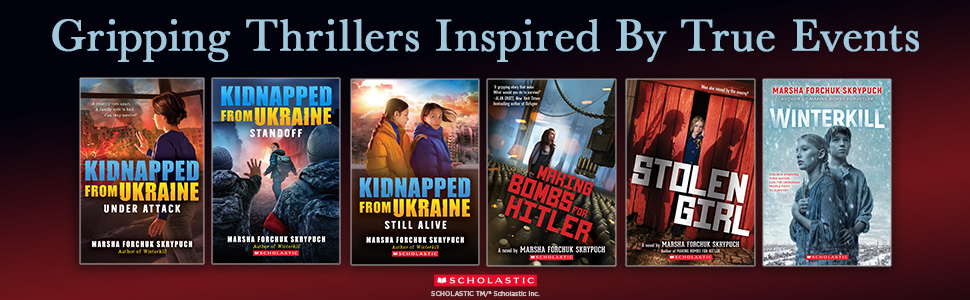
I am absolutely thrilled to be on the Forest of Reading list in two categories this year.

Making Bombs for Hitler has been shortlisted for the Silver Birch Fiction Award, and Last Airlift: A Vietnamese Orphan’s Rescue from War has been shortlisted for the Red Maple Non-fiction Award.

The Forest of Reading program is the hugely successful readers’ choice program run by the Ontario Library Association. In my opinion, the Forest of Reading has done more to promote a passion of reading in kids than any other program in the country.

It takes a massive number of volunteers to manage the various committees. For example, there is a selection committee for each of the Forest of Reading categories. The volunteers must read hundreds of books over the course of a year and then narrow down their selection to a mere ten in each category.  There is also a steering committee for each category, and these hard-working folk have a myriad of behind the scenes things to do.

The winners are chosen by kids themselves. In order to ensure that your vote counts, make sure to register!

The Harbourfront celebrations in mid-May are amazing! Thousands of kids from all over come together to meet in person their favourite authors. We get up on stage and are cheered. This is the closest a children’s author ever gets to feeling like a rock star!

In addition to Harbourfront, there are also celebrations in Parry Sound, Thunder Bay, and North Bay!

Dare I admit that I don’t care who wins? Being shortlisted means getting to participate in all the fun! Congratulations to all of my fellow nominees. Let the party begin!