The Brant News
by Colleen Toms
November 24, 2011
Flipping through the pages of Brantford author Marsha Skrypuch’s newest book, The Last Airlift, Tuyet Yurczyszyn points to a black and white photograph.
The picture shows numerous children, including babies strapped into cardboard boxes, sitting in the belly of a Hercules aircraft.
An arrow with the name Tuyet points toward a young girl.
“That’s me right there,” Yurczyszyn said.
Skrypuch’s latest novel, her first non-fiction work, chronicles the story of Yurczyszyn’s journey to Canada as one of 57 Vietnamese orphans rescued from the city of Saigon during the Vietnam War.
Eight years old and walking with a limp as a result of polio, she was one of the oldest children in her Saigon orphanage. Her age and limp marked her as “unadoptable.”
That all changed when a Brantford couple turned up at Surrey Place in Toronto. For the first time she could remember, Yurczyszyn was part of a family. She was about to head to her new home.
The Last Airlift is an uplifting story geared toward readers in Grades 4 to 8. Skrypuch said the book not only offers insight into the fate of children in war, but also how people can overcome seemingly insurmountable obstacles.
“Whether they are children or adults, we see people walking around but we don’t know what people have gone through or what they have gone through to become Canadians,” she said. “Every single one of us has something to make them feel that they are different. With this story, the reader can have more empathy for other people.”
Upon her arrival to Canada, Yurczyszyn discovered her first blade of grass, stars in the night sky and a bed of her own. More importantly, she discovered what it was like to be part of a family with a real mom and dad.
“There were mostly nuns at the orphanage, not males so much,” she said. “I remember thinking it’s a really great feeling, like I belong to somebody now. The only thing was, my fear was always that I was going to be sent back, that I wasn’t good enough.”
Enjoying a traditional Vietnamese meal at Quan 99, Skrypuch was preparing to interview Yurczyszyn about her life growing up in Brantford as the newest daughter of John and Dorothy Morris. It will become a sequel to The Last Airlift.
“It was after interviewing Dieu and Hung Nguyen (the owners of Quan 99) in the early 1990s that first sparked my interest in Vietnamese-Canadian stories,” Skrypuch said. “It was an odd thing for Tuyet to have her childhood recorded in other people’s history. I am thankful to have been able to give that back to her.”
Yurczyszyn is now happily married to husband Darren and has two children, Luke and Bria.
Here I am with Tuyết, Tuyet, and Thi Mai at the Last Airlift book launch in Toronto on November 15th — three of the girls who in 1975 were airlifted out of Saigon in the Last Airlift.
Fans of Marsha Forchuk Skrypuch’s books will know her most recurring themes are the effects of war on children and her young protagonists’ struggles to find family and home in the wake of it. In her first nonfiction YA title, Skrypuch explores these areas of human ferocity and need once again, but this time readers experience the story through the eyes of Son Thi Anh Tuyet, the girl who actually lived it.
Rather than using the first-person point of view that is common to memoir, Skypuch has settled on a third-person narrative to tell Tuyet’s story. Here, the choice serves to echo some of the isolation and estrangement Tuyet feels, while the real and telling details obtained by the close collaboration between the author and the now-adult Tuyet pull the reader into the emotional upheaval the child Tuyet has to deal with every day.
It is 1975, and Tuyet is eight-years-old. She is housed in an orphanage in Saigon, South Vietnam. She can’t recall a time before she lived there. Inside the orphanage, she can hear helicopters and airplanes, and bombs going off. But she can’t see them because the children are not allowed to go outside, ever. Outside, the Vietnam War is going on.
Then, in April, Saigon falls to the Viet Cong, and Tuyet is thrust headlong into a journey she does not understand and of which she is even more afraid than she had been of the war and her life in the orphanage.
In the world the eight-year-old knows, only perfect children are adopted or kept alive. Tuyet is imperfect. Polio has ruined her left leg and foot. So, she has been vigilant to find ways to make herself useful enough that the nuns who run the orphanage have let her stay and have given her food. But now she is removed from the relative safety of the system she has so carefully worked out. She does not know where she’s going, or why, or what will happen when she gets there.
On each leg of the long and exhausting journey, there are new challenges and terrors Tuyet must overcome. Young readers will find themselves riding an emotional roller coaster with her as she is taken away by strangers who speak a language unintelligible to her and put aboard a van, and then an airplane filled with screaming babies. Readers will learn what she endures as she loses everything she knows, or attaches to, including the only two friends she has ever had. Nor does her ordeal end when the airplane touches down in a foreign land called Canada. But along the way, her courage and resourcefulness allow her, and her readers, to carry on.
Overall, the 24 black and white illustrations serve to increase readers’ understanding of Tuyet’s journey as she experienced it. The tanks (ill. 2 1) and the photos of the babies (ill. 3 1) and the children (ill. 4 1) inside the plane give readers a clear sense of urgency and exhausting nature of the airlift rescue scheme, while photos of Tuyet, including her arrival in Toronto (ill. 4 4), and the Morris family photo (ill. 6 2) clearly show the strain and sorrow suffered by the little girl and her clinging to the man she is still afraid might send her back to her war torn country. In the end, readers also clearly see a transformation taking place (ill. 10 1 with Linh and ill. 10 2).
Some of the illustrations caused a disruption in the flow of Tuyet’s story and might have been better placed in the endnotes. Examples are: the pilot (ill. 4 3), which shows a calm looking man readers have not gotten to know, and the care workers with other children (5 1), which lifts readers out of Tuyet’s story.
Documents, such as the birth certificate (1 1), and the adoption order (6 1), which, as it’s placed, gives away the future and reduces the tension the author is trying hard to maintain, might also be better in the endnotes.
The author’s endnotes serve to clarify another sticking point for this reader, which was that apparently neither the nuns at the orphanage nor any of the adults Tuyet met during the journey who spoke her language (and there were some) took time to sit down with the terrified girl and explain what was happening. But there is a credible explanation for that blank spot. The historical note brings readers up-to-date and lays the facts of why Tuyet’s journey was so necessary on the line.
Last Airlift is the story of an heroic deed, of one young girl’s courage and resourcefulness when she most needs it, and of the ending she could not foresee.
Highly Recommended.
Jocelyn Reekie is a writer, editor and publisher in Campbell River, BC.
1. Push forward, not back. Ie, don’t worry about grammatical errors, spelling mistakes, gaps in logic etc during that frantic first draft. Once it’s down on the page, don’t look back. Revision can come after you’ve written “the end”.
2. Write for at least an hour at a time during NaNoWriMo but do not write to the point of exhaustion on any given day. There is a sweet spot for the imagination and it comes between one and five hours. If you write more than that in a day, you’re likely writing gobbledegook. Find your sweet spot and don’t write beyond it.
3. When you stop writing for the day, stop in the middle of a paragraph. Stop in the middle of a sentence. Better yet, stop in the middle of a word that’s mid paragraph. This way, when you go back to your manuscript the next day, you’ll have no trouble picking up where you left off.
4. When you are drifting off to sleep at night, force yourself to think of the scene where you last left your characters and ask yourself what are the variations of what will happen next. Go through all of the events of your character’s day the way you’d normally be going through your own. By doing this, you can train yourself to dream-problem-solve the next chunk of your novel.
5. If you write yourself into a corner, try switching to another character’s point of view. Or just leave that scene behind and start something new on a totally different day and scenario for your character. Have your character do something mundance like the laundry or picking up a prescription from the drug store. Soon your head will fill back up with ideas and you’ll be clipping along again.
Marsha at Brier Park school with Tuyet and her children, photo by Wendy Oliver, Expositor
An uncanny number of coincidences brought author Marsha Skrypuch and Tuyet Yurczyszyn together five years ago.
Skrypuch had long been interested in writing a book about Vietnamese immigrants. She had written, more than 20 years ago, an article about Vietnamese boat people for a local historical publication and their stories stuck with her.
She had read many newspaper accounts of operations to rescue South Vietnamese children from orphanages before the fall of Saigon and the capture of the capital city by the Viet Cong and the North Vietnamese, which ended the war there.
The Last Airlift, the title of Skrypuch’s new book, was the last rescue operation to arrive in Canada. Among the 57 babies and children on the flight, sponsored by the Ontario government, was eight-year-old Son Thi Anh Tuyet.
Thinking the story of this flight, part of a mass evacuation of thousands of children to various countries in April of 1975, had the makings for a book, Skrypuch began contacting the orphans that had been rescued.
But, she said, all had been babies while aboard this last airlift into Canada and had no memories of the experience.
It was then that she discovered Son Thi Anh Tuyet, now Tuyet Yurczyszyn, living in Brantford, just a few miles from her own home.
In another strange turn, Yurczyszyn had attended Brier Park Elementary School, where Skrypuch’s son had been a student and where the author had some of her earliest experiences as a writer, conducting volunteer workshops in classrooms. Yurczyszyn’s own children, 13-year-old Luke, and Bria, 11, are current students at Brier Park.
“It was meant to be,” said Yurczyszyn on Wednesday as she and Skrypuch gave Brier Park students a sneak peek of Last Airlift: A Vietnamese Orphan’s Rescue from War.
The book will be officially launched at the school next Wednesday at 7 p.m.
Skrypuch’s first version of the book was a work of fiction, drawing from the interviews of many people. At the behest of her publisher, she rewrote the book as the non-fiction account of Yurczyszyn’s early life.
The book begins in early April 2005 with a description of the conditions at the Saigon orphanage.
“Tuyet could not remember a time before the orphanage. She thought that all children lived together in a building with sleeping rooms, a play area, school, and chapel. She remembered sleeping together with the older girls on a wood-slat floor, without blankets or pillows. In the morning, she would line up with the other girls. One of the nuns would rip bread from a giant loaf and give a piece to each child.”
Yurczyszyn said she has no memory of her father and thinks a woman who visited her a couple of times at the orphanage may have been her mother, but she’s not sure.
Her life changed on April 11, 1975, when the doors of the orphanage opened and a white Volkswagen van screeched to a halt. Rescuers had arrived to transport the children to the airfield. Nuns worked frantically to pack up the babies and supplies and load them into the vehicle. Young Tuyet was surprised to learn she’d be going, too. She had given up hope of leaving the orphanage after a bout of polio withered her left leg and she was deemed “not adoptable.”
Although she was just eight, she said she remembers the terror she felt as she was shuttled out into the streets. The sound of gunfire was everywhere as hysterical South Vietnamese civilians tried to flee the city.
“I thought it was the Viet Cong coming to take us away, not nice soldiers coming to rescue us,” said Yurczyszyn.
Aboard the Hercules aircraft, babies were loaded into cardboard shoeboxes and strapped down with duct tape. Outside the windows, Yurczyszyn could see smoke billowing from a huge rescue aircraft that had crashed into a rice paddy just days before, killing 138 passengers, including 78 children.
Several flights later, Yurczyszyn arrived first in Vancouver and then Toronto, where she spent a couple weeks at a rehabilitation facility called Surrey Place.
A story printed in the April 23, 1975 edition of The Expositor appears under the headline, Viet orphan joins city family. John and Dorothy Morris of Brantford had applied about three weeks before to adopt a Vietnamese orphan and were told just three days before picking up Tuyet that she would be their child.
The speed with which their application was processed may have been due to the Morris family having already adopted two other children, one from Vietnam and another from Bangladesh.
Yurczyszyn said her adoptive parents were wonderful. Her father died in 2006 and her mother continues to live in the city. Both Yurczyszyn and Skrypuch dedicated the book to the couple.
Yurczyszyn, who still lives in the house where she grew up, said her story was difficult to tell, and for her children to read.
“I cried a lot when she asked certain questions,” she said of her many meetings with Skrypuch.
The award-winning Brantford author has enjoyed success with novels that tell people’s “coming to Canada stories.
“You pass people on the street and you have no idea what they had to do to make their life possible.”
Skrypuch plans to continue Yurczyszyn’s story in a second book that will recount the woman’s “childhood in Brantford, the challenges of being a new Canadian, a visibility minority with a disability, and being adopted.
“She is my hero,” the author said.
Yurczyszyn said she felt “honoured and blessed” when she first held Last Airlift in her hands this week.
“It was a struggle,” she said of her life so far. “But I couldn’t have asked for a better ending.”
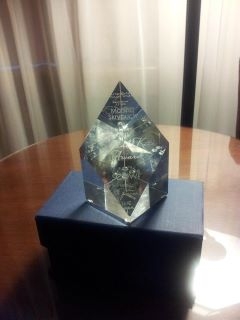
Lizann Flatt presented me with this beautiful award at the Ottawa SCBWI conference this past weekend.
All awards are of course wonderful, but peer award is special. And this one comes with its own pair of cotton gloves!
Stolen Child was selected as the SCBWI members’ choice for juvenile novel in the Americas (Canada, Panama, South America and Mexico). A stunning honour.
I finished the first draft of Making Bombs For Hitler in February and I’ve gone through two substantive edits since then. It is scheduled to be published by Scholastic in 2012. That first draft took four intense months. The edits were easier, thanks to SB, my fabulous editor!
Many people are daunted at the prospect of writing historical fiction. Here are some suggestions on how to begin:
Do preliminary research of the era you want to write about and try to imagine yourself living in that time. Non-fiction children’s books are a great preliminary research tool. Also encyclopedias and textbooks. At this stage you just want to gather enough background to get the general lay of the land.
In order to come up with a premise for a novel, ask yourself: What would happen if…
Think in terms of a dilemma for a person in your historical era.
As an example, for my 2008 Armenian genocide novel Daughter of War, the question was: If you were pregnant by rape but survived a genocide, would you want your fiance to find you?
If you can’t boil your novel idea down into a question like that, it’s too unwieldy a concept.
Do an outline. I hate outlines, but it is amazing what you can pre-organize by doing a one or two page point form plotting of your entire novel.
Try writing a sample chapter or two. This will help you narrow down the point of view, as well as voice and tone.
After you’ve done the outline and initial chapters, do more research.
Do read memoirs, diaries, newspaper articles, recordings, interviews, maps, city directories of your era. Look at photographs. If people are still alive, talk to them.
Do not read novels set during your era. If you do that, you may unconsciously pick up inaccurate bits, or you could unwittingly copy the author’s style or turns of phrase.
Try to get opposing points of view of the same situation. As an example, when I was researching Daughter of War, I consulted both Armenian and Turkish memoirs, as well as those of missionaries and medical personnel of the time. Inter-library loan and abebooks.com are great resources for this sort of item.
Over-researching is great procrastination technique. Not only do you waste time, but you’ll also be tempted to use everything you learn, which makes for a very boring novel.
I like to do commando research — ie — only as much as I’ll need for the next 20 pages or so. When I dry out, I do more research.
Now start writing!
Think in terms of scenes. You don’t have to write the story in order. I like to start with the scene that is most vivid in my imagination. As I write each scene, I decide whether it comes before or after that first one. As the writing continues, the story develops like raindrops forming a puddle. Don’t worry about sticking to your outline. Let your characters take you to new places.
Goal one is to get the first draft finished.
Set yourself a schedule. It might be to write one new page a day, or maybe to write just one new paragraph a day. I like to write one scene a day. Butt in chair (or feet under tread desk) and get those words out. Don’t get up (or get off) til your goal is achieved.
Don’t give in to excuses. The most lame one is that you’re too busy to write. Writing can be done in a steno pad while waiting in line at the grocery store or watching your kids play baseball, or on the subway. My favourite writing place is at an airport.
Do not keep going back to page one in an attempt to make it perfect. That is just a procrastination technique. First drafts aren’t supposed to be perfect.
Once you finish your first draft reward yourself!
It is a huge achievement to be able to write The End. Go to the movies, Eat chocolate. Drink wine.
Let that first draft cool off for a couple of days before looking at it again. Once you’ve given your brain a chance to clear, print your draft and read it aloud, carefully, a few pages at a time. You will be amazed at what you can catch when you speak your words and read them on paper instead of the screen.
There are many more steps to revision, but that’s another post.
Last Airlift is the true story of the last Canadian airlift operation that left Saigon and arrived in Toronto on April 13, 1975. Son Thi Anh Tuyet was one of 57 babies and children on that flight. Based on personal interviews and enhanced with archive photos,Tuyet’s story of the Saigon orphanage and her flight to Canada is an emotional and suspenseful journey brought to life by the award-winning children’s author, Marsha Skrypuch. Continue reading “Last Airlift: A Vietnamese Orphan’s Rescue from War By Marsha Skrypuch”