Do a brainstorming exercise. Get a piece of paper and write down the names of the two key players.
Ask yourself such things as:
What does this person love? Want? Need?
What bad habit does this person have?
What secret?
What shame?
Something that would make others hate them
Write all of this down on your bit of paper.
Now go to a fast food restaurant and get an application form (or two). Try to fill the application out as if you were one of those characters. You’ll be surprised at what they tell you.
Now think of the relationship between your two key characters. Think of each of their wants/needs/loves. How do they interact? If one character achieves a want/need/love, does that mean the other character loses the same? That is a story.
Now set that all aside and write a simple scene with one of these characters. Don’t try to do too much with it. Show the character involved in a daily task. Give the character the opportunity to reflect on things and react to things. It is what happens inside that most counts, not the outer journalistic stuff. Readers want to step inside a character’s head and live that person’s life for awhile. Your job is to enable that.
Once you’ve written that scene, ask yourself “and then what happens?” Write that. When you write yourself into a corner, try stepping into the head of your other key character. Repeat.
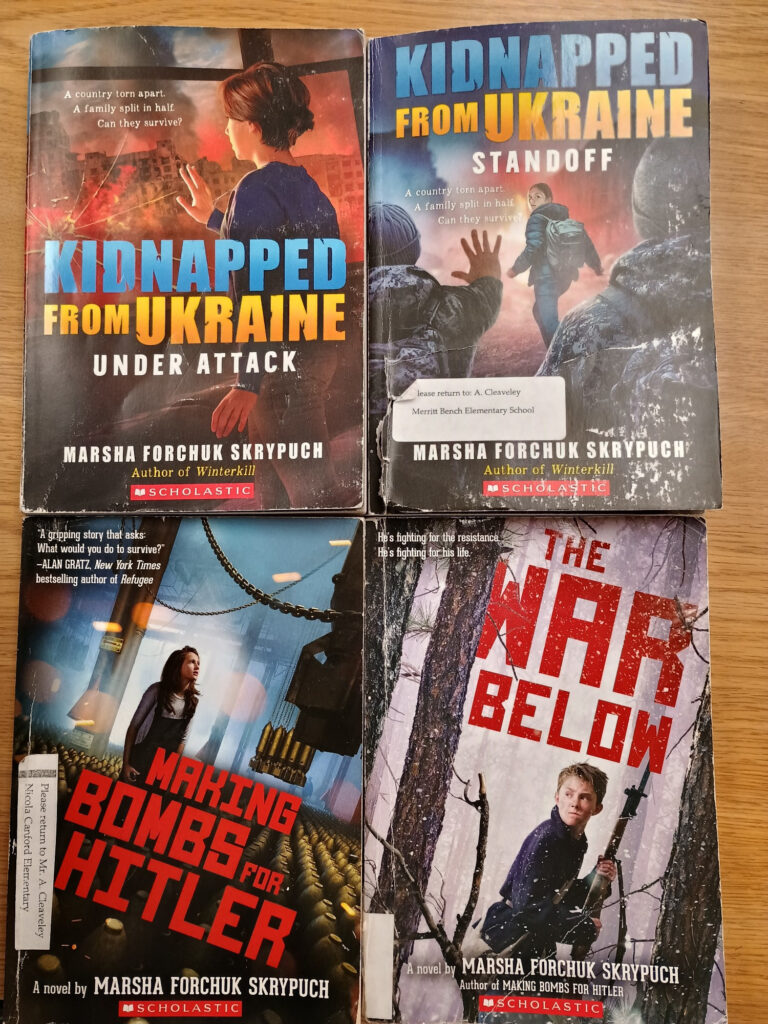
I finished the first draft of Making Bombs For Hitler in February and I’ve gone through two substantive edits since then. It is scheduled to be published by Scholastic in 2012. That first draft took four intense months. The edits were easier, thanks to SB, my fabulous editor!
Many people are daunted at the prospect of writing historical fiction. Here are some suggestions on how to begin:
Do preliminary research of the era you want to write about and try to imagine yourself living in that time. Non-fiction children’s books are a great preliminary research tool. Also encyclopedias and textbooks. At this stage you just want to gather enough background to get the general lay of the land.
In order to come up with a premise for a novel, ask yourself: What would happen if…
Think in terms of a dilemma for a person in your historical era.
As an example, for my 2008 Armenian genocide novel Daughter of War, the question was: If you were pregnant by rape but survived a genocide, would you want your fiance to find you?
If you can’t boil your novel idea down into a question like that, it’s too unwieldy a concept.
Do an outline. I hate outlines, but it is amazing what you can pre-organize by doing a one or two page point form plotting of your entire novel.
Try writing a sample chapter or two. This will help you narrow down the point of view, as well as voice and tone.
After you’ve done the outline and initial chapters, do more research.
Do read memoirs, diaries, newspaper articles, recordings, interviews, maps, city directories of your era. Look at photographs. If people are still alive, talk to them.
Do not read novels set during your era. If you do that, you may unconsciously pick up inaccurate bits, or you could unwittingly copy the author’s style or turns of phrase.
Try to get opposing points of view of the same situation. As an example, when I was researching Daughter of War, I consulted both Armenian and Turkish memoirs, as well as those of missionaries and medical personnel of the time. Inter-library loan and abebooks.com are great resources for this sort of item.
Over-researching is great procrastination technique. Not only do you waste time, but you’ll also be tempted to use everything you learn, which makes for a very boring novel.
I like to do commando research — ie — only as much as I’ll need for the next 20 pages or so. When I dry out, I do more research.
Now start writing!
Think in terms of scenes. You don’t have to write the story in order. I like to start with the scene that is most vivid in my imagination. As I write each scene, I decide whether it comes before or after that first one. As the writing continues, the story develops like raindrops forming a puddle. Don’t worry about sticking to your outline. Let your characters take you to new places.
Goal one is to get the first draft finished.
Set yourself a schedule. It might be to write one new page a day, or maybe to write just one new paragraph a day. I like to write one scene a day. Butt in chair (or feet under tread desk) and get those words out. Don’t get up (or get off) til your goal is achieved.
Don’t give in to excuses. The most lame one is that you’re too busy to write. Writing can be done in a steno pad while waiting in line at the grocery store or watching your kids play baseball, or on the subway. My favourite writing place is at an airport.
Do not keep going back to page one in an attempt to make it perfect. That is just a procrastination technique. First drafts aren’t supposed to be perfect.
Once you finish your first draft reward yourself!
It is a huge achievement to be able to write The End. Go to the movies, Eat chocolate. Drink wine.
Let that first draft cool off for a couple of days before looking at it again. Once you’ve given your brain a chance to clear, print your draft and read it aloud, carefully, a few pages at a time. You will be amazed at what you can catch when you speak your words and read them on paper instead of the screen.
There are many more steps to revision, but that’s another post.
A reader emailed me today with a question that all writers get asked all the time, but this reader was so polite and thoughtful by the way he asked, that I’m sharing both Q and the A:
Q:
Dear Marsha,
I really enjoy your books. I’m currently reading “The War Below,” and I really admire your writing. You make your work come alive, and I can visualize every little bit in my head.
I have considered writing a novel of my own, and I’ve decided I am going to do it. But there is one problem, and that is that I cannot think of an idea.
Did you ever experience writer’s block? If you did, I was wondering how you thought of ideas. I would really love your help.
Thank you very much, and I love your work.
A:
Dear __,
A really good way of getting ideas is by talking to people about their lives. I asked a lot of questions of all of my grandparents, my parents and my husband’s parents. That kickstarted a lot of my stories. I also ask a lot of questions when I meet someone new. I want to know what it would be like to be them. To be a writer, you need to be able to step into another person’s (actually, many different people’s) shoes and figure out what it would be like to be them on a day to day basis.
You generally can’t just start asking a total stranger to tell you everything about them, but you’ll be amazed by what you learn by asking open ended questions and just listening. People who have lived through war or trauma often have a world of story bottled up inside but you can’t just come out and ask them. I like to get around it sideways. For example, if I’m talking to someone much older than myself or from a different cultural background, I ask them something about their past that will evoke a comfortable memory, like the first day of school, or a memorable celebration. Their anecdotes about that can give you ideas for other questions.
That’s not all there is to writing a book, but that’s a way to get some ideas. You may have noticed that a lot of writers are not big talkers, and that’s because they’re asking questions and listening.
There are lots of bad habits that can mess up a manuscript, but here are three that often show up in early drafts.
ONE: Exclamation marks
Don’t use them.
You can always go back and sprinkle some in later but try to get away with as few as possible. They are a crutch and each time you use one their effect is diminished. Avoiding them will force you to be a better word-selector.
TWO: Fancy and extended dialogue tags
Don’t laden your dialogue tags with description, (ie she said angrily as she took a sip of her hot cider). The words you put in your character’s mouth should imply the power of their wants/needs/loves/hates and the dialogue itself is implicit action, or SHOWING, whereas dumping info into the dialogue tag is by definition TELLING — and should be avoided.
A quick way of cleaning up about 60% of this is to do a global search on “ily” because you’ll find a lot of the adverbs that way and adverbs are all about telling. Trust your power of good dialogue and avoid the temptation of second-guessing yourself by adding into the dialogue tag what you already make clear with your choice of words and tone in what your characters say. Less is more.
THREE: Dialogueinstead of scenes
Do you have pages of solid dialogue? This is a red flag for action that happened in the past. If you find sections of your story that are almost entirely dialogue, check it to see if you’re using dialogue as a scene avoidance technique. While conversation is nominally action, over dependence on dialogue is a way to unconsciously avoid writing a scene.
Every paragraph in a story should include at least one powerful action event. Don’t waste action potential on a scene with two heads yakking at each other after the fact. Plunge your scene in the middle of the action, and then chase your characters, keyboard in hand. Your readers will thank you for that.
Congratulations on being such an avid reader and writer. That’s wonderful! As to the process of having a book published, it is a long and complicated thing. If you google how to get a book published you will encounter all sorts of scammers who just want to steal your money with the end result that your book might get printed, but that’s not the same as getting published. The difference is this: anyone can write a story and get the story printed and bound into book form, but the only people who would ever read that are the people you give it to. When a book is published, the writer crafts a unique story with wide appeal that a publisher (which is a category of business) buys and the publisher has the author work with editors to make the story even better. That part of the process alone can take several months. The publisher also works with marketing people and designers etc etc, and then gets a printing company to do the actual manufacturing of the book. The publisher also sends out advance review copies of the book to reviewers across the country. They read the book and then give it a rating and they write a review of it and those reviews get published in various places and readers read those reviews and it makes them decide whether they want to buy the book or not. The author doesn’t pay for any of that to happen and they’re really not involved in the business end of it. The author gets paid. How much? On a $10 book, an author would be paid $1. So the way to have an income as an author is to write a book that a ton of people will buy. Publishers are very picky about the books they publish because it’s such a complicated and expensive process for them. In fact, a publisher might get thousands of people sending them book manuscripts in a year and they only publish one out of maybe 10,000.
To put it another way, what if you were interested in being a veterinarian? No matter how gifted you were in science, you still wouldn’t do surgery on a dog, right? You still need all the training. It’s the same thing for being an author. There are lots of people who are talented in writing, but they still need the training.
My advice to you is to take your time and learn about the craft of writing now, rather than trying to get published right off the bat. A good way to prepare yourself to be an author is to read widely, which I know you’re already doing. Set yourself a goal of reading 1000 books in the same genre as what you’d like to write. I know that sounds daunting, but reading widely is the way to expose yourself to all sorts of story techniques and give yourself ideas of what may work for you. It’s a pathway for you to develop your own unique writing voice. People who haven’t read widely risk sounding like the last author they read.
The other thing to do is to write every day, which I suspect you’re also already doing. Keep up the good work! Just like a marathon runner trains for a race by running, an aspiring author trains by writing.
If you get your whole book written, the next thing to do is join a critique group where others who are writing books give you feedback on your story and that helps improve it. Writers need to be humble and to realize that they can always improve. It’s a hard profession.
I knew I wanted to be a writer since I was in 4th grade and I wrote my first novel in 8th grade but my first book wasn’t published until I was 42 years old. I did have other stuff published before that though. For example, I was the editor for the school yearbook in 8th grade and wrote for the high school newspaper and was a freelance writer for newspapers and magazines before writing books. I also went to college and did a bachelor’s degree in English Literature and a master’s degree of Library Science. When publishers look at manuscript submissions, they also look at the writer’s background. They are more likely to be interested in a story written by someone who has been published before and who takes their writing so seriously that they study in college to improve themselves, so taking these steps at the beginning can lead to long time success.
I run a private online crit group where participants “pay” by giving critiques in order to get them from other participants. Recently, one participant posted this question after my feedback on her work-in-progress
Question: I’m not sure if I totally understand something you advised me on. You said, “No second stage directions in one sentence.” an example of this is when I wrote a triple stage direction: “Maria crossed herself, picked up her spoon and said X”
Why, Marsha is 2 or 3 stage directions not to be done? Is it because it is “over-writing?” I looked that term up and I think that is why you advised this. And yet, in novels it seems common to do multiple stage directions. For example: “Laila kneeled before her mother and took her hand.” “He coughed, cleared his throat.” “He hunkered down, pulled her to him, and held her for a long time.“
Answer: It’s overwriting when the actions aren’t necessary to move the scene forward.
The examples you posted from published books are not equivalent to the example from your own work. Maria crossing herself, picking up a spoon and saying something are not three significant actions. One of those actions will move the story forward with fewer words and in a less distracting way.
In this example: “Laila kneeled before her mother and took her hand.”
Both of Laila’s actions are separate and significant. If you took one of them out, the meaning would change. The writer has used an economy of words and action to progress the story. It’s a beautifully pared down sentence that’s infused with action and emotion.
An overwritten version of the above would be: Laila smoothed the wrinkles out of her skirt, then looked into her mother’s blue eyes. She knelt down onto the small embroidered cushion at her mother’s feet, then reached out and took her mother’s hand.
In this example: “He hunkered down, pulled her to him, and held her for a long time.”
Again, the actions are quite separate and vivid with an economy of words. You couldn’t remove any of the actions and have the same progression of story. And again, this is a beautiful sentence, infused with meaningful action. Actually three significant actions, vividly shown, in just 14 words.
I finished the first draft of Making Bombs For Hitler in February and I’ve gone through two substantive edits since then. It is scheduled to be published by Scholastic in 2012. That first draft took four intense months. The edits were easier, thanks to SB, my fabulous editor!
Many people are daunted at the prospect of writing historical fiction. Here are some suggestions on how to begin:
Do preliminary research of the era you want to write about and try to imagine yourself living in that time. Non-fiction children’s books are a great preliminary research tool. Also encyclopedias and textbooks. At this stage you just want to gather enough background to get the general lay of the land.
In order to come up with a premise for a novel, ask yourself: What would happen if…
Think in terms of a dilemma for a person in your historical era.
As an example, for my 2008 Armenian genocide novel Daughter of War, the question was: If you were pregnant by rape but survived a genocide, would you want your fiance to find you?
If you can’t boil your novel idea down into a question like that, it’s too unwieldy a concept.
Do an outline. I hate outlines, but it is amazing what you can pre-organize by doing a one or two page point form plotting of your entire novel.
Try writing a sample chapter or two. This will help you narrow down the point of view, as well as voice and tone.
After you’ve done the outline and initial chapters, do more research.
Do read memoirs, diaries, newspaper articles, recordings, interviews, maps, city directories of your era. Look at photographs. If people are still alive, talk to them.
Do not read novels set during your era. If you do that, you may unconsciously pick up inaccurate bits, or you could unwittingly copy the author’s style or turns of phrase.
Try to get opposing points of view of the same situation. As an example, when I was researching Daughter of War, I consulted both Armenian and Turkish memoirs, as well as those of missionaries and medical personnel of the time. Inter-library loan and abebooks.com are great resources for this sort of item.
Over-researching is great procrastination technique. Not only do you waste time, but you’ll also be tempted to use everything you learn, which makes for a very boring novel.
I like to do commando research — ie — only as much as I’ll need for the next 20 pages or so. When I dry out, I do more research.
Now start writing!
Think in terms of scenes. You don’t have to write the story in order. I like to start with the scene that is most vivid in my imagination. As I write each scene, I decide whether it comes before or after that first one. As the writing continues, the story develops like raindrops forming a puddle. Don’t worry about sticking to your outline. Let your characters take you to new places.
Goal one is to get the first draft finished.
Set yourself a schedule. It might be to write one new page a day, or maybe to write just one new paragraph a day. I like to write one scene a day. Butt in chair (or feet under tread desk) and get those words out. Don’t get up (or get off) til your goal is achieved.
Don’t give in to excuses. The most lame one is that you’re too busy to write. Writing can be done in a steno pad while waiting in line at the grocery store or watching your kids play baseball, or on the subway. My favourite writing place is at an airport.
Do not keep going back to page one in an attempt to make it perfect. That is just a procrastination technique. First drafts aren’t supposed to be perfect.
Once you finish your first draft reward yourself!
It is a huge achievement to be able to write The End. Go to the movies, Eat chocolate. Drink wine.
Let that first draft cool off for a couple of days before looking at it again. Once you’ve given your brain a chance to clear, print your draft and read it aloud, carefully, a few pages at a time. You will be amazed at what you can catch when you speak your words and read them on paper instead of the screen.
There are many more steps to revision, but that’s another post.
I’m wondering if you would clarify something for me about your approach to writing. On your web site, in your critiques of others, and again with your advice on my last posting, you come down pretty hard against dialogue. I can see why in many cases. A lot of us have the habit of using dialogue in place of exposition, and it ends up sounding wooden and slowing down the story. That’s one of my biggest challenges, I think.
But it seems to me that there is another type of dialogue — one that is in itself the action. If two people are having a verbal disagreement, that’s action. If someone is threatening someone, that’s action. So long as you keep the dialogue on the matters of the here-and-now, and resist the temptation to use it for backstory, isn’t it part of a “scene” rather than “exposition” or “narrative”?
What are your thoughts on this?
Here’s my answer:
Of course dialogue can be in an action scene and it can be used to progress the action. That’s not how you’re using it. If you did a point form list of the actions your character makes during the dialogue, you’ll see that they’re talking heads.
I have taught many writing workshops in addition to what I do here and there is a distinct pattern in the progression of writers who are working on first novels. Here’s what I’ve noticed:
1. Talking head syndrome.
The over-reliance on dialogue indicates to me that the writer hasn’t mastered some of the other techniques for story progression. I’ve seen dialogue being used instead of an action scene, instead of a flashback (which is essentially an action scene), and most commonly, I’ve seen dialogue used to tell backstory. My five word rule for dialogue on my website is a measuring tool. I posted that so that people could check their own dialogue and see whether they were doing this stuff or not.
2. Unclear point of view.
This can be head-hopping, where the narration meanders between a number of people in the room, or it can be a narration from several people at once — “we did….”. First person is the most immediate and the one that first novel writers gravitate towards but it is also the most difficult one to pull off effectively. A third person intimate perspective is very close to first person, but it gives you the ability to change points of view in alternating chunks when you need to — ie — writing a chapter from someone else’s point of view. This can also be done with two first person Ps of V, but is harder to pull off and perhaps shouldn’t be attempted until a subsequent novel.
3. Beginning a story with backstory rather than plunging into action.
Writers have all sorts of interesting snippets of research and background material on their characters and stories and there is a great temptation of sharing all of that with the reader. Only 2% of what you want to be in your story should end up in your story. The writer will know the rest, but will keep it and dole out snippets like gold. But there is this tendency in first novel writers to want to start way too early in a story, or give a prologue which is another form of backstory.
4. Giving too much information.
A painting with some canvas showing through is more intriguing that a photographic rendering of a subject. In the same way, a story is more intriguing by what you hold back as much as by what you show. That’s what causes pull and mystery. No matter what the genre, there has to be something there to propel the reader to want more.
5. Undeveloped characters.
Each person in a story must be unique within themselves. A key indicator that they’re not is when there is that “we” POV. What makes a character distinctive? Their inner life. Their thoughts and desires. For every character, you must know what they want, what they love and what they need. A story is all about one character’s wants/loves/needs clashing with another character’s wants/loves/needs.
6. Lack of precision in concrete detail.
And by this I don’t mean than one should list everything in a room, or what a person is wearing or what a person looks like. One small unique item can say so much about a character or circumstance. For example, who cares if someone has blue eyes? Is that a character trait? But if a person’s thumbnail is bitten down to the quick, that shows a lot about the person’s character and circumstances without the writer having to tell it.
Have you tried brainstorming about your main character? This is an exercise I teach in writing workshops and it seems to help get writers out of a rut. Basically, write down your main character’s first name and last name on a piece of paper. Do the same with a secondary character (could be someone they’re in conflict with). Then consider the following:
nickname? if yes, why? if not, why not?
what does this person love?
what do they want?
what bad habit do they have?
what do they eat for breakfast?
what kind of underwear to they wear?
where do they sleep?
what’s their job?
is there something everyone around knows them for?
etc etc
Another idea is to get a job application form and try and fill it out for your characters. What all this does is expand your thoughts about your characters and think about them in a different way. Midway through the brainstorming your mind will explode with revelations. When that happens, think about how these two character confront each other, and then write that scene.
Remember that you don’t have to write your book in a linear way. You can start any place. Do this scene, and then write what comes before and comes after and eventually you’ll catch up to what you’ve already got.
I like to take my characters through a typical 24 hour day. Much of that ends in the trash heap, but again, doing this gives you revelations.
Also, think about your setting in a minute way. What the floor looks like. Are there bugs? What are the smells, touches.
As a writer, I have found that one of the best ways of getting good feedback on works-in-progress is to join a critique group. I run a free online crit group here. The group I run is hidden from public view and to get in, one must ask for permission.
In our online crit group, we all give and get feedback on our works-in-progress. I find that doing crits teaches the critter as much as the crittee.
One of the things that I have noticed after over a decade of critting and being critted is that dialogue is often used as a crutch in early drafts. I have come up with a self-editing technique that I like to call Marsha’s 5 word rule for dialogue. Here goes:
Anytime a character says more than five words at a time, look carefully at what you’re trying to accomplish with the dialogue. Often, you’re using dialogue as:
— an information dump
— backstory
— scene avoidance
— saying something instead of showing it
— saying something you’ve already just shown
Long dialogue always slows the story down. Pare whenever possible and when necessary replace with a scene. Alternately, pare out that dialogue altogether and save that information for later on in the story. Doing so can add suspense.