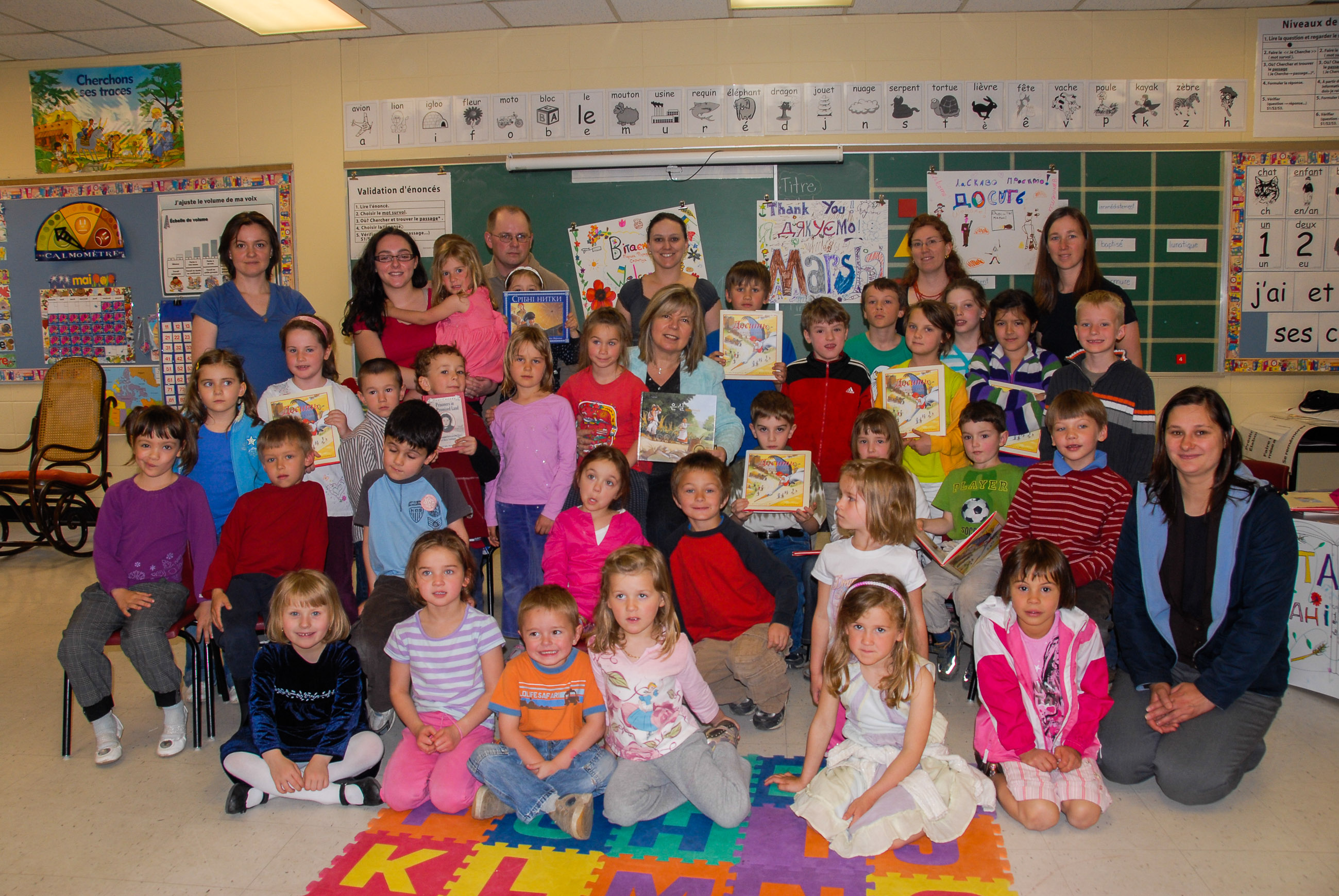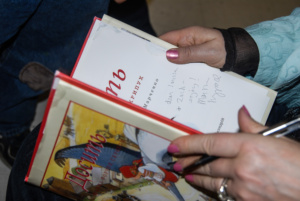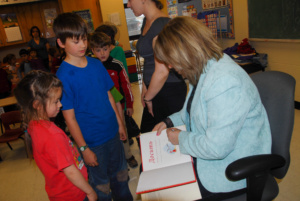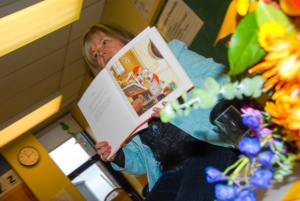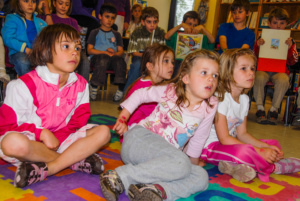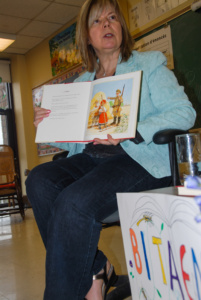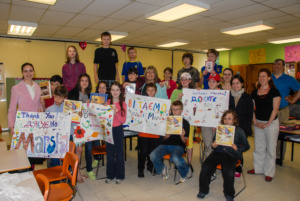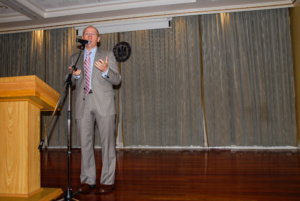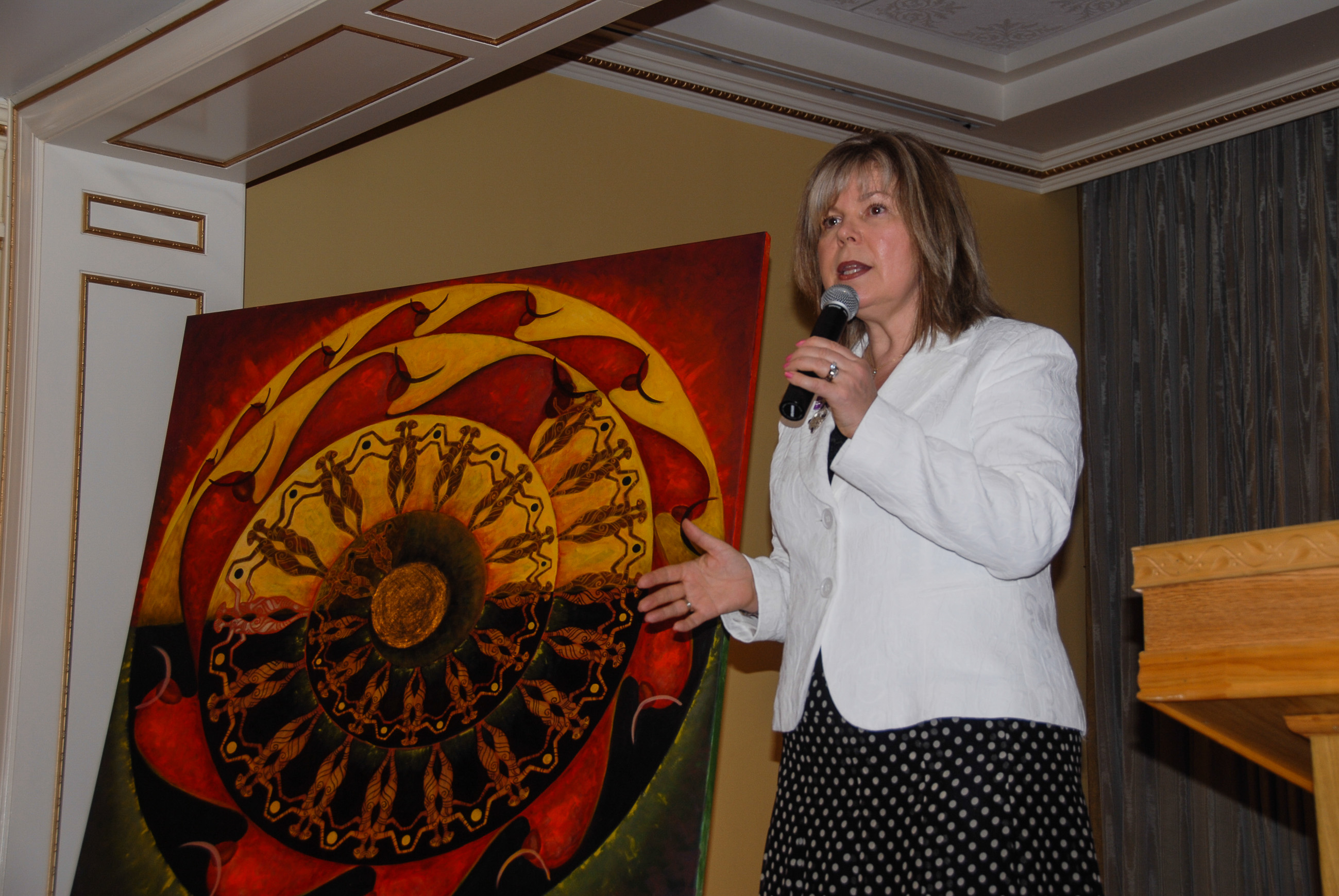
Here’s a photo of the children who were part of the audience for my presentation at the Vernon Elk’s Hall.
writes about war from a young person's view #bannedbyrussia
I’m visiting a few cities at the end of April/early May to promote my
most recent novel, Stolen Child.
Here are the public events I’ll be at. If you have the time and
inclination, please drop by and say hi!
Sunday, April 25
3PM:
presentation open to the public at:
Ukrainian Orthodox Parish Hall
1935 Barlee Road
Kelowna, BC V1Y 4S3
Monday, April 26
6:30pm
Vernon Elks Hall
3103 – 30th Street
Vernon, BC
Tuesday, April 27
6:30 PM
Ukrainian Youth Unity Complex,
9615 – 153 Avenue,
Edmonton
Thursday, April 29
7:30pm
Oseredok Ukrainian Cultural Centre
184 Alexander Avenue
Winnipeg, MB R3B 0L6
Tuesday, May 4
7:30
McNally Robinson
Saskatoon SK
The brochure for SWW 2010 is now available online here.
If you’re interested in attending, do send in your registration and cheque soon to ensure you get a spot. Anyone who has participated in kidcrit, Humber or has been to SWW before does not have to submit a writing sample. Just note that on the form.
I am thrilled with the line-up. We have kids’ publishers and adult publishers, kids’ writers and an adult writer. We also have an agent who does both. The most popular aspect of SWW are the blue pencil sessions. These are 10 minute face to face opportunities with publishers, editors and an agent. Think speed dating for writers. Every participant will have several blue pencils.
I am also thrilled that Diane Kerner, director of publishing for Scholastic Canada is presenting. She will be giving everyone who wants it a flash assessment. Ie, she’ll look at a cover letter and the first page of a manuscript and give her brutal assessment of how she would deal with it if it were a submission. People can stay anonymous, but they can put their names on their submissions if they want. She will be giving the flash assessments to everyone at once and we will all have a packet of the same submissions. This will provide invaluable insight into the submission process and also give a behind-the-editor’s-desk view of that process.
A caveat: if everyone on my tentative list of attendees does indeed attend, we will only have about 4 open spots. So send in your application asap.
A participant in my online private crit group recently asked:
I’m wondering if you would clarify something for me about your approach to writing. On your web site, in your critiques of others, and again with your advice on my last posting, you come down pretty hard against dialogue. I can see why in many cases. A lot of us have the habit of using dialogue in place of exposition, and it ends up sounding wooden and slowing down the story. That’s one of my biggest challenges, I think.
But it seems to me that there is another type of dialogue — one that is in itself the action. If two people are having a verbal disagreement, that’s action. If someone is threatening someone, that’s action. So long as you keep the dialogue on the matters of the here-and-now, and resist the temptation to use it for backstory, isn’t it part of a “scene” rather than “exposition” or “narrative”?
What are your thoughts on this?
Here’s my answer:
Of course dialogue can be in an action scene and it can be used to progress the action. That’s not how you’re using it. If you did a point form list of the actions your character makes during the dialogue, you’ll see that they’re talking heads.
I have taught many writing workshops in addition to what I do here and there is a distinct pattern in the progression of writers who are working on first novels. Here’s what I’ve noticed:
1. Talking head syndrome.
The over-reliance on dialogue indicates to me that the writer hasn’t mastered some of the other techniques for story progression. I’ve seen dialogue being used instead of an action scene, instead of a flashback (which is essentially an action scene), and most commonly, I’ve seen dialogue used to tell backstory. My five word rule for dialogue on my website is a measuring tool. I posted that so that people could check their own dialogue and see whether they were doing this stuff or not.
2. Unclear point of view.
This can be head-hopping, where the narration meanders between a number of people in the room, or it can be a narration from several people at once — “we did….”. First person is the most immediate and the one that first novel writers gravitate towards but it is also the most difficult one to pull off effectively. A third person intimate perspective is very close to first person, but it gives you the ability to change points of view in alternating chunks when you need to — ie — writing a chapter from someone else’s point of view. This can also be done with two first person Ps of V, but is harder to pull off and perhaps shouldn’t be attempted until a subsequent novel.
3. Beginning a story with backstory rather than plunging into action.
Writers have all sorts of interesting snippets of research and background material on their characters and stories and there is a great temptation of sharing all of that with the reader. Only 2% of what you want to be in your story should end up in your story. The writer will know the rest, but will keep it and dole out snippets like gold. But there is this tendency in first novel writers to want to start way too early in a story, or give a prologue which is another form of backstory.
4. Giving too much information.
A painting with some canvas showing through is more intriguing that a photographic rendering of a subject. In the same way, a story is more intriguing by what you hold back as much as by what you show. That’s what causes pull and mystery. No matter what the genre, there has to be something there to propel the reader to want more.
5. Undeveloped characters.
Each person in a story must be unique within themselves. A key indicator that they’re not is when there is that “we” POV. What makes a character distinctive? Their inner life. Their thoughts and desires. For every character, you must know what they want, what they love and what they need. A story is all about one character’s wants/loves/needs clashing with another character’s wants/loves/needs.
6. Lack of precision in concrete detail.
And by this I don’t mean than one should list everything in a room, or what a person is wearing or what a person looks like. One small unique item can say so much about a character or circumstance. For example, who cares if someone has blue eyes? Is that a character trait? But if a person’s thumbnail is bitten down to the quick, that shows a lot about the person’s character and circumstances without the writer having to tell it.
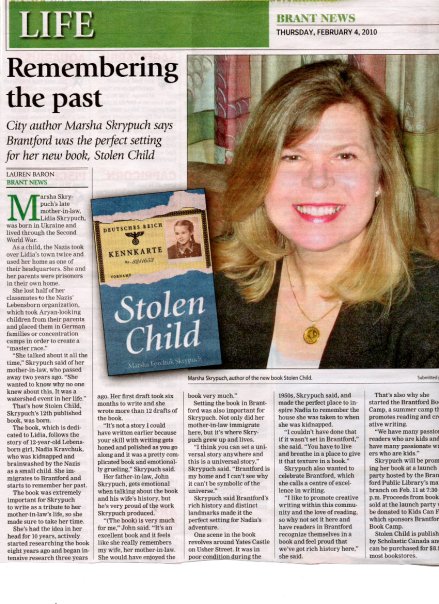
Elizabeth Yates just posted this youtube link of me reading from Stolen Child. Thank you for making this video, Elizabeth!
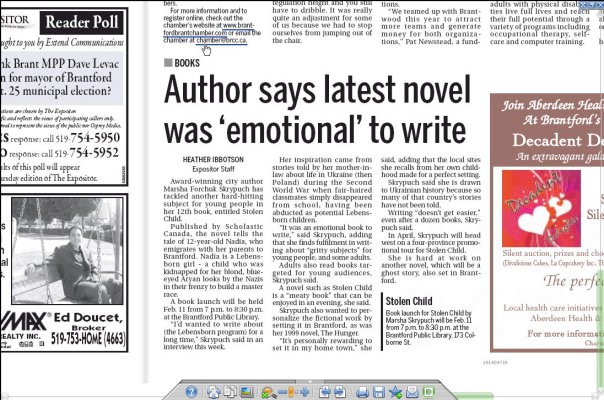
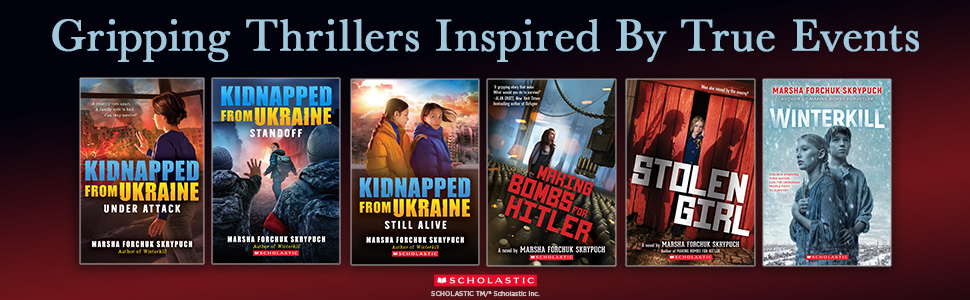
I was thrilled to receive my first advance copy of Stolen Child in the mail yesterday. It was an emotional roller coaster to write this novel. It was inspired by my late mother-in-law’s WWII memories in Ukraine.
The novel will be coming out on Feb 1, 2010.
Here’s a bit more about the book:
In an effort to boost the birth rate of the master race, the Nazis instituted a frightening program called Lebensborn (the Fount of Life). SS soldiers were encouraged to breed with females deemed to be of racially valuable stock. Some were German, others were women and girls of captive nations and in 1942, an even more sinister aspect of the Lebensborn program was established. The Nazis believed that there were lost seeds of the Aryan nation amidst the Slavs. In an effort to reclaim these supposed lost Germans, children were stolen from their parents and shipped to Lebensborn homes for further testing and brainwashing.
In Stolen Child, Marsha Skrypuch imagines the story of twelve-year-old Nadia Krawchuk, who has immigrated with her parents to Canada, but her re-location triggers disturbing dreams and ultimately vivid memories of another family and a girl she recalls as Gretchen. This is a powerful, moving and disturbing tale of one of the lesser known horrors of Hitler’s racial obsession.
And an excerpt:
Dark shadows dance on the scuffed white walls. Someone else’s fingernail scratches are etched around the glass doorknob and there are tiny splinters of wood fraying from the door itself. For a few trembling moments I look out at the dirt-trampled snow far below my window. Why am I a prisoner in this house?
My throat is raw from screaming, and my fingernails are bloodied from scrabbling at the doorknob. I lie on the wooden floor and stare up at the bare lightbulb. I can hear nothing but my own gasping breaths.
Shuffling. A struggle. A child screams down the hallway. A door slams shut.
Another stolen child.

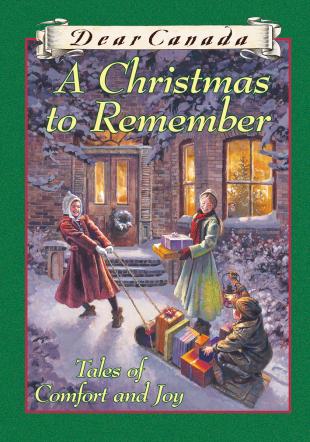
It was satisfying to write a short story about my character Anya from Prisoners in the Promised Land for this Dear Canada Christmas anthology. Lots of great stories in this collection. In addition to my own, there are two by Jean Little, one from Carol Matas, Karleen Bradford, two from Maxine Trottier, two by Julie Lawson, one from Sarah Ellis and one from Perry Nodelman.