Can be purchased in Canada from Koota Ooma. In Ukraine, from here: https://www.books-xxi.com.ua/products/mi-robili-bombi-dlya-gitlera
Audible edition
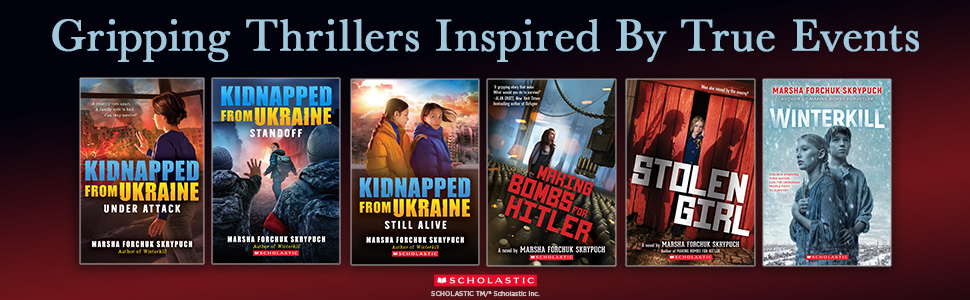
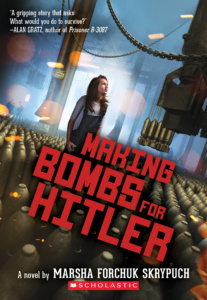
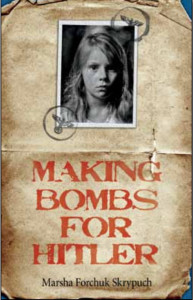
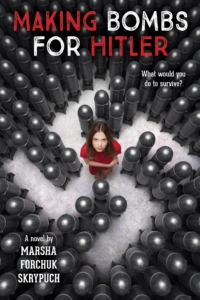
In this companion book to the award-winning Stolen Child, a young girl is forced into slave labour in a munitions factory in Nazi Germany. In Stolen Child, Marsha Forchuk Skrypuch introduced readers to Larissa, a victim of Hitler’s largely unknown Lebensborn program. In this companion novel, readers will learn the fate of Lida, her sister, who was also kidnapped by the Germans and forced into slave labour — an Ostarbeiter.
In addition to her other tasks, Lida’s small hands make her the perfect candidate to handle delicate munitions work, so she is sent to a factory that makes bombs. The gruelling work and conditions leave her severely malnourished and emotionally traumatized, but overriding all of this is her concern and determination to find out what happened to her vulnerable younger sister.
With rumours of the Allies turning the tide in the war, Lida and her friends conspire to sabotage the bombs to help block the Nazis’ war effort. When her work camp is finally liberated, she is able to begin her search to learn the fate of her sister. In this exceptional novel Marsha Forchuk Skrypuch delivers a powerful story of hope and courage in the face of incredible odds. Continue reading “Making Bombs for Hitler”
The interview was originally published on Christine Kohler’s website here.
One piece of advice that writers are given is to write what we know. I disagree with that. I think it’s more important to write what you don’t know, but what you’d like to know about.
Before I became a writer, I got my Master’s degree in Library Science, not to become a librarian, but to learn what I didn’t know. Becoming a librarian helped me become a history detective. All of my books delve into some fragment of history that has been shoved under the carpet and forgotten.
Lidia, my mother-in-law, died in early 2008. A few weeks before her death she said to me, “You’ve written all these stories about bits of history that no one else has written about, but you haven’t written about what it had been like for me as a Ukrainian child in World War Two.”
Her comment stunned me, but there was much truth in it. She had told me so much her childhood, living on the Front, in the midst of where the battles were actually fought. In case you don’t know what the Front is, it’s where the two fighting armies confront each other— in this case, the Soviets and the Nazis. I asked her once how you could tell when the Front was upon you. “The ground trembles,” she said, “from the tanks.”
The Nazis moved through her home town of Zolochiv in Western Ukraine twice. Both times, they took over her house. They didn’t allow her or her parents to leave: The three were captive hosts, expected to cook and clean for the invaders. But they also listened in on conversations. Once, Lidia heard of an “Action” at her school the next day. “You’re staying home,” said her mother. When she went back two days later, all of the blonde and blued-eyed girls had been taken away, never to be seen again.
Years later, my mother-in-law found out that they were all dead. They had been taken for the “Lebensborn Program” where carefully selected Polish and Ukrainian children were stolen from their families and brainwashed into thinking they were German, then placed into high-ranking Nazi households as trophy children. When the Nazis lost the war, these children were no longer trophies. They were an embarrassment and a badge of guilt. Some were abandoned, never understanding why. Others will killed. Others continued as members of their “family” after the war, but sometimes remembered who they really were in their old age, realizing their whole life had been a lie, and those they considered family were actually the killers of their real family.
This was an aspect of World War Two that I had never heard from anyone beyond my mother-in-law. At her deathbed, I promised her that I would write about her experiences. The first novel of my WWII trilogy was Stolen Child— not about Lidia—but about a girl like one of her less fortunate classmates—stolen by the Nazis and robbed of her identity.
As I did the research for that novel, I realized how rare it was for a child to be deemed “worthy” of the Lebensborn program. The Nazis captured millions of Ukrainian and Polish children, but only a few hundred thousand were selected. The rest were labeled “not racially valuable” and were either killed outright or used as slave labour.
This fact became the inspiration for the second novel of my trilogy. What would it be like to be stolen with your sister, but separated for different fates because your sister was considered “racially valuable” while you were considered disposable?
Lida, the disposable sister, is the heroine of MAKING BOMBS FOR HITLER, the second novel of my trilogy.
While writing that novel, the character of Luka appeared, initially as nothing much more than a “wild-haired boy.” Soon, as good characters are wont to do, he took on a life of his own. Ultimately, he escaped from the slave labour camp. The third novel in the trilogy explored what he ended up doing after hiding in a wagon of corpses and jumping out in the middle of nowhere before the wagon got to the crematorium.
His story is based on real experiences as well—about the many escaped slave labourers and other survivors of the Front who just couldn’t take it anymore. They stole weapons from the Soviets and the Nazis and formed an army that hid literally under the ground. They fought the invaders on two sides—the Soviets and the Nazis—and hid under the mountains and forests. For that novel, I interviewed people who had done exactly this as children—took up arms and fought—realizing that they would likely die, but it was worth it if it meant that future generations might live in freedom.
The events unfolding in today’s Ukraine have chilling parallels to what I’ve written about in my World War Two trilogy. I pray that we are not on the brink of World War Three.
My name is T, and I would like to tell you this wonderful story.
My mother had given a copy of your book, Nobody’s Child, to my teenage children about a year ago. Being an Armenian, and having read many books based on the Armenian Genocide, I was curious about the information contained in this little book. As I read it over the past summer, I fell in love with it and immediately got and read Daughter of War. I was amazed at finding all the delicate, small but important details in those two books, things that I had not seen in the many books I had come across before.
In our school district for 10th grade English class the children have to choose a book from a list of books, representing conflicts in the history of different nations, and write a research paper on that subject as well as present it to the rest of the class.
Last year, with my daughter being in that class, she wished to do her paper and presentation about the Armenian Genocide.
Since she had not yet read any books on this subject, and there were no books about this in the class list, I suggested Nobody’s Child and the teacher approved. She did an excellent job with both the paper and the power point presentation, scoring a perfect grade plus extra credits. We were thrilled with this; but there was more to come.
The teacher had liked the book and added it to the list. This meant that as of January 2011, for years to come, every 10th grader in our district will be told the true facts of the Armenian Genocide, based on your book.
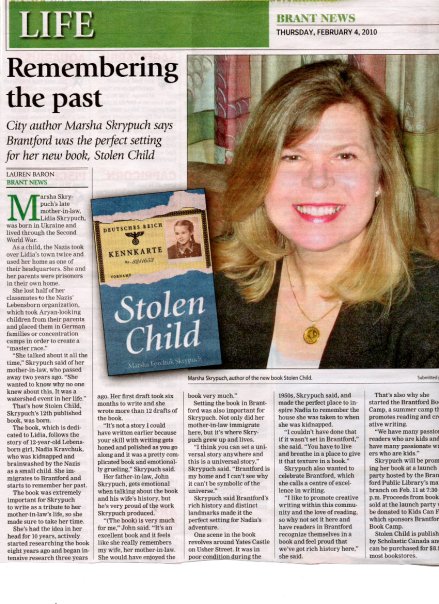
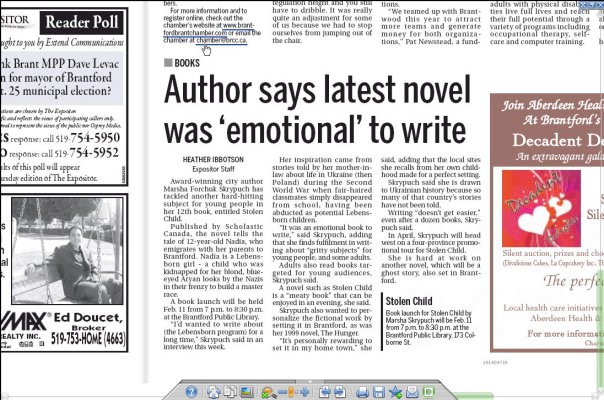
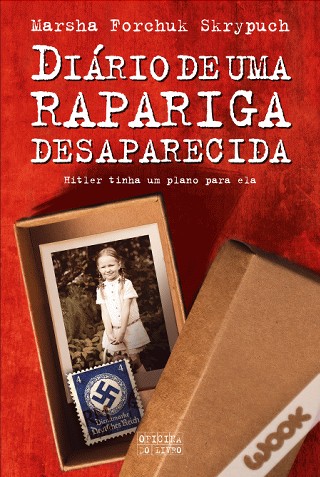
I was thrilled to receive my first advance copy of Stolen Child in the mail yesterday. It was an emotional roller coaster to write this novel. It was inspired by my late mother-in-law’s WWII memories in Ukraine.
The novel will be coming out on Feb 1, 2010.
Here’s a bit more about the book:
In an effort to boost the birth rate of the master race, the Nazis instituted a frightening program called Lebensborn (the Fount of Life). SS soldiers were encouraged to breed with females deemed to be of racially valuable stock. Some were German, others were women and girls of captive nations and in 1942, an even more sinister aspect of the Lebensborn program was established. The Nazis believed that there were lost seeds of the Aryan nation amidst the Slavs. In an effort to reclaim these supposed lost Germans, children were stolen from their parents and shipped to Lebensborn homes for further testing and brainwashing.
In Stolen Child, Marsha Skrypuch imagines the story of twelve-year-old Nadia Krawchuk, who has immigrated with her parents to Canada, but her re-location triggers disturbing dreams and ultimately vivid memories of another family and a girl she recalls as Gretchen. This is a powerful, moving and disturbing tale of one of the lesser known horrors of Hitler’s racial obsession.
And an excerpt:
Dark shadows dance on the scuffed white walls. Someone else’s fingernail scratches are etched around the glass doorknob and there are tiny splinters of wood fraying from the door itself. For a few trembling moments I look out at the dirt-trampled snow far below my window. Why am I a prisoner in this house?
My throat is raw from screaming, and my fingernails are bloodied from scrabbling at the doorknob. I lie on the wooden floor and stare up at the bare lightbulb. I can hear nothing but my own gasping breaths.
Shuffling. A struggle. A child screams down the hallway. A door slams shut.