April 21: Worldwide Reading in commemoration of the Armenian Genocide

It poured rain and there was even some hail as I lugged my books plus a large object in a garbage bag into the Brantford Public Library. As I was drying out and setting up, Sharon Gashgarian also came in with a mystery object wrapped in plastic. Paula Thomlison, librarian extraordinaire, got us each an easel and we propped up our items, then hid them behind babushkas.

marshaap21

People began to come in, from Brantford, Cambridge, Burlington, Toronto … Soon, Paula had to get more chairs. It is a lovely thing when a presentation needs more chairs.

This presentation was to commemorate those writers who had been killed for speaking out about the Armenian Genocide. It was happening on April 21 all over the world. In Canada, the Montreal Armenian community was presenting at the exact same time as I was.

I read the passage from Dance of the Banished when 800 prominent Armenians were loaded into oxcarts used for garbage and taken out of Harput. Hours later, the oxcarts came back, bloodied and empty.

libraryap21

I then read an excerpt from a Danish missionary’s memoir recounting the eye-witness testimony of one man who escaped that massacre and made it back to the mission. After the reading, Victoria Bailey asked if I could show her the book that I had just read from. It turned out that one of her own ancestors had been given refuge at that Danish missionary’s orphanage, the Bird’s Nest. It was an emotional connection.


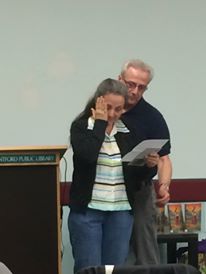
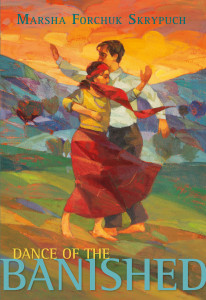
Next, I turned the floor over to Sharon Gashgarian, who, with much emotion, spoke of how she was affected by the painting that graces the cover of Dance of the Banished.


With permission from both me and the artist, Pascal Milelli, Sharon created a fabric artwork inspired by Pascal’s art. I unveiled his original and she unveiled her fabric art. Hers also included an inscription of “I remember” in Armenian, Ukrainian, English and French.

library21


friends2ap21The library is displaying Sharon’s beautiful art piece in their window for the rest of April in commemoration of the 100th anniversary of the Armenian Genocide. Within the window too, are some of my books an also other books about the Armenian Genocide.

A moving evening for very many reasons.



Talking about Genocide with very young children

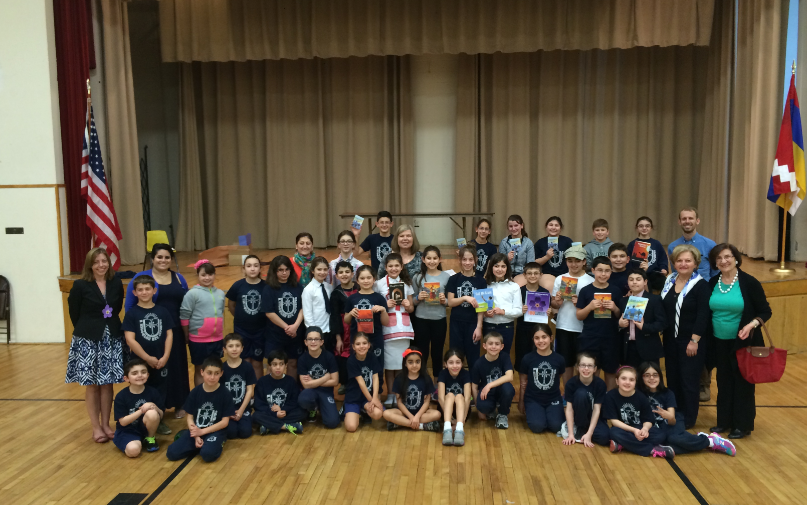
I was honoured to present at St Stephen’s Armenian Elementary School in Watertown MA last week. Before speaking to the older students, I dropped in on the very youngest. How do you talk about genocide with the very young? And especially how do you do that about a genocide in which their own ancestors had died? Gently, and not directly.

With my chapter books, Aram’s Choice and Call Me Aram, I spoke about the fact of these first 50 orphaned Armenian boys and their journey half way around the world to Canada and Georgetown Ontario. How and why they were orphaned wasn’t part of the conversation. Instead, we concentrated on what it would be like to be one of 50 very young children traveling across the world with just one adult teacher. In increments, they will learn the rest.

Capture9


Student stars for Underground Soldier

undergroundstarredGot this lovely message from a Vancouver teacher today, and she sent me this jpg of the book with the student stars:

I just had two students come and ask me to put a student starred sticker on Underground Soldier. This means that they believe it is so good that everyone should read it! Within five minutes, two others added their stars to the book!!


To be considered a Blockbuster Female Author! How nice!

Check out this School Library Journal Teen column!

DanceOfTheBanished_HR_RGB1SKRYPUCH, Marsha Forchuk. Dance of the Banished. 288p. Pajama Press. ISBN 9781927485651. JLG Level: PBH : Paperbacks High (Grades 10 & Up).

Ali leaves his village in Anatolia so that he can earn enough money to bring his fiancé, Zeynep, to Canada. Shortly after his departure, the Young Turk revolutionary forces turn on Zeynep’s Armenian Christian neighbors. While she struggles with trying to save the lives of her friends, Ali is captured and sent to an internment camp. Can they survive the war and reunite from an ocean apart?

For readers without prior knowledge of the Armenian genocide and Canadian internment camps from 1914, a visit to ArmenianGenocide.org provides background, while the Kapuskasing Internment Camp website sheds light on Canadian immigration fears. Fans may read the author’s blog. How do you pronounce her name? TeachingBooks.net has an audio file.


Dance of the Banished — Winnipeg Free Press review

Thank you, Helen Norrie, for the lovely review:

Brantford, Ont. author Marsha Forchuk Skrypuch has written a number of books about the Armenian genocide. Dance of the Banished (Pajama Press, 240 pages, $16, paperback) is set just before and during the First World War. It tells the story of two young lovers, Ali and Zetnep, separated by the war — Ali is taken to Canada by an uncle, while Zetnep remains in Anatolia. When war breaks out, Ali is imprisoned in an internment camp as an enemy alien, while Zetnep struggles to survive in a place where neighbours and friends are being massacred as Armenian Christians — and only an acquaintance with the American consul prevents her from being arrested.

The scenes in the internment camp are some of the most interesting parts of Skrypuch’s story, as Ali is forced to cut down trees, which he regards as sacred, in order to construct buildings for the camp. Skrypuch has just been appointed to Canada’s First World War Internment Recognition Endowment Council as a direct descendent of an internee. Written for ages 12 and up.


Dance of the Banished “an outstanding testament to Skrypuch’s mastery”—Canadian Children’s Book News

DanceOfTheBanished_HR_RGB1“It is June 1913, when Ali breaks the news to his fiancée Zeynep that he will be leaving their Anatolian village to go to Canada. Once there, he hopes to finally be able to save enough money to pay for her passage, and to build a new life for them there. But the world is on the brink of war and everything soon changes. The two record the events that they both witness in journal entries to each other, even though they both fear that they will never see one another again.

Alternating between these two sets of journal entries, readers learn Zeynep’s story of going to live and work with Christian missionaries. As World War I looms, she witnesses first-hand the horrors of the Armenian genocide at the hands of the Young Turks who now control the government. Conditions for her and the other Alevi Kurds are only marginally better, but that is small consolation as she watches Armenian men, women and children being cruelly treated and marched to their deaths. Meanwhile, in Canada, Ali and the other Alevi Kurds who had tried to settle in Brantford, Ontario, are falsely accused of a crime and sent to an internment camp in northern Ontario. As these two separate stories unfold, a vivid and devastating picture unfolds.

This latest work is an outstanding testament to Skrypuch’s mastery as a writer of historical fiction for young readers. She has created forthright and dramatic accounts of two little-known events from that time period, inviting readers of all ages to try to understand the depth of suffering that these groups have experienced. She has put a profoundly human face on the horrors of war while also creating an insightful portrait of the Alevi Kurds. Zeynep and Ali are both forced to mature very quickly, and their development is convincing. Skrypuch skillfully captures their voices, their longing, their heartbreak and their courage.”

—Lisa Doucet