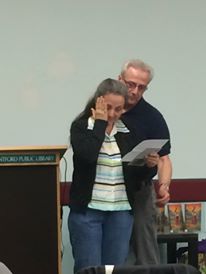
After my presentation at the Watertown MA Public Library last week, I was honoured to be presented with a copy of Karnig Panian’s memoir about his time as a child genocide survivor who is taken to the Orphanage of Antoura in Lebanon where the administrators tried to Turkify him. Panian’s daughter, Houry Panian Boyamian, wrote the acknowledgements. This photo shows Houry and I together. She is inscribing her very first autographed copy. Here is more information on this important memoir.
Tag: Armenian Genocide
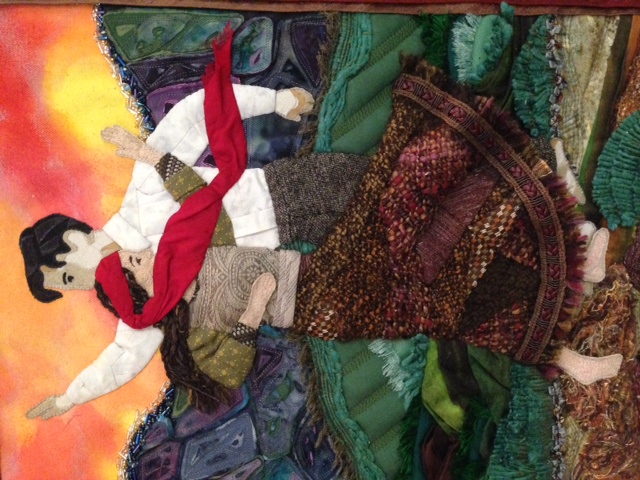
Sharon Gashgarian’s stunning fiber artwork inspired by Dance of the Banished
Writing YA books about the Armenian Genocide
Interview with Marsha Forchuk Skrypuch: Dance of the Banished and the Armenian Genocide
Posted on April 23rd, 2015 by pajamapress
On April 24, 2015, Armenians around the world will mark the 100th anniversary of the Armenian Genocide, a systematic campaign by Turkish leaders in the Ottoman Empire to remove the empire’s Christian Armenian population. As evidenced by recent headlines, the subject is controversial today because the Turkish government denies that these deportations and killings can be labelled “genocide.” Continue reading “Writing YA books about the Armenian Genocide”
April 21: Worldwide Reading in commemoration of the Armenian Genocide
It poured rain and there was even some hail as I lugged my books plus a large object in a garbage bag into the Brantford Public Library. As I was drying out and setting up, Sharon Gashgarian also came in with a mystery object wrapped in plastic. Paula Thomlison, librarian extraordinaire, got us each an easel and we propped up our items, then hid them behind babushkas.
People began to come in, from Brantford, Cambridge, Burlington, Toronto … Soon, Paula had to get more chairs. It is a lovely thing when a presentation needs more chairs.
This presentation was to commemorate those writers who had been killed for speaking out about the Armenian Genocide. It was happening on April 21 all over the world. In Canada, the Montreal Armenian community was presenting at the exact same time as I was.
I read the passage from Dance of the Banished when 800 prominent Armenians were loaded into oxcarts used for garbage and taken out of Harput. Hours later, the oxcarts came back, bloodied and empty.
I then read an excerpt from a Danish missionary’s memoir recounting the eye-witness testimony of one man who escaped that massacre and made it back to the mission. After the reading, Victoria Bailey asked if I could show her the book that I had just read from. It turned out that one of her own ancestors had been given refuge at that Danish missionary’s orphanage, the Bird’s Nest. It was an emotional connection.

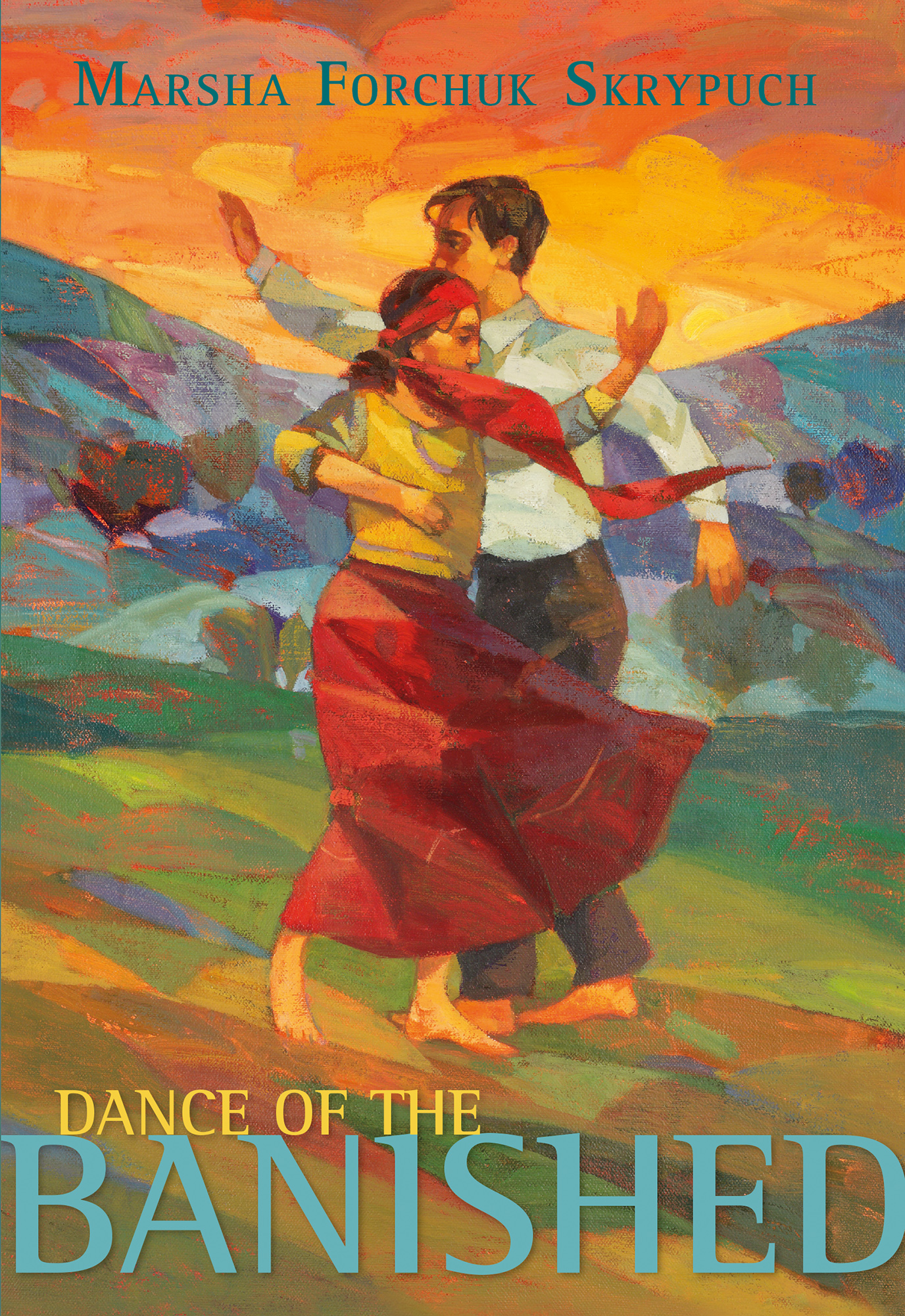
Next, I turned the floor over to Sharon Gashgarian, who, with much emotion, spoke of how she was affected by the painting that graces the cover of Dance of the Banished.
With permission from both me and the artist, Pascal Milelli, Sharon created a fabric artwork inspired by Pascal’s art. I unveiled his original and she unveiled her fabric art. Hers also included an inscription of “I remember” in Armenian, Ukrainian, English and French.
The library is displaying Sharon’s beautiful art piece in their window for the rest of April in commemoration of the 100th anniversary of the Armenian Genocide. Within the window too, are some of my books an also other books about the Armenian Genocide.
A moving evening for very many reasons.
Talking about Genocide with very young children
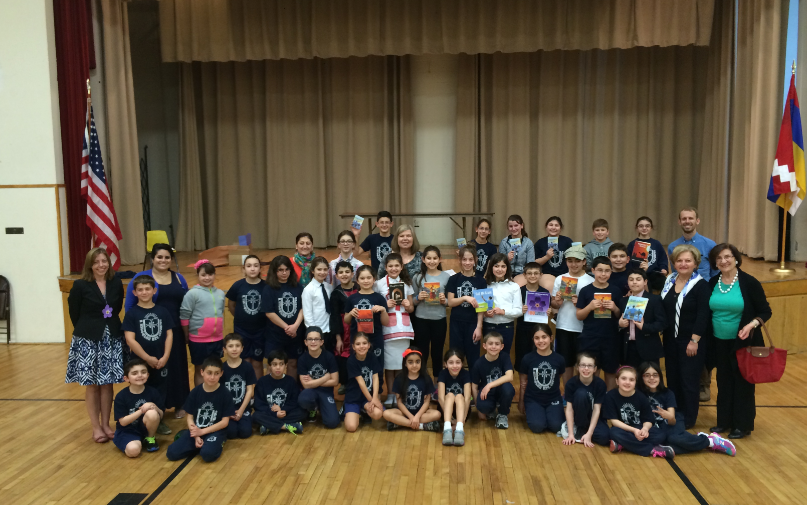
I was honoured to present at St Stephen’s Armenian Elementary School in Watertown MA last week. Before speaking to the older students, I dropped in on the very youngest. How do you talk about genocide with the very young? And especially how do you do that about a genocide in which their own ancestors had died? Gently, and not directly.
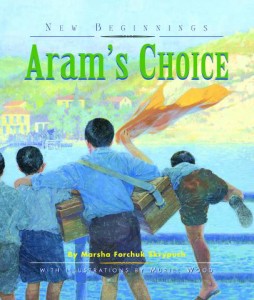
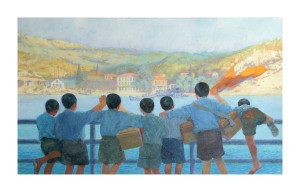
With my chapter books, Aram’s Choice and Call Me Aram, I spoke about the fact of these first 50 orphaned Armenian boys and their journey half way around the world to Canada and Georgetown Ontario. How and why they were orphaned wasn’t part of the conversation. Instead, we concentrated on what it would be like to be one of 50 very young children traveling across the world with just one adult teacher. In increments, they will learn the rest.

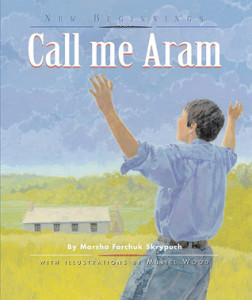
Call Me Aram

From the New Beginnings series, comes Call Me Aram, the sequel to Aram’s Choice. Aram Davidian, like his fellow orphaned Armenian refugees, is delighted with his new home on a farm in Georgetown, Ontario. But despite the excitement his new surroundings, Aram worries about his young friend Mgerdich, who was injured on the long trip to Canada and is recovering in France. And what is more worrying is that he and the other boys have been assigned new English names. How will their extended families find them one day if all the boys have new identities? Even when their translator assures them that their hosts want only the best for the boys, Aram cannot accept the name David Adams. When Mgerdich finally arrives at the farm, a relieved Aram finds the courage to lead the boys in a gentle revolt. Together, they must find a way to convince the Canadian adults that the boys, as grateful as they are for their new lives, cannot forget their old ones. Theymust keep their names.
Every incident in Call Me Aram is based on real events from the lives of the Georgetown Boys — from the boys’ reaction to porridge and cameras and weekly showers to their revolt to get their own names back. Marsha spent hundreds of hours listening to taped interviews of the original Georgetown Boys in order to glean these snippets of truth.
Continue reading “Call Me Aram”
Aram’s Choice
From the New Beginnings series, comes Aram’s Choice, a story that follows the life of a boy who loses his family in the Armenian genocide in Turkey and is exiled in Greece. The book follows Aram while he travels to Canada with forty-seven other Armenian boys in what was Canada’s first international humanitarian effort.
Marsha Forchuk Skrypuch first heard about the Armenian Genocide seventeen years ago while doing research for a magazine article about the first “Georgetown Boys” — a group of 47 Armenian orphans who were rescued by Canada in 1923 and were housed and schooled at a farm in Georgetown, Ontario.
After interviewing the son of a “Georgetown Boy,” Marsha was left with more questions than answers. For example, why were all of the rescued orphans male? Why were they all between the ages of eight and twelve? What happened to their parents? What happened to their sisters?
After years of research, Marsha was able to write Aram’s Choice. Based on true events, this book gives children a chance to learn about effects of genocide through one that the Turkish government has long denied ever happened.
Marsha Forchuk Skrypuch is the author of many books for children, including Silver Threads and Enough as well as her YA novels, The Hunger and Nobody’s Child, which was nominated for the Red Maple Award, the Alberta Rocky Mountain Book Award, and the B.C. Stellar Award.
Muriel Wood has been illustrating books for children since 1964, including the Canadian classic, The Olden Days Coat written by Margaret Laurence. Other books that she has illustrated include Old Bird, and the first two titles from the New Beginnings series, Lizzie’s Storm and Scared Sarah.
Continue reading “Aram’s Choice”
Thank you Penny Draper and the National Reading Campaign for this wonderful review!
Children’s Book Review: Dance of the Banished
Zeynep, fierce and bold, and Ali, caring and principled, live in the same village in Anatolia and plan to marry. Unexpectedly, Ali is sent to Canada and Zeynep is left behind. Each writes in a journal for the other, but as war comes to both countries it is unlikely their words will ever be shared. Still, they keep on. Zeynep writes an eyewitness account of the genocide from the point of view of the Alevi Kurds, telling a little known side of this tragic story. Ali, in turn, gives an accounting of life in an internment camp in, surprisingly, Kapuskasing. For each, the journal entries are a coping mechanism, a way to bear witness to the atrocities of war and ultimately, to bring justice.
Skrypuch’s compelling characters give an authentic voice to this well researched story. It is definitely a book for adults as well as teens. And although it is a story of war it includes moments of great joy, making it much more than a tragedy. Whether together in Turkey or alone in banishment, both Zeynep and Ali are able to lose themselves when they dance. Their troubles are momentarily forgotten in an ecstasy of whirling that reminds us of the cyclical nature of human events. Preserving the past, as Skrypuch does so well, is part of that cycle.
Dance of the Banished
By Marsha Skrypuch
978-1-927485-65-1
Pajama Press
August 22, 2014
288 pp
Ages 12+
Penny Draper lives in Victoria, British Columbia. She is the author of the award-winning “Disaster Strikes!” series, historical fiction that places young protagonists at the centre of real Canadian disasters.

The National Reading Campaign publishes children’s book reviews under a Creative Commons License. This review is entirely free to reproduce and republish online and in print. Credit must be given to the reviewer and the National Reading Campaign. Reviews can be edited for brevity only. Contact Us for more information.
Melanie Fishbane’s Dance of the Banished interview
Thank you, Melanie, for this great interview!
An Interview with Marsha Skrypuch
Marsha Skrypuch and I have a history.

It makes sense because we both write and care about history–particularly stories where there has been injustice. I believe that we are humanitarians, who hope that our stories of the past will resonate with the present, bringing awareness about people who have for–one reason or another–been silenced. Continue reading “Melanie Fishbane’s Dance of the Banished interview”
Nobody’s Child
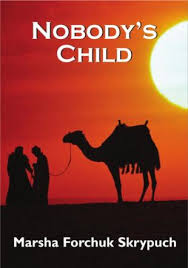
Orphaned by the Adana massacre in 1909, Mariam and her siblings, together with their friend Kevork and his aunt, travel home to Marash hoping to find their remaining family still alive. Six years later, when the teens face deportation from Turkey, they are torn apart despite their best efforts to stay together. One thing sustains them throughout their horrifying ordeals — the hope that they might one day be reunited.
A sequel to the highly successful The Hunger, Nobody’s Child is a stirring and engaging story set during the Armenian Genocide, one of the twentieth century’s most significant events.
Continue reading “Nobody’s Child”