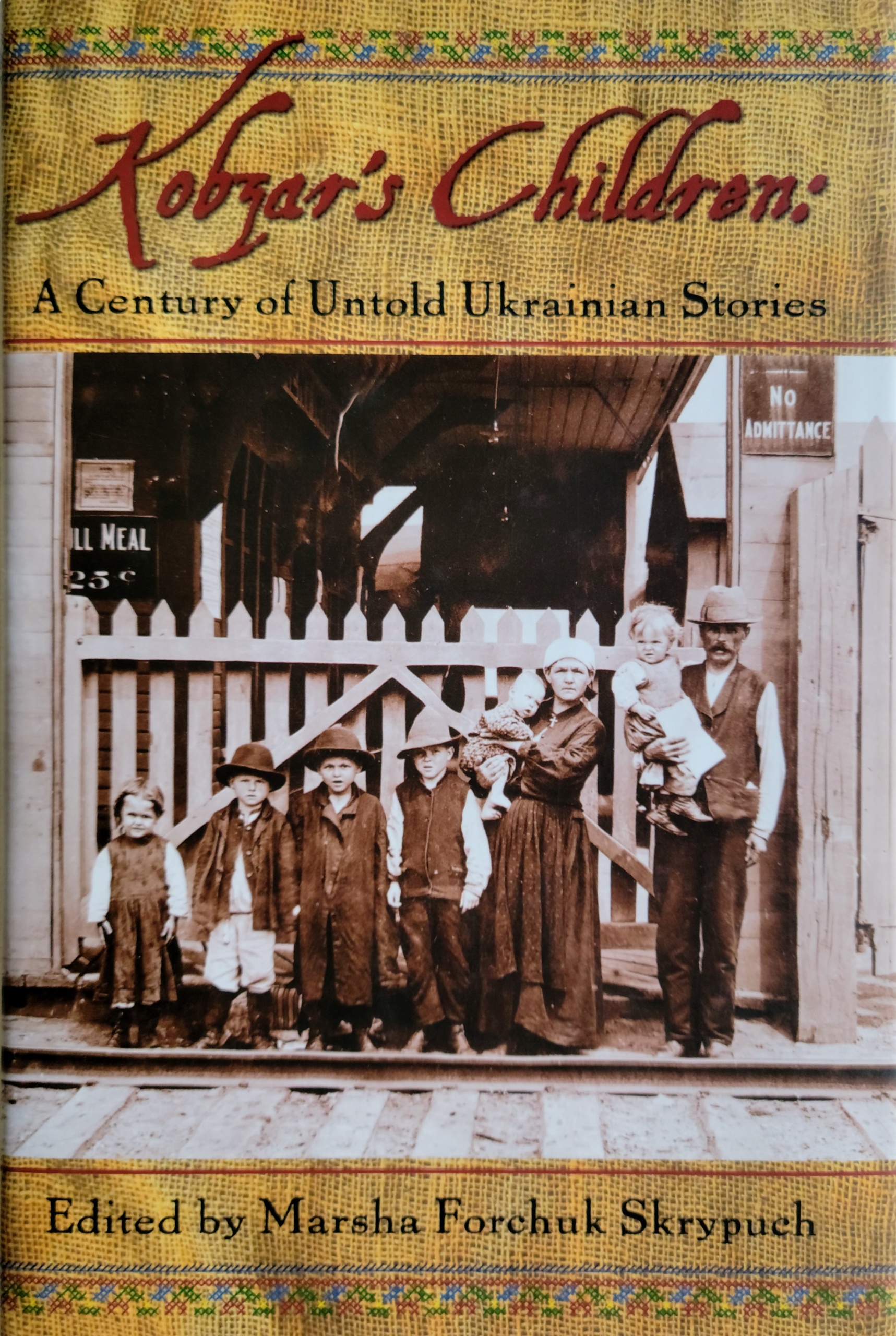
Kobzar’s Children

This unique anthology introduces new voices and a century of hidden stories.

The kobzars were the blind minstrels of Ukraine, who memorized the epic poems and stories of 100 generations. Traveling around the country, they stopped in towns and villages along the way, where they told their tales and were welcomed by all. Under Stalin’s regime, the kobzars were murdered. As the storytellers of Ukraine died, so too did their stories.

Kobzar’s Children is an anthology of short historical fiction, memoirs, and poems written about the Ukrainian immigrant experience. The stories span a century of history; and they contain stories of internment, homesteading, famine, displacement, concentration camps, and this new century’s Orange Revolution. Edited by Marsha Forchuk Skrypuch, Kobzar’s Children is more than a collection; it is a moving social document that honors the tradition of the kobzars and revives memories once deliberately forgotten.
Continue reading “Kobzar’s Children”

Hope’s War

Kataryna Balyk, a gifted fine arts student, is hoping to have a fresh start at Cawthra School for the Arts, after a less-than-successful year at the neighbouring Catholic high school.

But her hopes for a peaceful grade ten are shattered when she comes home from one of her first days at Cawthra and finds the RCMP interrogating her grandfather Danylo Feschuk. Kat learns that Danylo is accused of being a policeman for the Nazis in World War II Ukraine, and what’s worse, he is suspected of having participated in atrocities against civilians.

When the story is exposed in the local newspaper, Kat and her family become the centre of a media storm. Her grades in school and her relationships with friends suffer. Her only support comes from her family and Ian, a classmate with whom she discovers she has more in common than just artistic promise.
Continue reading “Hope’s War”

lovely letter

Hello Marsha,

My name is T, and I would like to tell you this wonderful story.

My mother had given a copy of your book, Nobody’s Child, to my teenage children about a year ago. Being an Armenian, and having read many books based on the Armenian Genocide, I was curious about the information contained in this little book. As I read it over the past summer, I fell in love with it and immediately got and read Daughter of War. I was amazed at finding all the delicate, small but important details in those two books, things that I had not seen in the many books I had come across before.

In our school district for 10th grade English class the children have to choose a book from a list of books, representing conflicts in the history of different nations, and write a research paper on that subject as well as present it to the rest of the class.

Last year, with my daughter being in that class, she wished to do her paper and presentation about the Armenian Genocide.
Since she had not yet read any books on this subject, and there were no books about this in the class list, I suggested Nobody’s Child and the teacher approved. She did an excellent job with both the paper and the power point presentation, scoring a perfect grade plus extra credits. We were thrilled with this; but there was more to come.

The teacher had liked the book and added it to the list. This meant that as of January 2011, for years to come, every 10th grader in our district will be told the true facts of the Armenian Genocide, based on your book.

Thank you for a beautiful book.

T