Brantford plaque unveiling for 100th anniversary of WWI Internment

What an honour it was to be part of the wave of plaque unveilings across the country on Friday at 11am, commemorating the 100th anniversary of Canada’s first national internment operations. The hundred plaques project, known as CTO (Ukrainian for 100) was the brainchild of Dr. Lubomyr Luciuk and was organized and funded by the Canadian First World War Internment Recognition Fund.

Since there were only 100 plaques for the entire country, as soon as I heard about this project, I put Brantford down for one. Here’s what the plaques look like:


STO plaque image

There were about 80 people in attendance, many driving in from Toronto and Cambridge including people of Alevi and Armenian heritage. The prayers and hymns were a moving tribute to those who had been unjustly imprisoned by Canada one hundred years ago. Both priests spoke eloquently, as did our government representatives.

What sets Canada apart from many countries is that we do acknowledge injustices. That’s what these 100 plaques are all about — commemorating a past injustice so it will never be repeated.

btfdcto
The Very Reverend Father Bohdan Mironovich of the Ukrainian Catholic Church of St. John, The Reverend Father Vartan Tashjian of the Armenian Apostolic Church of Montreal, author Marsha Skrypuch, Dr. John Skrypuch, the Honourable Dave Levac, MPP for Brant and Speaker of the Ontario Legislature, the Honourable Phil McColeman, MP for Brant, Sub-Deacon Paul Vandervet, Diane Martyniuk.


Brantford’s plaque


Researching — every which way! Thank you Hamilton Berry Farm.

When I was writing Underground Soldier, there was a ton of research to do. I had to figure out what was going on in Kyiv before Luka was captured by the Nazis, and I needed to find out what the underground bunkers of the Ukrainian Insurgent Army looked like, and figure out what an escaped slave would eat on the run, and where he would hide.

But there were also small day to day scenes that needed to be accurate. For example, what was growing in the field that Luka walked through once he jumped out of the wagon of corpses? Another thing I had to figure out is what the interior of the barn that he hid in would look like. I’ve been in barns before, but not until you have to write a scene inside a barn do you realize all that you need to know.

For my barn research, I called upon Marna Hamilton, a berry grower who lives not far from me. For years I have been buying berries in season from her farm, but while I was writing Underground Soldier, I noticed her barn. It’s about the same age as the one Luka would have hidden in. It’s in Brant County, not the Third Reich, but all barns of an era have some things in common. Marna kindly took me on a tour of her barn and answered all my questions. That was two summers ago. This week the strawberries are lush and so I dropped back by to get berries, but also to thank Marna for her help and to give her a copy of Underground Soldier. Here she is:


marna

Marsha’s Forest of Reading exciting Monday!

I got home from Book Week late Saturday afternoon, had one day to do laundry and rest, then on Monday, drove to London for their first Forest of Reading event. It was held at the Western Fair Grounds and the volunteers were absolutely spectacular, thinking of EVERYTHING.


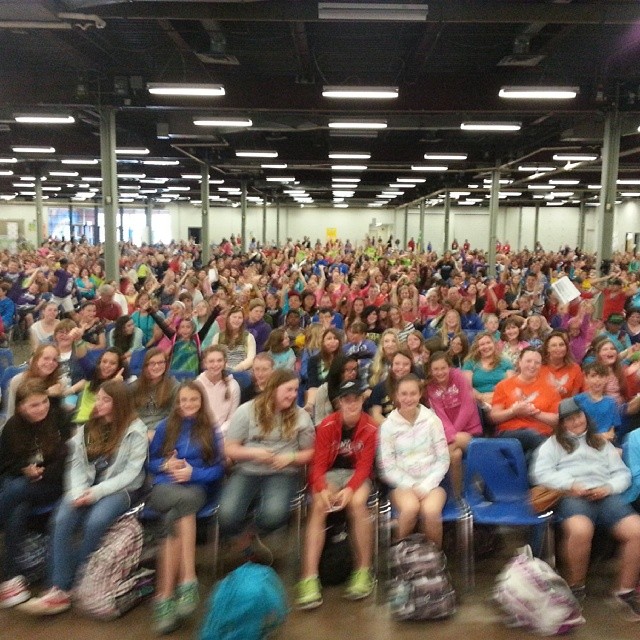
The audience! 1900 strong!

In London, I won the Silver Birch non-fiction award, David Carroll won the Silver Birch fiction award, and Eric Walters won the Red Maple. Here’s the stunningly amazingly beautiful plaque I was given:


I gave it to Tuyet, who was THRILLED:

She and her husband are also holding footstep shaped letters from the students of Our Lady of Lourdes.

There was lots of news coverage for the London event. Like this article on CTV. And this one in the London paper. And this CTV video.


Marsha’s Quebec #TDBookWeek — the final day!


I drove to Quebec City after leaving Shawinigan High School. I didn’t get stuck in traffic and arrived at the Courtyard Marriott in the heart of old Quebec City at around 6:30pm. There was enough time to walk through town and find a place to eat, and what a treat it was.

Friday May 9, 2014

I packed up and checked out early, then headed to Corcelette for a visit to the students of Dollard des Ormeaux School.

Librarian Kerry Ann King asked me to time my arrival for just after the buses had departed, so I waited, then parked in the bus lanes. I followed the last students into the school.

Here’s a photo of Kerry Ann, standing beside the TD Book Week poster. She is wearing red in honour of our veterans.


I did three sessions in speedy back to back to back without even a minute break in between. The first two sessions were 30 minute ones for the primaries and the final session was for grades 3 and 4. Some parents attended as well, and many students and adults wore red in honour of our veterans. I wish I had known, and I would have worn red as well! When I finished, Kerry Ann helped me pack up quickly. “There’s a parade starting up soon,” she said. “And you don’t want to get stuck in the middle of it.” I was so thankful for my good parking spot. I dashed out and made it out of town just before the parade.

I drove back into Quebec City to meet Guy Dubois of La Maison Anglaise Bookstore at Cosmos restaurant. How wonderful to have good food and good company. When we finished, I followed Guy’s car to St-Charles Garnier School where I presented to French students who were in the advanced English language program.

I finished at about 3:30, then hopped into the car and drove to Cornwall, where I stayed overnight (running into friends from Brantford there too!). On Saturday, I drove the rest of the way back to Brantford.

A fabulous adventure! I met many wonderful students and many devoted teachers, librarians, booksellers and parents. I’d do it again in a flash.

Thank you, Canadian Children’s Book Centre, for organizing all of the author visits across the country. One school visit at a time, we can transform the country into passionate readers.


Marsha’s Quebec #TDBookWeek continued

Wednesday, May 7, 2014

I checked out of the Marriott and headed over to Akiva School in Westmount. My GPS wanted me to turn onto Kensington, which was illegal. I circled a few times, navigating the heavy traffic and one way streets, not seeing any place to park. I phoned the school and asked where I should park. “Ooooh, this is Wednesday,” said the receptionist. “Not a good day to find a parking spot in the area…” She suggested I park a couple of streets away, so I drove out of the immediate area and found a spot about eight blocks away. My presentation materials are in rolling luggage, so it wasn’t a problem. I got to the school with about 15 minutes to spare. Librarian Janice Camlot met me at the door.

20140507_093315

As the students assembled in the library, I saw that many of them were holding their own copies of my books — in particular — Stolen Child, Making Bombs for Hitler, and Underground Soldier.Lots of great questions and enthusiastic comments.


After the Akiva presentation I enjoyed a stroll through Westmount to my car, enjoying the sun and the warm weather. My next stop was Westmount Park School and I did two presentations there, both sponsored by Montreal Children’s Library (Atwater Branch). One session took place before lunch and the other immediately after lunch. This meant that I had the opportunity to sit and relax and chat with librarian Elizabeth Macdonnell. What a treat it was!

20140507_101833Here’s a photo of my first group. I talked about my own reading difficulties as a child and the fact that I had dyslexia. I presented One Step At A Time and Last Airlift and I had a bizarre thing happen. I had just prepped the students for a reading from One Step and grabbed my book to open it to the marked spot, but my book mark wasn’t there! It took me one very long minute to find my spot and read the excerpt.

After the session, a child came up to me and said, “You have dyslexia, right?” I nodded. “I have pneumonia,” he said.

<!!!>

Over lunch, I checked the reading copies of all my books. The bookmarks had disappeared from them all! Elizabeth gave me strips of paper and I re-bookmarked them all so I wouldn’t be caught short again!

The second group was much younger, but they too were enthralled with Last Airlift and One Step At A Time. I think the fact that many of them had family that had escaped from war made those two books quite pertinent. Here’s a photo of them, sitting with rapt attention.

20140507_130550


My last session of the day was at the Hebrew Academy, which was a half an hour away. Lovely students and thoughtful librarians. I really enjoyed the energy of this school. The students hammed it up for photos. 20140507_15295720140507_153007And they asked really insightful questions about my World War II trilogy.


20140507_203956

It was nearly 5pm by the time I got on the road. Next stop: Shawinigan. I drove through hours of terrible traffic but once I was out of Montreal, the traffic dispersed and the scenery was beautiful. So many flocks of geese in intriguing patterns in the sky. I got to Auberge Gouverneur Shawinigan just before 9pm, ordered room service, and was soon sound asleep.


Thursday, May 8, 2014

20140508_083758Here’s what it looked like across the road from my hotel:


And here’s the sign that greeted me at Shawinigan High School:

20140508_090958

Teacher librarian Kim Kiolet had been planning for Book Week since the beginning of the school year. When I stepped in, I felt like a rock star. All of the students knew who I was. First order of the day was for Kim and her colleagues to distribute a free book to every student in the school. This was from funding from the Literacy Foundation.

20140508_092659_1Here are the students, holding their books! I’m in there somewhere too.


20140508_092736_2


20140508_095638Kim had set up a table for me at the front of the auditorium and she added the TD Bookweek poster, so I had to get a photo of it!

The primaries came in shortly after.


20140508_103809_8_bestshotHere they are, hamming it up before we got started.


20140508_104350Here are the kindies.


kioletThis photo was snapped by Kim Kiolet as I was presenting Last Airlift to one of the older groups.


kiolet2SHS teachers prepped their students on the geography and customs of the regions my books are set in. Here is a lovely wall display just outside the auditorium. And here is a great group of students!


kiolet3I’m all packed up after 4 sessions and having a chance to meet every student at SHS. Thank you, Kim, for your wonderful preparation. This is Kim:


I hopped into my car and drove to Quebec City.
My writing process blog tour — Marsha Skrypuch

Thank you, Stella Papadopoulos, for inviting me to be a part of this writing process blog tour. Stella is a Montreal artist and entrepreneur. Being of Greek heritage, the gift of artistic journeys, and endless beauty of Greece inspired her art and writings. While at home with her young children she taught Moms and Tots painting classes at the Jewish Public Library. She subsequently obtained a Diploma in Illustration and Design at Montreal’s Dawson College.

She is a member of the Montreal Children’s Literature Roundtable, CANSCAIP, and CCBC (Canadian Children’s Book Center).

In addition she combines her illustration and writings for magazines and has been featured online and in print in The Link & Visitor, a Canadian Baptist Women’s publication.

After much virtual communication, we will be meeting in person for the first time this week.

Here is my turn to describe my Writing Process:

What are you working on?

I am in the midst of edits for Dance of the Banished, my YA novel being published by Pajama Press in August.

Based on true accounts, Dance of the Banished is the story of a teenager who leaves his fiancé behind in their Anatolian village to make a new life in Canada for them both; but soon after he arrives, World War I breaks out and the boy is sent to an internment camp in Kapuskasing, Ontario, while his betrothed struggles to survive and find a way to join him.

How does your work differ from others of its genre?

My genre is historical fiction, but I only write on historical topics that have been ignored or misrepresented. If I can find a novel to read on a topic that I’m interested in, I read it. If I can’t, I write it.
Why do you write what you do?

I feel a moral responsibility to shed light on those bits of history that have been forgotten or ignored. I can’t do all of them, of course, but I gravitate towards WWI and WWII untold stories.
How does your writing process work?

I think about any given novel for a few years before ever writing down a word. During this time, I read widely on the subject, accessing primary documents when I can, and talking to survivors of the historical incident, when possible. Over the years, I have been gifted with journals, documents and letters from war survivors and their families. I read these in addition to the other sorts of documents that I can get. It takes about ten years of research before I can write about a particular era, but once I’ve done that research, I can write a number of books. For example, I’ve had two previous books published that were set during the WWI Ukrainian internment — Silver Threads and Prisoners in the Promised Land. That prior research came in handy when I embarked upon Dance of the Banished, although this novel required additional research because Ali is not Ukrainian, he is an Alevi Kurd who was interned in Canada. I have also written five previous novels set during the Armenian Genocide — The Hunger, Nobody’s Child, Daughter of War, Aram’s Choice and Call Me Aram. Half of Dance of the Banished is set in the Ottoman Empire during the time of WWI and the Armenian Genocide but it shows a completely different aspect of this history.

I had many false starts with this novel. I abandoned a 40,000 word chunk and set the entire book aside for a year. I couldn’t quite get the voices of Ali and Zeynep, plus the history behind the story was so huge that I feared it would overtake what is essentially a love story. My editor Ann Featherstone gave me a brilliant suggestion which ended up resolving my issues with voice. She suggested that Ali and Zeynep exchange journals when they part, so their alternating WWI stories are both told from starkly different first person points of view.

Once I had the issue of voice settled, writing the story was a breeze. I finished it in a matter of months.

Thanks for reading my blog tour post! Next Monday, Lisa Dalrymple and Karen Autio will be posting:

Lisa Dalrymple is the author of Skink on the Brink which won The Writers’ Union of Canada’s Writing for Children Competition in 2011. Her other books include If It’s No Trouble… A Big Polar Bear and Bubbly Troubly Polar Bear. A Moose Goes A’Mummering will be out in the fall of 2014.

q

Karen Autio is the author of a trilogy of historical novels for young readers. She writes about events in Canada’s history that haven’t had much attention, such as the sinking of the Empress of Ireland and spies, sabotage, and internment during the First World War. Her latest book Sabotage has been shortlisted for the 2014 Arthur Ellis Award for Best Juvenile/YA Crime Bookand the 2015 Manitoba Young Readers’ Choice Award.

Karen-Autio-Author