I heart OLA!

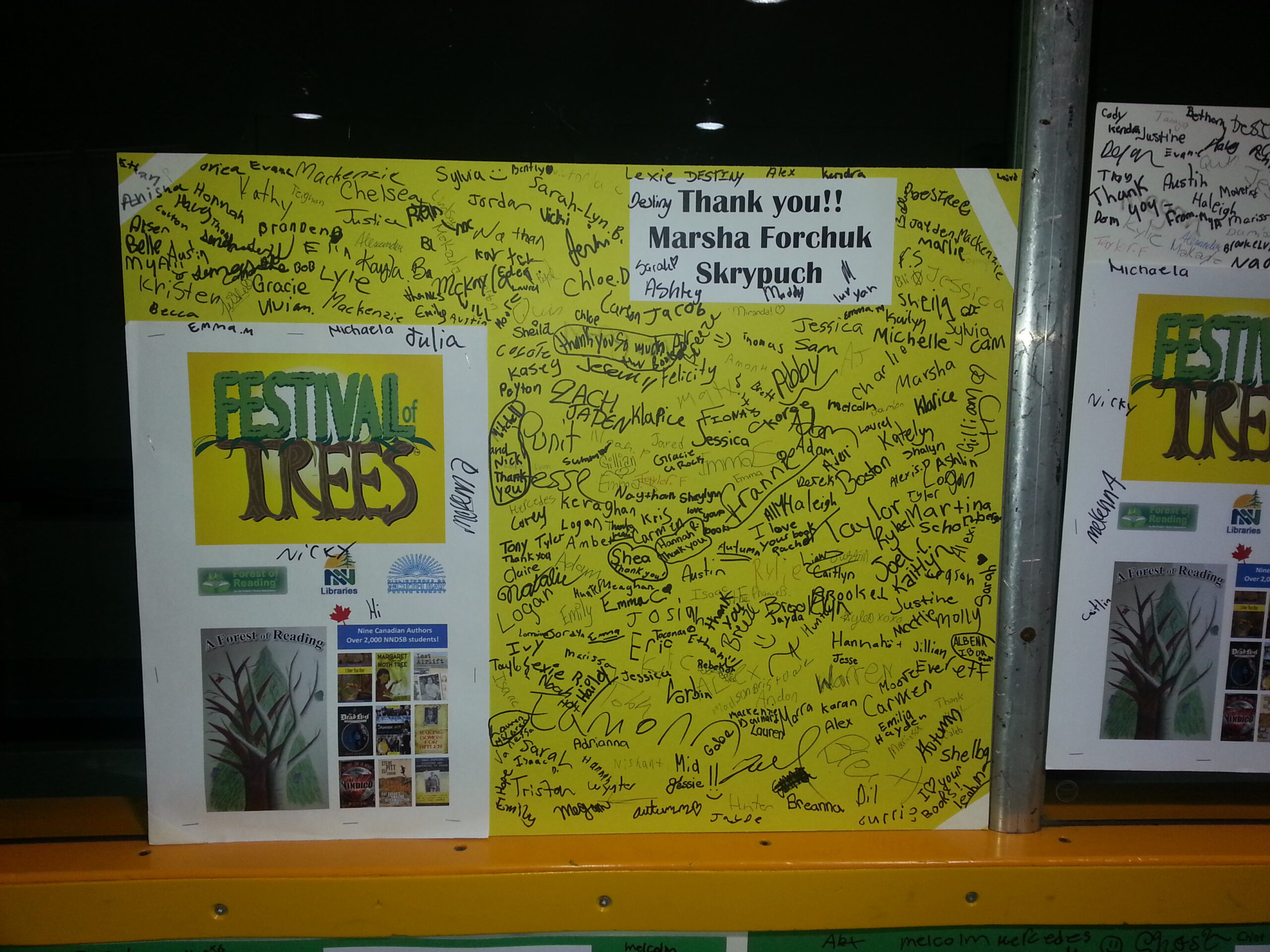
Where can a Canadian children’s author feel like a rock star? At the Superconference, and at Forest of Reading events — both organized by the OLA!

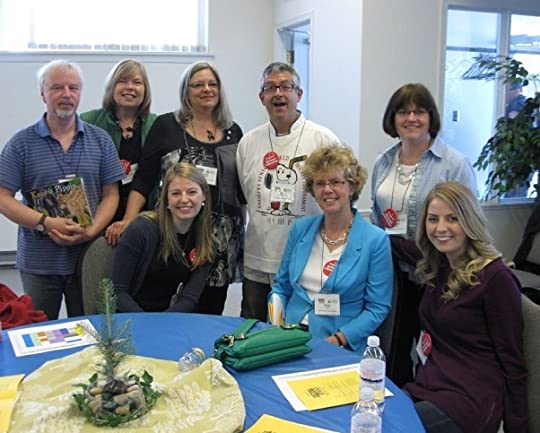
What a wonderful time I had last week, meeting up with fellow writers, teacher-librarians and librarians. I am especially in awe of the myriad of volunteers who run the Forest of Reading festivities.

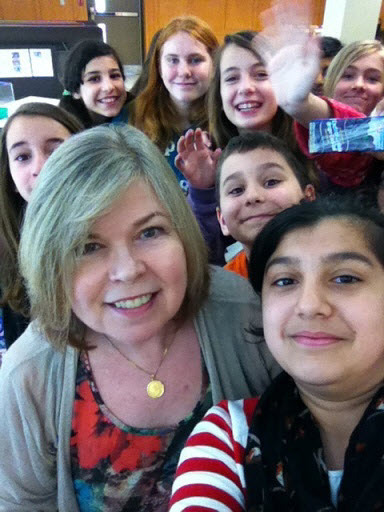
Here’s a photo of me with the wonderful Gianna Dassios, who co-chairs the Forest of Reading with Helen Kubiw. We ran into each other at the Second Cup and she bought me a heart.

At the OLA Superconference with Gianna Dassios.

Get Thee to a Bookstore With This YA Booklist

From The Winnipeg Review:

By Marsha Forchuk Skrypuch

In the spirit of December gift-giving, I asked my fellow children’s authors to help me put a list together of books they’re giving and ones they’re looking forward to reading over the holidays.

Here are picture book suggestions:

Margriet Ruurs, whose most recent book is Amazing Animals: The Remarkable Things That Creatures Do (Tundra, 2011) will be giving Island Santa written by Sheryl McFarlane and illustrated by Sheena Lott, to the children on her list. “It’s a beautiful story and one that all children on the Gulf Islands can relate to as we watch Santa arrive by boat.”

Marilyn Helmer says, “I just bought a copy of Lisa Dalrymple’s new seasonal picture book, If It’s No Trouble…a Big Polar Bear. The story is about adjusting to new and unusual situations. The illustrations compliment the story perfectly and the rhythm and rhyme make it a great read aloud book.” I have ordered copies of this book as well and am looking forward to reading it before giving them away. Lisa is a rare author who can amuse in perfect rhyme. Marilyn’s newest picture book is called That’s What Bears Are For, illustrated by Sonia Nadeau (Peanut Butter Press, 2012) will surely find its way under a number of trees as well.

“I would like another copy of Picture a Tree by Barbara Reid,” says artist and illustrator, Kristi Bridgeman. The book shows tree varieties through the seasons, “but what I love are the plasticine images and green cover because it makes me want to make play dough.” Krisi also recommends Solomon’s Tree by Andrea Spalding and Janet Wilson (Orca, 2005), “because it made me cry in the bookstore.”

One of illustrator Dianna Bonder’s favourite seasonal books is a hard to get classic by Jerry Pallotta called Dinosaur Christmas (Scholastic US). I searched around for this one and the only place that it’s available is from Pallotta’s website (www.jerrypallotta.com) but he’ll autograph it for you. The most recent book Dianna has illustrated is Pedro the Pirate, by Tim Hoppey (Raven Tree Press, 2012).

Short story writer Merna Summers, who won the Marian Engel Award in 1989, says “I have just read Noah’s Bark (Lerner, 2010) by Stephen Krensky, with enchanting illustrations by the Quebec artist Rogé. It tells the story of how each animal was given its individual way of speaking by Noah, as a means of keeping some sort of order on the ark.”

Christine Tripp (illustrator of Sheri Radford’s Penelope and the Preposterous Birthday Party, Lobster, 2009) says, “I’ve picked up a copy of Mine (Knopf, 2012), a little picture book with illustrations by Patrice Barton, for my 3.5 year old granddaughter. The author is Shutta Crum. The illustrations are what really knock this little book out of the park, so, so sweet. The story line of everything thing being the older sisters, EVERYTHING, would apply to any home where there is a baby sibling. It suits two of my granddaughters to a tee!”

Children’s Book News editor Gillian O’Reilly will be giving Crazy About Soccer!, a collection of poems about the sport by Loris Lesynski, with illustrations by Gerry Rasmussen (Annick Press) to her 3.5 year old great-niece.  “To describe her father and brother as avid soccer fans is putting it mildly, so the subject matter and the amazing versifying talent of Loris Lesyski seems like a perfect combination. The fact that the illustrations are by one of the creators of my favourite Canadian comic strip (Betty) is icing on the cake.” Gillian is the author of two non-fiction titles herself: Slangalicious: Where We Got That Crazy Lingo (Annick, 2004) and The Great Number Rumble: A Story of Math in Surprising Places (co-written with Cora Lee, Annick, 2007).

Helaine Becker’s A Porcupine in a Pine Tree, illustrated by Werner Zimmerman (North Winds Press, 2010) is finding its way onto several gift lists this year, in its traditional format from years past and new this year in a book and gift package. Maureen McGowan , author of Deviants, (Amazon Children’s Publishing 2012) says, “I’m  looking forward to reading A Porcupine in a Pine Tree, by Helaine Becker, with my four-year-old nephew. He was introduced to it last year and nearly had it memorized. I’m hoping he’ll sing the book to the whole extended family this Christmas.”

Wendy Whittingham, illustrator of Valerie Sherrard’s Miss Wondergem’s Dreadfully Dreadful Pie (Tuckamore, 2011), is buying A Porcupine in a Pine Tree for herself, “because it’s Canadian and because it’s awesome!” Wendy also recommends Maurice Sendak’s classic Where the Wild Things Are and Mo Willem’s Don’t Let the Pigeon Drive the Bus.

Wendy also says, “I’m looking forward to giving a copy of I’m Bored, by Michael Ian Black, and illustrated by Debbie Ridpath Ohi to my nephew (Simon & Schuster, 2012),” says Maureen McGowan. “The minimalist illustrations really capture the emotions of the characters–even the potato!” Christine Tripp agrees:  “I am very tempted to keep it for myself, just because I love that ridiculous damn potato! The idea of trying to entertain a bored potato alone keeps making me chuckle.”

Marjorie Gann, author of Five Thousand Years of Slavery (illustrated by Janet Wilson, Tundra, 2011) suggests four picture books:

The Huron Carol, illustrated by Frances Tyrrell (William Eerdmans, 2003): “Tyrrell’s exquisite illustrations situate this famous carol squarely within the native context. Mary is a Huron mum, the manger a longhouse, Bethlehem a boreal forest, the kings wear snowshoes, etc., all as in Father Brebeuf’s telling. Tyrrell is a brilliant draughtsman, and the design of each page is enchanting: an arched window in the centre concentrating on the story, framed by a background of the Canadian landscape or sky (constellations representing bears, wildcats, etc.)” This classic book is out of print but can be purchased used.

“Zlateh the Goat,” by Isaac Bashevis Singer. “This comes in a collection by Singer, Zlateh the Goat and Other Stories, illustrated by Maurice Sendak (Programs and Genres, 2001). Set in the vanished world of the European Jewish communities, this Hanukkah story begins when the father tells his son Aaron to take their goat Zlateh to the butcher; the money for the animal will help the family to buy what they need for Hanukkah. But on the way, the wind whips up a fearsome snowstorm. The beloved goat leads the boy to shelter in a haystack while the winds whirl; the goat nourishes herself on the hay, Aaron drinks her milk, and they stay warm and safe. The storm ended, the boy is found by his panicking father and — you guessed it — Zlateh returns home to the grateful family. A beautiful book. There’s a video made in black and white, set in Czechoslovakia, with Janacek’s music in the background, that captures the story’s tone magnificently.

The Tailor of Gloucester by Beatrix Potter (Little Simon, 1987). “Well, this will never go out of print! I’m sure everyone knows the story (of the tailor who has to finish the mayor’s waistcoat by Christmas morning but becomes ill – only to be saved by the little mice who live in his walls, and are threatened by Simpkin the cat!) but I wouldn’t want to forget it. Quaint, old-fashioned — but my (Grade 4) students loved it.

Elijah’s Angel: A Story of Chanukah and Christmas by Michael J. Rosen, illustrated by Aminah Brenda Lynn Robinson (Harcourt, 1992). “Elijah Pierce really existed — an African-American barber and woodcarver who was a friend of both the author and illustrator. This is the story of a friendship between a Jewish-American boy and a devout Christian woodcarver, of how they shared their traditions. It’s not at all sappy or Brotherhood Week – ish, though. But it is about Christmas angels and Hanukkah menorahs, and how they bond two people together.”

I have a whack of picture books to give out myself and I always enjoy reading them gently before wrapping. Rebecca Bender’s Don’t Laugh, Giraffe (Pajama Press, 2012) is a fabulous selection on so many levels. I love how it demonstrates the teasing that can happen between friends but gently shows how a tease gone wrong can hurt. The illustrations and text are both vivid yet simple. A great choice for toddlers to grade two.

I am also giving Cat’s Night Out by Caroline Stutson and J. Klassen (Simon & Shuster, 2010). Ostensibly a counting book, but it will not bore the adult reader no matter how many times a child wants to hear it. The illustrations are visually stunning, showing detailed streetscapes, many retro styles of clothing, dance and music.

A Birthday for Bear by Bonnie Becker and illustrated by Kady MacDonald Denton (Candlewick, 2012) is the perfect book to get a child out of a spoiled brat funk. Humourous and engaging.

Children Make Terrible Pets by Peter Brown (Little-Brown, 2010) will make your littlest family members chuckle but it will also make them think from the point of view of the animal when they drag in a squirrel or sparrow and want to keep it as a pet.

For kids eight and up, Robin Stevenson, author of Hummingbird Hearts (Orca, 2012), has a great suggestion. “I will be buying my eight-year-old son as many Foxtrot comic books as I can find! The first books he enjoyed reading on his own.” For example, AAAA: A Foxtrot Kids Edition, by Bill Amend, (Andrews McMeel, 2012). “The character of ten-year-old Jason is kind of like a grown up techie version of Calvin [from Calvin and Hobbes],with the same quirky humour and mischievous spirit. Anyone who likes math, science and computers will love this kid and his family.”

My own suggestion for kids aged eight and up is Jennifer Lanthier’s stunning new picture book, The Stamp Collector, illustrated by Francois Thisdale (Fitzhenry & Whiteside, 2012). I didn’t include it in the picture book category above because it really is for older kids and adults. It’s the story of a city boy and a country boy, both who grow up in a repressed country. One becomes a writer and is imprisoned for his stories. The other becomes his prison guard. A powerful and nuanced story that is sure to win awards.

Illustrator Jan Dolby, (Gabby, by Joyce Grant, Fitzhenry & Whiteside, 2012) is giving her daughter Hockey Girl by Natalie Hyde (Fitzhenry & Whiteside, 2012) for Christmas. Jan says it’s “a perfect fit for her…she plays girls’ peewee rep hockey and has played for boys’ hockey league as well. I think the story line will grab her attention and she will finish the book with excitement.”

Dianna Bonder is looking forward to reading the Penderwicks books with her oldest daughter over the holidays. Jeanne Birdsall’s Penderwicks books are The Penderwicks at Point Mouette, The Penderwicks on Gardam Street, and The Penderwicks: A Summer Tale of Four Sisters, Two Rabbits, and a Very Interesting Boy (Yearling). They just begun reading the series and she called them “truly excellent!”

Wendy Whittingham suggests J. R. R. Tolkien’s The Hobbit, Yann Martel’s Life of Pi, Charlotte’s Web by E. B. White, Holes by Louis Sachar, and The Lion, the Witch and the Wardrobe by C. S. Lewis for kids aged ten and up.

And what children’s novels are authors reading and giving over the holidays? An eclectic variety:

“I am saving Shane Peacock’s Vanishing Girl from Tundra Books to read over the season,” says Marilyn Helmer.

“I plan to give Urve Tamburg’s The Darkest Corner of the World to an Estonian friend who came to Canada when she was a young girl in the 1950s,” says Judith Robinson, playwright and author of Working Miracles: The Drama & Passion of Aimee Semple McPherson (James Lorimer & Company, 2006). “Her grandfather was interned by the Soviets and never returned. I’m sure the experiences in the book will speak to her about her own family.”

Helaine Becker, author of Porcupine in a Pine Tree: is looking forward to reading Leah Bobet’s Above (Arthur Levine, 2012), Joanne Levy’s Small Medium at Large (Bloomsbury, 2012), Deborah Kerbel’s GG-nominated novel, Under the Moon (Dancing Cat, 2012), and Valerie Sherrard’s Counting Back From Nine (Fitzhenry & Whiteside, 2012).

Valerie Sherrard recommends Amphibian by Carla Gunn (Coach House, 2009). “It’s a crossover book – written for adults but also great for young people.” Sherrard also recommends Mahtab Narsimhan’s The Tiffin. “It had me instantly mesmerized with its rich descriptions. A wonderful story that plunks you down in Mumbai and takes you along on a young man’s perilous search for hope and home.”

Gillian O’Reilly says, “What I’ll be reading over the holidays is Trilby Kent’s Stones for My Father, (Tundra, 2011) recent winner of this year’s TD Canadian Children’s Book Award.”

Rebecca Upjohn, author of The Secret of the Village Fool (illustrated by Renné Benoit, Second Story Press, 2012) says, “I am really looking forward to reading Mastiff (Random House, 2011) book three in Tamora Pierce’s Beka Cooper trilogy. I have long enjoyed Pierce’s books for their smart female characters who often challenge the status quo. Her books set in the kingdom of Tortall are among my favourites. The Beka Cooper series is about a young woman employed by the city guard. She and her working dog, Achoo, and a cast of many take on such subjects as slavery, counterfeiting, and the clash between those living in poverty and those born to nobility. The books in this series are long but Pierce is a compelling storyteller and a master world builder and there is always a payoff worth the read.”

Rebecca Upjohn has another suggestion as well. “Although marketed for adults, I would consider giving an older teen who loves epic fantasy, K.V. Johansen’s Blackdog (PYR Books, 2011). The world created in the book is compelling. There is an intriguing treatment of gods and other immortal beings and the charged history between these beings and humans is slowly revealed. The story focuses on a mortal girl, the living incarnation of a goddess, and Blackdog, a spirit who possesses a human mortal male. Blackdog’s only goal is to protect the goddess regardless of the toll it takes on the man whom it possesses. It is a layered story with many twists which kept me guessing. The connection between the goddess and Blackdog and that between their two human counterparts is complex and unpredictable. Altogether a great read for someone in need of a book to sink their teeth into.”

“A book I am looking forward to re-reading over the holidays is Dianne Linden’s beautifully-written Shimmerdogs (Thistledown, 2008),” says Merna Summers. “It is the story of a little boy whose world falls apart in various ways after his mother is posted out of the country on a peace-keeping mission. The joy of the book, besides its honesty, is the beauty of the prose. I believe that Dianne was short-listed for a GG Award for this one, and anyone who reads it will readily understand.”

Maureen McGowan, is looking forward to reading Insurgent, by Veronica Roth (Katherine Tegan, 2012). “I thoroughly enjoyed her first book, Divergent, because it’s fast-paced and tackles big questions we first faced as teens such as, who do I want to be, and what kind of person am I? Her dystopian world poses the questions: ‘Can you be too honest? Too self-sacrificing? Too brave? Too friendly? Too knowledgable?’ in an interesting and exciting way. I’ve been saving Insurgent as a treat for when I finish the last book in my own dystopian trilogy.”

For myself? Many of those I’ll be giving will be books that I reviewed over the past year. I would also highly recommend The Talk-Funny Girl by Roland Merullo (Crown Publishing, 2011), a novel about a dirt-poor girl who transcends her abusive childhood. It will appeal to anyone who loved Jeanette Walls’ The Glass Castle (Scribner, 2006).

It Takes a Village as applied to YA fiction

http://www.winnipegreview.com/wp/2012/11/it-takes-a-village-as-applied-to-ya-fiction/

Posted: NOVEMBER 8, 2012

Columns, The Winnipeg Review

By Marsha Forchuk Skrypuch

I find it lonely being one of the few fiction writers who has tackled the lesser-known stories of World War II. The atrocities of Hitler are justifiably infamous, but a troubling number of people have never even heard of Stalin and his atrocities. Part of the reason for that is because you can’t tell your story if you’re dead, and Stalin managed to silence a whole heck of a lot of people.

In The Darkest Corner of the World (Dancing Cat Books), Urve Tamberg has managed to give voice to an entire small nation that was nearly obliterated in World War II. Well-researched and compellingly written, it deserves to be widely read.

Urve agreed to answer my questions for TWR.

The Darkest Corner of the World is set during WWII, yet the part of WWII  history you deal with has received very little attention. Can you tell me about that?

Winston Churchill said that “history is written by the victors.” For most of the twentieth century, the Soviet Union was the “winner.” They illegally annexed the Baltic countries of Estonia, Latvia, and Lithuania during the Second World War, and for five decades the Iron Curtain limited communication between the West and the Eastern Bloc countries. Letters were censored, and people on both sides of the ocean were afraid to tell their stories.

After Estonia regained independence in 1991, stories slowly started to filter out, but even now there is very little written in English, much less written for a younger audience.

Another reason that Estonia’s stories have not been told is because of its tiny population. There are about 1.5 million Estonians in the world. Much of the literature to date has been written in Estonian, so fluency in the language has been a necessity.

This story is a personal one for you. Are any of the characters based on
family members?

The story is personal, but the characters are fictitious though I’ve tried to portray Estonian characteristics such as dark humour, sarcasm, and sheer stubbornness in the characters.

The setting on Hiiumaa Island takes place on my mother’s farm. When I was growing up, I thought Hiiumaa was a sleepy place where nothing interesting happened, but during the Second World War, the front passed through my mother’s farm twice, once in 1941 when the German Army drove the Soviets out of Estonia, and once in 1944 when the Soviets returned to occupy the country for the next fifty years.

Which character is most like you?

There is no one character I’d compare myself to. I’d like to think that, like Madli, I would’ve been brave, and smart, and defiant. But as a fifteen-year-old girl, could I have stood up to a Russian soldier? Could I have protected my little brother from the Soviet army? I know that I could do all that and more as a mother protecting my children, and I hope that I would have done the same as a teenager.

One doesn’t know how one would react under adversity until one is confronted with it. In researching the novel, stories of kindness came up time and time again, even in the most horrific of circumstances. For example, on the night of the deportations, when soldiers rounded up the families, some men told the deportees to bring warm winter clothes, sewing machines, and food since they knew that people were being sent to Siberia. Deportees were actually allowed to bring up to 100 Kg of supplies with them, but other soldiers gave people no time to pack, and literally forced people in their nightclothes to waiting trucks.

Do you believe in evil?

Yes, I believe people can be evil. If you believe people are good, then you must believe in the opposite as well. There is no other word than “evil’ to describe the actions of Stalin and Hitler.

Will there be a companion novel or sequel?

I’ve had a number of people ask me about a sequel, and I’ve started to research the next book.

My work-in-progress sheds light on another little-known story of World War II in the Baltics. In the late summer and early fall of 1944, over seventy thousand Estonians (along with thousands of Latvians, and Lithuanians) escaped to Sweden or Germany as the Red Army returned to occupy the Baltic countries. My parents were among those who left on small boats, and risked their lives to cross the stormy waters while Soviet planes patrolled overhead. Hundreds of people did not survive the hazardous journey.

What was your biggest challenge in writing this novel?

Since this is my first novel, there are three things that were challenging for me. I call them the three Rs — researching, rewriting, and relevancy.

As someone with no background in history, I had to research everything from the dates of major events to bathrooms, shoes, and bathing suit styles. Accuracy was very important because I felt that I had to honour the events and people of Estonia during that time period. My ability to read Estonian gave me access to a richness of work that wouldn’t be available to anyone who didn’t speak the language (needless to say, there aren’t many of us). I spend months reading life histories, and textbooks in both Estonian and English.

E.B. White said, “The best writing is rewriting.” I gave myself permission to use my first novel as a learning experience and spent years learning about the craft of writing. It was very tempting to rush the process, but it took about four or five years from conception to publication, and countless rewrites. I joined critique groups, SCBWI, CANSCAIP, and started going to courses and conferences. I love that I’m always learning something new, and that writers are so generous about sharing their experiences.

And finally, relevancy. How could I make this story appeal to teens? I knew the story had to draw them in on an emotional level and decided to included romance and betrayal. Also, Madli likes all the same things today’s teens do. Boys, summer vacation, parties, movies from America, and travelling. When I went to school, history was taught as a series of dates and treaties and wars and battles, none of which interested me in the least. Now I realize I’m interested in how people felt, and the every-day dilemmas they faced.

Did you ever feel like giving up? What made you continue?

I’m not the type to give up. So no, I didn’t think of giving up, but there were periods of lengthy procrastination, and navel gazing. Coming from a background of science and business, it’s hard to know if your writing will connect with people. The reason I persevered was due to the support of other writers, through associations such as SCBWI and CANSCAIP, as well as critique groups such as Kidcrit [Editorial note: Marsha Skrypuch has been running this free online critique group for sixteen years. To join, you must have a completed first draft of a children’s or YA manuscript. For permission to join, go here].

My critique partners helped me put my work into perspective. They praised the good parts, and offered gentle criticism for the sections that required work. I’m the type of individual who really wants to know how to improve, and am happy when there are many suggestions to consider.

This is your first novel. Can you tell me about your publishing journey?

I didn’t know I wanted to be a writer until a few years ago. I’ve always been an avid reader, and somewhere in the back of my mind, had the desire to write a novel. Like many people, I didn’t think writing would be as difficult as it was.

It took me four intense years of historical research, and learning writing craft before I submitted the manuscript for publication. I think the hours that I put in were probably the equivalent of another university degree, though the end result is a published novel, not a degree.

I could never have done this on my own. Like any profession, it’s important to connect with your peers. From the start, I have been part of amazingly supportive and perceptive critique groups. Organizations such as CANSCAIP and SCBWI provided important resources, and still do.

I met my editor, Barry Jowett from Dancing Cat Books, at a course run in Brantford (many Ontario writers would know that course was run by you). At a one-on-one meeting, he liked my first page, and wanted to see more. And based on some good advice, I didn’t rush to send him the manuscript. In fact, after much consideration, I ended up rewriting the whole novel from first person to third person before I sent it to him. That took a year. Fortunately, when I contacted him, he did remember the novel, asked to see the entire manuscript, and the rest is history.

What advice would you give an aspiring writer?

They say it takes a village to raise a child. It also takes a village to write and publish a novel so my advice would go something like this:

First— congratulations! You’re the prospective parent of a manuscript! The manuscript may have as few as five hundred words if it’s a picture book, or sixty-thousand words if it’s a young adult novel. You have an embryo of an idea, and want to nurture it to life. Gestation could take months, or even years. During that time, you’ll want to talk to other parents/writers, compare progress, and read as much as possible about care and feeding of your new manuscript. And when you need a break from that, reach for a good book.

During the time of manuscript gestation, you’ll get lots of questions, and perhaps even receive unsolicited advice from well-meaning people who are not writers. Why is this manuscript taking so long? Will it be published by Christmas? Do what any expecting parent usually does; smile knowingly and mumble “As long as it’s healthy.”

Hang around with experienced parents, i.e. people who have written books and had them published. In other words, find your writing tribe. Join associations, whether it’s SCBWI and CANSCAIP for children’s writers, or other groups for mystery writers, or romance writers, or sci-fi writers. Learn the craft of writing. We learn science, piano, and other skills. Writing is a skill that can be learned through courses, workshops, and reading books about writing.

Find trustworthy caretakers i.e. find a critique group. Find those people who you can trust to read your work, and offer suggestions for improvement. These people will cheer you on, and keep you motivated. Find people whose aspirations are in line with your own. Although writing may be solitary work, getting a manuscript to publication takes a village


Resource Links review of One Step At A Time

Resource Links

Volume 18, Number 1

October, 2012

SKRYPUCH, Marsha Forchuk

One Step at a Time: A Vietnamese Child Finds Her Way

Pajama Press, 2012. 92p. Illus. Gr. 3-6.

978-1-927485-02-6. Pbk. $12.95

One Step at a Time is an easy-to-read book about Tuyet, a Vietnamese girl adopted by a Canadian family. It is the sequel to Last Airlift: A Vietnamese Orphan’s Rescue from War and picks up where that book leaves off. Tuyet suffers great pain from having a weak ankle. Just weeks after her adoption, her new family decides Tuyet should have surgery to correct the problem. Tuyet goes through the surgery, learns to use crutches, and takes physiotherapy in the hope of one day being able to walk confidently on her own two feet.

At the same time, Tuyet, who speaks little English, is learning about her new family, new home, and new culture and is healing from terrifying experiences in Vietnam. Events that seem ordinary to many Canadian children are extraordinary for Tuyet, and we share her confusion and delight as situations—such as a flaming cake and a pile of pretty boxes, or the passing of a crop-dusting airplane—begin to resolve into meaning.

This is a gentle non-fiction telling of a particular period in Canadian history and of the experience of being a new immigrant with health concerns. Notes in the end matter provide some useful context for readers who may not understand the significance of polio or the conventions of narrative non-fiction. Black-and-white photos, including pictures of Tuyet and her family, add to the reading experience. Although Tuyet’s experiences are unusual and sometimes frightening, the narrative is full of love, kindness, and comfort.

One Step at a Time is a good choice for sensitive young readers interested in non-fiction about other children, other cultures, and recent history; it may be eye-opening for many readers. Although aspects of Canadian culture have changed, the disorientation that new Canadians experience may be similar to Tuyet’s. The book is likely to encourage many questions and wide-ranging discussion in a reading group, and the story is highly likeable. Readers do not need to know the author’s earlier book about Tuyet to understand this one, but many will want to read more about this brave and spirited girl.

Thematic Links: Families; Adoption; Vietnam; Health and Wellness

Leslie Vermeer

Making Bombs for Hitler: The Book Shelf review

Thursday, November, 08, 2012 – 1:01:00 AM

The Book Shelf – Nov. 8

Making Bombs for Hitler, By Marsha Forchuk Skrypuch, 160 pages. @ SPL: J FIC Skryp

Making Bombs for Hitler brings to light one of the lesser-known aspects of World War II and the Holocaust – slave labourers, often teenagers or young people in their early 20s. Captured by Nazi soldiers in Russia, especially in the Ukraine, they were brought to Germany and forced to perform dangerous work from dawn to dusk.

Regarded as “expendable,” they were shot if they became too sick to work. In Marsha Skrypuch’s story, Lida was one of the youngest slave labourers. When she was taken by Nazi soldiers, Lida was separated from her parents and her younger sister and sent to a labour camp. Surviving on a meager daily portion of bread and thin soup, and clothed in only a thin dress, Lida survived the long days of hard work only through luck, resourcefulness and the desire to find her sister.

Then, with a group of other girls, she was assigned the dangerous work of constructing bombs that would be used by the Nazis to kill allied soldiers and civilians. How Lida survived the terrible days which followed was later a mystery to her.

But she did survive, barely, and was later rescued by allied soldiers, only to find that she could not go home. Joseph Stalin regarded anyone who had been captured by the Nazis to be a Nazi. Such people were either killed or sent to work camps in Siberia.

Making Bombs for Hitler is a companion book to writer Marsha Skrypuch’s award-winning Stolen Child, which relates the story of Lida’s sister, Larissa. Both of these stories, told with sensitivity and compassion, are based on historical fact.

** Recommended for ages nine to 12.

Sally Hengeveld, librarian

Nice review of Making Bombs and Susan Aihoshi’s Torn Apart

By Fran Ashdown, North Shore NewsNovember 7, 2012

Making Bombs for Hitler by Marsha Skrypuch (Scholastic Canada) $8.99

Torn Apart: the Internment Diary of Mary Kobayashi, by Susan Aihoshi (Scholastic Canada) $16.99

ON Remembrance Day especially we take time to pay homage to those who went to war so that we might enjoy freedom – a freedom which was bought at a horrific cost for so many.

We can more easily appreciate the sacrifices made on our behalf by learning about them through various resources – family history, television documentaries and books. One very powerful approach to learning is through personal narrative, which broadens and enriches the historical perspective. Kids (and this reviewer) can relate more easily to social history, which allows them to see through the eyes of the protagonist and comprehend how war affects a particular individual.

Two excellent books that provide this perspective are Making Bombs for Hitler by Marsha Skrypuch and Torn Apart by Susan Aihoshi. Both titles focus on individuals who by strength of character and resourcefulness face and deal with circumstances that drastically change their worlds.

Skrypuch writes about the slave raids conducted by Hitler throughout the Soviet Union during the Second World War. Between three million and 5.5 million Ostarbeiters, as these people were called, were transported to Germany and forced to work under horribly inhumane conditions. Thousands died either from starvation or from overwork.

Many who were rescued and sent back to the Soviet Union were killed by Stalin who considered even Nazi captives to be Nazis. For this reason people kept silent for many years about their experiences as captives and it was not until the Soviet Republic dissolution in 1991 that information began to surface.

The story describes the capture by the Nazis of eight-year-old Lida and her little sister Larissa. They endure appalling conditions on the train to the work camp and are separated as soon as they arrive.

Lida is advised by another prisoner to lie about her age and find a skill or she will likely be killed. She tells the Germans about her ability as a seamstress and is sent to work in the laundry where she proves that she is indeed talented. Unfortunately, she is soon transferred to a new assignment, assembling bombs. With incredible bravery, Lida and her fellow prisoners risk certain death in carrying out a plan to sabotage the bombs and contribute their bit to defeating the Nazis. Finally, they are rescued and in the gruelling aftermath of war Lida and her friend Luca face more challenges in the refugee camps.

The harsh, brutal and unrelenting pain, fear and misery encountered by the camp labourers is made evident in Skrypuch’s wonderful writing. Lida’s world is documented with clarity and accuracy. The reader is left wondering how anyone can survive such misery and thankful that we live in a different place and time.

Susan Aihoshi’s Torn Apart is subtitled “The Internment Diary of Mary Kobayashi” and is set in Vancouver in 1941. While in no way as gut-wrenching as the Skrypuch title, it makes it clear that war affects everyone. This is another title in the excellent Dear Canada series which melds fiction with historical information and photographs.

In the acknowledgements we learn that the author has drawn on family experiences to flesh out the book’s main character. The diary format provides a window on the everyday life of a girl whose entries begin on her 12th birthday, Saturday, May 24, 1941. We see her happy family life begin to disintegrate as the government imposes more and more restrictions on Japanese Canadians.

Mary’s entry for Sunday, Dec. 7, 1941 describes the news about the bombing of Pearl Harbor and its effect on the family. Mary ends her entry with the comment, “The war has finally become real in a way it never was before.” Finally, the unthinkable happens and Mary’s grandfather is sent away to a labour camp.

A mere seven months later Mary and her sisters find themselves on a train to New Denver to begin a new life in an internment community. Her family is fractured as her mother is still in Vancouver caring for an ill brother and her father has been detained for questioning. The diary ends with a reunited family still living in New Denver hoping to eventually return home.

Mary’s life as a child in the 1940s in Vancouver in many ways reflects the life of any child of that era. She describes her enjoyment of Guides, her school life and her special interests and activities. Mary’s voice is authentic and charming and because she is so likable the reader is all the more appalled at the unfeeling cruelty of the government. It was not until Sept. 2, 1988 that Brian Mulroney announced a Redress Settlement which acknowledged the offences against Japanese Canadians during and after the Second World War and ensured that in future no Canadian would be subject to this kind of injustice.

Torn Apart is suitable for readers aged eight to 12. Skrypuch’s title is for a slightly older audience that includes adults. Reading either or both will reinforce your gratitude for the heroic efforts made by those who fought for us.

Fran Ashdown worked for many years as the children’s librarian at the Capilano branch of the North Vancouver District Library. She will be thinking of her father, an RAF radio officer, on Remembrance Day. For more information check your North Shore libraries.

Contributing Writer

© Copyright (c) North Shore News

Next big thing: What I’m working on now…

Writers are tagging each other with a questionnaire about what they’re working on now.  I was tagged by Gary Barwin. To read Gary’s answers, go here.

I would like to tag Lisa Dalrymple, Urve Tamberg, Sylvia McNicoll, Karen Wilsey Bass, and Gabriele Goldstone.

Addendum: Karen Wilsey Bass has responded here.

Urve Tamberg has responded here.

Gabriele Goldstone has responded here.


What is your working title of your book?
Luka Underground

What is the one-sentence synopsis of your book?

The story of an Eastern European boy captured by the Nazis who escapes and joins the resistance.

Where did the idea come from for the book?
This is a linked novel to two of my previous WWII novels, Stolen Child and Making Bombs for Hitler. All three novels step into the shoes of a child captured by the Nazis. The first is about Larissa, who is deemed “racially valuable” and brainwashed into thinking she is German. The second is about her sister Lida who is deemed “not racially valuable” and is used as a slave to make bombs. This current work-in-progress is about Lida’s friend, Luka, who escapes the slave camp in a wagon of corpses, joins other escapees and fights back.
What genre does your book fall under?
Historical fiction.

Which actors would you choose to play your characters in a movie rendition?
Liam Hemsworth is Luka all over.

Will your book be self-published or represented by an agency?
I am represented by Dean Cooke of The Cooke Agency. The novel is already sold to Scholastic Canada and will be published in Feb 2014.

How long did it take you to write the first draft of your manuscript?
I am still writing it! My first WWII historical came out eleven years ago. I have been researching the era for two decades. This particular story has been in my head for more than a decade, but I only began putting it down on paper in the spring.

What other books would you compare this story to within your genre?
Luka Underground is WWII historical fiction for children. Luka is Ukrainian, and other than the novels that I write, there is not a body of commercial fiction on Ukrainians in WWII. The European war was fought on land that is now Ukraine and between Hitler and Stalin, ten million Ukrainian civilians were killed, yet very few writers have tackled this topic.

Part of the reason is that it is hard to tell your story if you’re dead.

The other reason is because while Naziism ostensibly ended when Germany lost the war, the Soviet Union continued with their atrocities until that entity dissolved in 1991 (and have they truly ended? Putin is not exactly a shining light of democracy. Ditto for Yanukovych in Ukraine). It wasn’t until after the fall of the Soviet Union that people from nations oppressed by the Soviet Union were able to come forward and tell their stories.

Before 1991, the Soviets promoted a propagandized version of WWII, where all heroic deeds were done by “Russians” and citizens of nations captured by the Soviets were painted as evil. Non-Russian Soviets were sent in great numbers to the Gulags for “re-education”, so even after the fall of the Soviet Union, these people didn’t have the vocabulary to relate their own WWII experiences.

Recently there have been books written, like Timothy Snyder’s Bloodlands, and Alexander von Plato’s Hitler’s Slaves, that paint a more complete picture of the fate of Eastern Europeans in WWII.

Comparable novels would be Urve Tamberg’s just released The Darkest Corner of the World, about an Estonian child in WWII, and Ruta Sepetys’ Between Shades of Gray, about a Lithuanian child in WWII.

Who or what inspired you to write this book?

My late mother-in-law, who lived in Ukraine during WWII and survived the Front moving through her town — twice. She told me so many snippets and flashes of memory from a perspective that I had never read about in books. I promised her when she was on her deathbed that I would write the stories of people she had known and loved and lost. For Luka’s story in particular, Peter Potichnij, a retired professor from McMaster University, has been an inspiration. As a 12 year old, he joined the Ukrainian Insurgent Army, and he has spoken at length about his experiences, as well as collecting a tremendous amount of primary data.

What else about your book might pique the reader’s interest?

The two prior novels have met with critical acclaim. Stolen Child, published in 2010, was the inaugural winner of the Crystal Kite Award for the Americas, was shortlisted by the Canadian Library Association for Children’s Book of the Year and was an Honour Book for the Manitoba Young Readers’ Choice Award. Making Bombs for Hitler, just published in Feb 2012, has been shortlisted for the Ontario Library Association Silver Birch Fiction award and is receiving rave reviews.